
A customer asks for a carbon hood, roof spoiler and matching exterior trim for their G-Class. The catalog lists each item under “W463.” Is that enough information to place the order?
For W463 carbon fiber parts fitment, confirm the vehicle’s production details, body configuration and actual mounting surfaces for each selected part. The W463 label alone is too broad to establish that a hood, spoiler or trim piece will fit a particular vehicle.
Our catalog includes several hood and spoiler entries under W463, along with exterior trim and both overlay and replacement mirror-housing descriptions. These are starting points for selection. Product-specific year coverage, interfaces and fitment evidence still need confirmation before ordering.

AI-generated styling concept. This is not a model-year identification image or verified product installation.
Why “W463” is not a complete fitment description
The G-Class has retained a recognizable shape through substantial changes. Mercedes-Benz describes the generation introduced in January 2018 as a new generation of model series 463 in its G-Class anniversary history. That is a useful reminder that a series name does not identify every body interface.
The 2018 introduction is an identification checkpoint, not a universal aftermarket-parts cutoff. Production dates, market model years and registration dates are not interchangeable. A car registered in a given year may not match the version a supplier means by that year in a listing.
Ask for vehicle-specific production information and compare it with the supplier’s stated application. Do not extend W463 coverage to later updates, electric G-Class variants, special bodies or conversions without explicit product-specific confirmation.
Start with this vehicle checklist
| Information | What to request | Why your shop needs it |
|---|---|---|
| Vehicle identity | Exact model, production date, model year and market | Establishes which vehicle is being evaluated |
| Body configuration | Door count, body style, wheelbase or special version where relevant | Prevents assuming all G-Class bodies share the same interfaces |
| Current exterior | Original panels or aftermarket body conversion | The part must match what is installed now |
| Relevant equipment | Roof accessories, mirror equipment, lights, cameras and other nearby components | Identifies features that may affect selection |
| Selected product | Exact reference and marked catalog image | Distinguishes similar or repeated names |
| Fitment evidence | Supported years and configuration, interface photos and available test-fit records | Establishes what has actually been checked |
VIN-based vehicle information can help resolve uncertainty. Share a VIN privately through the relevant service or supplier channel when needed; a customer-facing badge or styling conversion is not a substitute for identifying the underlying vehicle.
Browse the W463 carbon fiber parts range and shortlist individual items before requesting a fitment review.
1. Carbon hoods: confirm the complete assembly
First establish whether the selected item is a replacement hood, a decorative cover or another type of hood accessory. The word “hood” in a catalog is not a complete construction or installation specification.
For a replacement hood, request photos of the actual underside and documentation covering the mounting and closure interfaces. Ask the supplier to identify the intended vehicle configuration and which original components are retained or transferred.
Your installer should review:
- The hinge and latch interfaces for the actual vehicle.
- The required closure and secondary retention provisions, where applicable.
- Supports, insulation, seals and other transferred components specified for the product.
- Clearances to surrounding panels and underhood components.
- Any required modifications and the product-specific installation instructions.
For an overlay, ask how it attaches to the existing panel and which hood shape it is designed to cover. Do not compare it with a replacement hood as if they were equivalent products.
Do not infer secure closure or compatibility from an exterior photo. Have the installer follow the applicable product and vehicle procedures for alignment and final checks before use. A cosmetic trial fit alone does not establish a completed hood installation.
2. Roof spoilers: identify the position and mounting surface
Our catalog includes front roof spoiler, rear roof spoiler and spoiler-with-base descriptions. Do not assume these names refer to interchangeable parts or a complete package with identical mounting requirements.
For each option, request a marked image showing its intended position. Then compare that location with the customer’s actual roof and surrounding bodywork.
Confirm:
- Front or rear location and the exact product version.
- Whether a separate base, side pieces or other components are required.
- The shape and condition of the mounting surface.
- Compatibility with existing roof racks, ladders or other accessories in that area.
- Clearance around doors and nearby equipment where relevant.
- The specified attachment method and installation requirements.
A rear three-quarter photo helps identify the area but cannot establish the underside interface. Ask for rear-side product photos and relevant test-fit records before approving the selection.
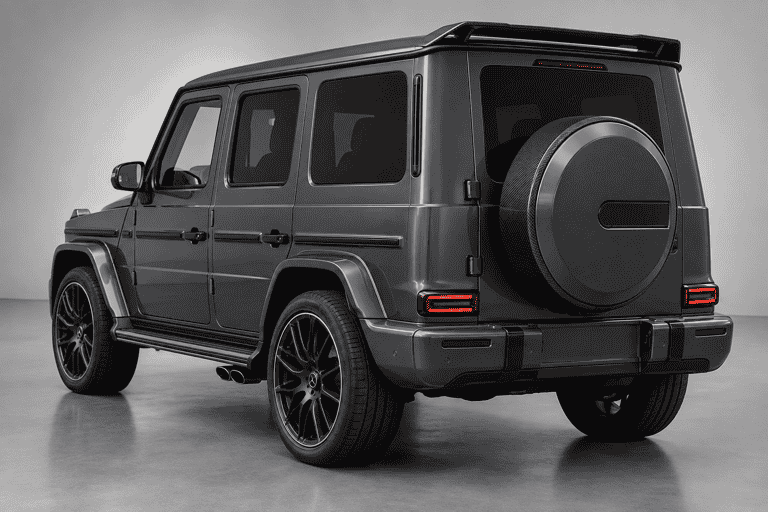
AI-generated styling concept. The spoiler and rear trim are not catalog specimens or mounting references.
3. Exterior trim: check each interface separately
Small trim parts can still be version-specific. The appropriate checks depend on what the component covers or replaces.
| Part type | Details to confirm |
|---|---|
| Mirror housings | Overlay or replacement; actual housing shape; relevant camera, indicator and other equipment provisions |
| Wheel-arch and bumper trim | Current arch and bumper design; original or converted bodywork; intended front/rear and left/right positions |
| Pillar covers and body moldings | Exact location, body configuration, piece count and matching surface contour |
| Spare-wheel rings and covers | Ring versus complete cover; actual cover and carrier arrangement; dimensions and attachment details required by the supplier |
| Door-handle trim | Cover or replacement, current handle design and clearance for fitted functions |
| Light surrounds | Existing lamp assembly and whether the product is trim only or includes lighting components |
Do not assume a carbon spare-wheel ring fits every cover, or that an overlay mirror cap shares the installation method of a replacement shell. Request the relevant interface photos for the selected version.
Where a part sits near a camera, sensor or lamp, confirm the related requirements separately. Physical fit does not, by itself, demonstrate retained functionality.
4. Check modified vehicles against their current bodywork
A G-Class may carry a newer-looking bumper, different wheel arches or an aftermarket hood while retaining its original underlying body. In that case, both the vehicle’s identity and the conversion details matter.
Record the brand and product reference of installed aftermarket panels where known. Ask whether the selected carbon part is intended for the original component or for that specific conversion.
Do not apply one approval to an entire bundle. A hood may match the underlying vehicle while bumper trim needs to match the converted bumper. A rear spoiler may require a separate check of the roof interface.
Use one enquiry line per part, with a product reference, intended location and relevant vehicle photo. This allows a supplier to confirm some items while identifying unresolved compatibility on others.
5. Send a photo set that answers the right questions
For an initial review, send:
- Full front view: show the hood, lights, grille and bumper together.
- Both side views: show doors, mirrors, arches, steps and roof accessories.
- Rear view and rear three-quarter view: show the roof edge, rear door and spare-wheel arrangement.
- Close-ups of each target area: document the actual surface or component the new part will cover or replace.
- Marked catalog references: identify the exact products requested.
Where hood underside or existing part-number photos are needed, arrange appropriate workshop access rather than asking a customer to dismantle components for an enquiry. Avoid photos cropped so tightly that the location becomes unclear.
Photos support identification; they do not replace required dimensions, installation information or physical checks. If the supplier requests measurements, agree the reference points and units first.
6. Obtain a written answer for every part
A useful fitment response should identify the product reference, supported vehicle configuration, installation scope and the evidence available. “Fits W463” leaves the original uncertainty unresolved.
| Result of the review | Next step |
|---|---|
| Vehicle and product application match with relevant documentation | Confirm included components and installation requirements before ordering |
| Vehicle identified, but product coverage unclear | Request the missing year, body or interface information |
| Aftermarket bodywork not covered by the listing | Seek confirmation for the actual converted component |
| Only styling photos are available | Treat compatibility as unverified and discuss further evaluation |
| Multiple parts have different confirmation statuses | Record them separately rather than approving the whole package |
When parts arrive, verify their references and condition before permanent installation. Carry out the instructed non-destructive trial checks where appropriate. Resolve mismatches before drilling, bonding or trimming; for hoods, complete the required closure and retention checks under the applicable procedure.
Keep the vehicle details and approved product versions with the job record for future reorders.
Frequently asked questions
Does a W463 listing cover every G-Class model year?
No. Request the intended production range and body configuration for the specific part. A broad catalog label does not establish universal compatibility.
Is the registration year enough to select parts?
Not always. Provide production information and the actual vehicle configuration, especially where a model transition or body conversion may be involved.
Will parts for a G 63 fit another G-Class variant?
Do not decide from the badge alone. Confirm the exact body components and equipment relevant to the selected product.
Can I order a hood and roof spoiler as one confirmed fitment package?
They can be included in one enquiry, but each needs its own application and mounting check. Confirmation of one part does not validate the other.
Are overlay and replacement mirror housings interchangeable?
They describe different product types. Confirm which you are ordering, what existing components remain and how the part attaches.
What if the vehicle has a newer-style body kit?
Provide both the vehicle’s original identity and the installed kit details. Compatibility needs to be assessed against the actual mounting component, not just the updated appearance.
Send vehicle photos to match your exterior parts
Request a W463 parts fitment review with the vehicle information and selected items below.
Copy and complete:
- Workshop name and delivery country:
- Exact vehicle model, production date and model year:
- Market, body style and door count:
- Original bodywork or conversion, with references if known:
- Selected product links or marked catalog images:
- Requested quantity for each item:
- Relevant roof, mirror, lighting and other equipment:
- Photos attached: front / sides / rear / target-area close-ups:
Please confirm for each item: supported vehicle and body configuration, replacement or overlay construction, supplied components, interface details, installation requirements and available fitment evidence. Please identify anything that remains unverified.
For parts intended for repeat stock, use our sample inspection guide to record the exact version and the scope of the evaluation before expanding the order.