

For G87 M2 carbon fiber hood fitment, identify the exact hood version and obtain its installation and closure requirements before quoting the completed job. An exterior photo or a “V1/V2” name cannot confirm hinges, latching, supporting components or the work your installer will need to perform.
A carbon hood—also called a carbon bonnet—is a substantial purchase for your customer. Your shop’s value is to turn that purchase into a defined project: the right part, the required components, an installer-reviewed scope and a delivery plan. Use this checklist before agreeing to a fixed installed price.

AI-generated styling concept; not a supplied hood version or verified installation.
Separate the styling choice from the installation decision
First ask what the customer wants: exposed carbon, a different profile, a vented appearance or a documented weight change. Then establish the car’s model year, relevant build details and any modifications around the hood, front bumper or engine bay.
Our catalog lists several G87 hood versions. Version names distinguish listings; they do not explain the engineering differences. Request the exact product reference, current revision and photographs of both surfaces. If the customer supplies an inspiration photo, keep it separate from the actual product being quoted.
Do not describe a hood as an upgrade for every G87 configuration simply because the catalog section says G87. The written application statement should identify what has been checked and what remains outside the supplier’s confirmation.
Obtain a specification pack that your installer can review
| Information to request | What your shop needs to resolve |
|---|---|
| Exact reference and application | Which physical product the quote covers |
| Upper and underside photographs | Shape, interfaces and components hidden in a beauty shot |
| Product-specific installation document | Required procedure and supporting parts |
| Hinge, closure and retention requirements | Whether the proposed installation has a documented arrangement |
| Support-system requirements | Which components are retained, replaced or added |
| Included accessories | What must be purchased separately |
| Vent and water-management details, if applicable | Suitability for the customer’s intended use |
| Packed size, weight and protection | Transport quote and receiving arrangements |
Give the pack to the technician who will assess the installation. Sales approval of the appearance is not technical approval of the job. If the required document is unavailable, keep the estimate provisional rather than treating missing information as “standard fitting.”
Resolve closure requirements before promising a bolt-on job
Ask the supplier to state the exact closure and retention arrangement required for that hood, including any specified additional components. Have the installer review it against the vehicle and applicable service information.
Do not assume that every carbon hood uses the original components unchanged, or that an additional retention device is required or sufficient for every design. Those are product-specific questions. This article does not provide a latch-adjustment procedure, fastener torque or test method.
A useful purchasing stop point is an unanswered closure question. If the supplier cannot identify the intended arrangement and provide the relevant instructions, there is not enough information to sell the job as a confirmed installation. Resolve that before a customer books workshop time or the part is shipped internationally.
Confirm accessories individually
Ask for a list showing each item as included, reused from the vehicle, required separately or not applicable. Depending on the selected design, the discussion may involve mounting hardware, trim, vent-related pieces or other associated components. The actual installation document should determine the list.
A separately listed accessory with “hood-specific” wording is not automatically compatible with every hood in the same chassis section. Ask which hood reference it belongs to and whether it is required for the quoted assembly. This is particularly useful when several versions have similar names.
Avoid using the word “complete” in a customer quote until the supplier has defined complete. A hood shell, a finished panel and a documented installation package are not interchangeable purchasing descriptions.
Review vents and weight claims on evidence
If the design has vents, ask whether they are open, how any related pieces are supplied and what information exists about water management. Discuss the customer’s actual use and storage. An aggressive opening in a rendering does not establish cooling performance, drainage or suitability for that use.
If weight reduction matters, request a measured weight for the supplied configuration. Compare like with like: identify which hardware, trim and other components are included in each figure. A bare panel weight should not be compared with a fully equipped original assembly without saying so.
Where measurements or tests are unavailable, quote verified styling and construction information only. There is no need to add an unsupported performance claim to make a well-specified product attractive.
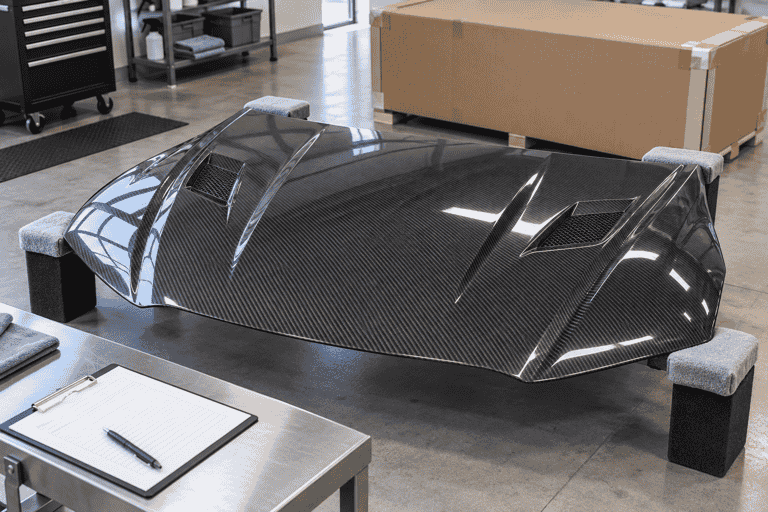
AI-generated inspection scene; not evidence of construction, closure design or packaging specifications.
Build a quote that separates confirmed and conditional work
Use separate lines for the hood, required accessories, freight, receiving inspection, existing-part removal, installation and any agreed finishing work. State what has been confirmed and what still depends on inspection or supplier documentation.
For example, if the customer wants a partly painted finish, confirm the finishing scope and suitable product guidance before pricing it. If a protective film is requested, have the relevant provider assess the actual finish rather than promising compatibility from the carbon label alone.
Keep the date and validity of the supplier quotation. Do not convert a provisional dispatch estimate into a guaranteed installation appointment. Your workshop schedule should reflect the arrival inspection and the readiness of all required parts.
When the hood is an optional addition to a wider build, add it as a separate line in the G87 carbon-package quote worksheet. Use the G87 spoiler-versus-wing guide for any rear-aero choice so the customer can approve each installation scope independently.
Plan delivery before releasing the order
Request packed dimensions, gross weight, the shipping method, delivery location requirements and the applicable damage-reporting process. Agree how the hood will be identified and documented before packing. Review accessible surfaces and packaging condition on arrival, retaining the evidence required by the agreed process.
Use the sample inspection guide to structure the record. An arrival inspection checks what has been received; it does not replace a product-specific fitment and closure assessment. Keep those two activities separate in your job file.
Copy this G87 hood inquiry
We are quoting a carbon hood for a BMW G87 M2, year [ ], build details [ ], existing modifications [ ]. Preferred appearance/reference: [ ]. Please provide the exact product and revision, confirmed application, upper/underside photos, installation and closure requirements, included/reused/separate components, vent details if applicable, measured weight basis, packed dimensions and current quote. Quantity [ ]; delivery country/postcode [ ]. Please identify any unresolved information before we quote installation.
Frequently asked questions
Do V1 and V2 indicate different model-year fitment?
Do not infer that from the names. Request the supplier’s application and difference list for the actual references.
Can we advertise the hood as a direct replacement?
Only if the product documentation supports the meaning of that claim. Explain any required components, modifications or installation conditions rather than letting the phrase hide them.
Can the shop reuse all original hardware?
That must be established by the selected hood’s instructions and the installer’s assessment. This guide does not authorize a universal reuse arrangement.
What if the supplier has only exterior photos?
Request the missing underside and installation information. Until the key requirements are resolved, treat the job as an estimate awaiting technical review, not a confirmed installation package.
Get a reviewable hood quote before committing your workshop
Send the vehicle details and selected G87 carbon hood reference through our trade inquiry page. Request the specification pack and transport quote together. That gives your buyer, installer and customer one defined project to assess before money and workshop time are committed.