If you have ever browsed several online stores selling carbon fiber parts for the BMW G80 M3, you may have noticed something interesting.
The same front lip appears on multiple websites. The photographs look similar, the styling is nearly identical, and sometimes even the product descriptions are remarkably close.
Yet the prices can be hundreds of dollars apart.
One store might sell a carbon fiber rear diffuser for $650, while another lists what appears to be the same design for $1,100. A third retailer may advertise the product under its own brand, with no mention of the original manufacturer.
So where are these carbon fiber car parts actually coming from?
The answer is that many automotive aftermarket retailers do not manufacture the products they sell. Instead, they source finished components from manufacturers, wholesalers, trading companies, or other distributors.
Some purchase directly from factories in China. Others work with domestic importers that hold inventory. Established brands may develop exclusive products through OEM or ODM manufacturing arrangements.
Understanding these supply chains is essential if you want to start a carbon fiber parts business, improve your purchasing margins, or build a private-label automotive brand.
This guide explains how the industry works, where retailers find their suppliers, and what buyers should verify before committing to a manufacturing partner.
Quick Answer: Where Do Carbon Fiber Car Parts Stores Get Their Products?
Most automotive carbon fiber retailers use one or more of five sourcing models:
| Sourcing Channel | How It Works | Main Advantage | Main Limitation |
|---|---|---|---|
| Direct manufacturer | Buy finished parts from the producing factory | Direct production communication | Requires supplier verification |
| Wholesale distributor | Buy from an importer or regional wholesaler | Easier local purchasing | Additional distribution margin |
| Trading company | Supplier coordinates products from different factories | Broad sourcing access | Less direct production control |
| Private-label OEM/ODM | Manufacturer produces or develops products for a brand | Brand differentiation | Development and tooling costs |
| Dropshipping supplier | Supplier ships orders individually to customers | Lower inventory commitment | Less control over fulfillment |
There is no single model that works best for every business.
A small tuning shop may prefer local stock because customers expect quick installation appointments. An online retailer entering a new market may prefer low-volume factory orders. A growing performance brand may invest in exclusive molds and custom packaging.
The right approach depends on your customers, available capital, product range, and expected order volume.
1. Buying Directly from an Automotive Carbon Fiber Factory
Direct factory sourcing is particularly attractive to businesses that want to build a long-term wholesale operation.
Instead of purchasing through several intermediaries, the retailer communicates with a manufacturer that produces the components.
For automotive exterior parts, this may include carbon fiber front lips, rear diffusers, side skirts, spoilers, hoods, trunk lids, mirror caps, and complete body kits.
China is an important manufacturing location for this segment, particularly for aftermarket products designed for European performance and luxury vehicles.
However, buying from China does not automatically mean buying directly from a factory.
Many companies advertise themselves as manufacturers while outsourcing some or all of their production.
A business may operate its own factory for certain products and purchase other components from external suppliers. That arrangement is not necessarily problematic, but buyers should understand who is responsible for manufacturing and quality control.
What Does a Carbon Fiber Factory Actually Do?
Depending on its manufacturing model, an automotive carbon fiber factory may perform several operations:
Mold development and preparation
Carbon fiber cutting and layup
Resin processing or prepreg preparation
Vacuum bagging and curing
Trimming, drilling, and edge finishing
Surface finishing and polishing
Dimensional and fitment inspection
Final inspection and protective packaging
Not every manufacturer performs every operation internally.
For example, a supplier may outsource mold machining while handling composite layup, curing, finishing, and inspection in-house.
What matters is whether the supplier can accurately explain its manufacturing responsibilities and maintain control over the finished product.
Why Direct Factory Sourcing Can Be Attractive
The most obvious potential advantage is pricing.
Removing an intermediary may reduce certain distribution costs, particularly when purchasing repeat quantities of established products.
But price is not the only benefit.
Direct communication can make it easier to clarify material construction, investigate fitment issues, discuss product modifications, or develop custom components.
For a retailer planning to introduce a new BMW carbon fiber product range, this access can be valuable.
Instead of relying on generic catalog information, the buyer can discuss the exact vehicle generation, bumper configuration, product finish, and packaging requirements with the supplier.
The trade-off is that international purchasing requires more work.
You may need to manage shipping, customs arrangements, product inspection, and longer replenishment cycles.
Direct factory sourcing is most useful when the buyer is prepared to manage those responsibilities or has a supplier that can support them.
2. Buying from Local Automotive Parts Wholesalers
Not every retailer needs to import directly from a factory.
For many tuning shops, purchasing from a domestic distributor is a practical decision.
Imagine a workshop in California that has a customer booked for a BMW M4 carbon fiber spoiler installation next week.
The workshop does not want to wait for international production and shipping.
A local wholesaler with inventory may be the better supplier, even if the purchase price is higher.
The retailer is effectively paying for inventory availability, domestic logistics, and reduced purchasing complexity.
When Local Wholesale Makes Sense
Local distribution can be especially useful when:
Customers require short delivery times.
The business does not have sufficient order volume for regular imports.
Products are needed for scheduled installation appointments.
The retailer prefers domestic customer service and returns handling.
Inventory availability matters more than the lowest possible unit cost.
However, local stock is not guaranteed simply because a supplier has a domestic website.
Some businesses advertise products locally but fulfill orders from overseas.
Before purchasing, confirm the physical stock location and whether the advertised delivery estimate includes production time.
The Hidden Cost of Convenience
Local purchasing often involves additional distribution margins.
Those margins may be justified by faster delivery and lower operational complexity.
The important question is whether the final cost still supports your business model.
For a workshop charging for installation, a higher component cost may be acceptable if the part arrives on time and fits correctly.
For an online retailer competing primarily on price, the same arrangement may leave too little margin.
3. Sourcing Through Trading Companies
Trading companies are common in international automotive parts supply chains.
A trading company may coordinate products from several factories, allowing a buyer to purchase different categories through one contact.
This can be convenient when the retailer wants a wide product range without managing many individual supplier relationships.
For example, one manufacturer may specialize in carbon fiber hoods, another in smaller trim components, and a third in fiberglass body kits.
A trading company may combine those products into a single catalog.
That can save time, especially for businesses that are unfamiliar with overseas sourcing.
However, there are trade-offs.
The company handling your order may not directly control manufacturing schedules, molds, or quality inspections.
When a fitment problem occurs, communication may have to pass through multiple parties before reaching the actual producer.
This does not mean trading companies are inherently unreliable.
Some provide valuable sourcing, inspection, and logistics services.
The key is transparency.
Ask whether the company manufactures the product, purchases it from a partner factory, or acts as an independent sourcing intermediary.
A reliable supplier should be able to explain the arrangement clearly.
4. Private-Label Carbon Fiber Parts: How Automotive Brands Build Their Own Product Lines
One of the most interesting aspects of the automotive aftermarket is how private-label brands operate.
A company does not necessarily need to own a carbon fiber factory to sell products under its own brand.
Instead, it may work with a manufacturer to produce existing designs with approved branding or develop entirely new components.
These arrangements are commonly described as OEM and ODM manufacturing, although the exact meaning can vary between suppliers.
Private Label Using Existing Products
The simplest approach is to purchase established products and sell them under a separate retail brand, subject to the manufacturer’s agreement and applicable intellectual property rights.
The business may focus on packaging, product photography, customer service, installation guidance, and marketing.
This model can reduce development costs because the product and mold already exist.
However, other retailers may sell similar or identical designs.
A brand built entirely around shared catalog products may struggle to differentiate itself.
Developing Exclusive Carbon Fiber Products
A more advanced approach involves custom development.
Imagine a performance parts company that wants to introduce a distinctive front lip for the BMW G87 M2.
The company may provide a physical reference part, CAD files, design drawings, or detailed vehicle information.
The manufacturer then evaluates whether the proposed component can be produced.
Depending on the project, development may involve design adjustments, tooling, prototype production, test fitting, and sample approval.
This process creates opportunities for differentiation, but it also introduces cost and risk.
Before paying for tooling, buyers should clarify several important questions.
Who owns the mold after payment? Can the manufacturer use the design for other customers? What happens if the first prototype does not fit? Who pays for revisions? How will future production prices be determined?
These questions should be answered in writing before development begins.
A custom product is not automatically exclusive simply because the buyer paid a tooling charge.
5. Can You Start a Carbon Fiber Parts Business Without Holding Inventory?
Yes, but the business model requires careful planning.
Some automotive parts retailers operate with limited inventory, purchasing products after receiving customer orders.
Others use dropshipping arrangements in which the supplier ships directly to the final customer.
These models can reduce the capital required to launch a store.
However, automotive carbon fiber products introduce challenges that are less common with small consumer goods.
A carbon fiber hood is large, relatively fragile, and expensive to ship.
A front lip may require careful packaging to protect its edges.
A product that fits one vehicle configuration may not fit another.
If the customer receives the wrong part, the retailer still has to manage the complaint, even if the supplier handled fulfillment.
Dropshipping Versus Blind Shipping
These terms are sometimes used interchangeably, but they are not identical.
Dropshipping describes a fulfillment model in which the supplier ships an order directly to the retailer’s customer.
Blind shipping generally means the shipment does not reveal the original supplier’s commercial identity to the recipient, subject to the agreed documentation and shipping requirements.
A supplier may support dropshipping without supporting blind shipping.
For private-label retailers, this distinction matters.
Before offering direct-to-customer delivery, confirm packaging, shipping documents, tracking, return handling, and the responsibilities of each party.
When Inventory-Free Selling Becomes Risky
The biggest problem is uncertainty.
If a supplier lists a product as available but actually needs several weeks to manufacture it, the retailer may disappoint customers who expect immediate shipment.
The same issue occurs when a product photograph does not accurately represent the supplied version.
A safer approach is to begin with a limited product range, verify samples, and establish realistic delivery expectations.
For large carbon fiber components, a small inventory of proven bestsellers may eventually be more practical than relying entirely on individual international shipments.
6. Why Do Different Online Stores Sell Similar Carbon Fiber Parts at Different Prices?
Price differences in the automotive carbon fiber aftermarket can be substantial.
But two products with the same styling are not necessarily identical.
Consider a carbon fiber front lip advertised for a BMW G80 M3.
One supplier may offer a carbon fiber component manufactured using prepreg materials and autoclave curing.
Another may offer a component using a carbon fiber outer layer with fiberglass reinforcement.
A third product may use a different mold, mounting design, or surface finish.
All three may look similar in a small online photograph.
Their manufacturing costs and performance characteristics can differ.
Retail pricing also reflects factors unrelated to manufacturing.
A local retailer may include domestic warehousing, customer support, advertising, import costs, and warranty administration in its selling price.
Another seller may ship directly from overseas and operate with lower overhead.
Neither pricing model automatically indicates better or worse product quality.
The only meaningful comparison begins with verified specifications and the total cost of receiving the correct product.
7. Dry Carbon vs. Wet Carbon: What Retailers Need to Understand
Material terminology is one of the most misunderstood parts of automotive carbon fiber sourcing.
Customers frequently ask whether a product is made from real carbon fiber, dry carbon, or wet carbon.
Unfortunately, these terms are not always used consistently in aftermarket listings.
Dry Carbon Fiber
In automotive aftermarket usage, dry carbon commonly refers to parts manufactured using prepreg carbon fiber materials.
Prepreg reinforcement contains a controlled resin system before layup.
The component is then cured using a defined manufacturing process, which may include vacuum bagging and autoclave curing.
For suitable applications, prepreg manufacturing can provide advantages in resin control and production consistency.
However, the quality of the final component still depends on design, layup, tooling, curing, and inspection.
Wet Carbon Fiber
Wet layup generally involves applying liquid resin to reinforcement during the manufacturing process.
Depending on the product, the laminate may incorporate carbon fiber, fiberglass, or other reinforcement materials.
Wet layup is not inherently unsuitable.
The appropriate process depends on the intended component, performance requirements, manufacturing volume, and budget.
What Should an Online Retailer Ask?
Instead of asking only whether a part is dry carbon, request the actual material construction.
Is it a full carbon fiber laminate? Does it use fiberglass reinforcement? What curing process is used? Is the product primarily decorative or intended for a functional application?
Accurate answers allow the retailer to write more reliable product descriptions and avoid misleading customers.
A carbon fiber appearance alone cannot confirm the manufacturing process.
8. Vehicle Fitment Is Often More Important Than the Lowest Factory Price
An incorrect fitment claim can eliminate the profit from several successful orders.
Imagine an online store selling a carbon fiber rear diffuser for a BMW M4.
The product description simply says “BMW M4 Carbon Fiber Rear Diffuser.”
That description is not sufficient.
Which generation is supported?
Is the part designed for the F82 or G82?
Does it fit the original bumper?
Does the vehicle have a facelift or a particular trim configuration?
These details can determine whether the component installs correctly.
For overseas orders, a fitment mistake is particularly expensive because returning a large carbon fiber part may be impractical.
How Professional Buyers Verify Fitment
Before adding a new product to their catalog, experienced buyers should request the exact vehicle application.
Where available, useful information includes chassis code, model year, body style, bumper configuration, installation photographs, and mounting requirements.
For high-value components, a physical sample and test installation can be worthwhile.
A supplier that provides accurate fitment information may create more long-term value than one offering a slightly lower price with vague compatibility claims.
9. How to Calculate the Real Cost of Importing Carbon Fiber Car Parts
Factory price is only the beginning.
For international retailers, the more useful figure is landed cost.
Landed cost includes the expenses required to bring the product to its intended destination.
Depending on the transaction, this may include manufacturing cost, export packaging, freight, insurance, import duties, taxes, customs handling, and local delivery.
Consider a hypothetical carbon fiber hood order.
| Cost Item | Illustrative Amount |
|---|---|
| Factory product price | $600 |
| Protective packaging | $35 |
| International freight | $220 |
| Import and handling charges | $95 |
| Total landed cost | $950 |
These figures are hypothetical and are not a quotation for a specific product or destination.
If the retailer sells the hood for $1,250, the difference between selling price and landed cost is $300.
That is not necessarily profit.
Payment processing, advertising, warehousing, customer support, installation disputes, and potential damage claims still need to be considered.
This is why retailers should avoid setting prices based only on factory quotations.
Large products such as hoods and diffusers can be especially sensitive to shipping costs.
A product that appears inexpensive at the factory may be commercially unattractive once delivered.
10. How to Verify a Carbon Fiber Car Parts Supplier Before Ordering
Finding a supplier online is easy.
Determining whether that supplier is suitable for repeat business requires more work.
A professional sourcing process should begin with the products you actually intend to sell.
Verify the Supplier’s Manufacturing Role
Ask whether the company manufactures the requested products directly.
If it uses partner factories, establish which operations are outsourced and who is responsible for quality control.
Factory videos, production photographs, tooling information, and inspection documentation can provide useful evidence.
However, none of these alone proves ownership of every manufacturing operation.
Request a Product Sample
A sample provides information that cannot be reliably assessed from a catalog.
Inspect the surface finish, carbon weave, edges, mounting points, and overall dimensions.
For vehicle-specific parts, arrange a test fit where practical.
A successful sample does not guarantee identical future batches, but it helps establish an initial quality standard.
Confirm Product Availability and Lead Time
Ask whether the product is physically in stock, scheduled for production, or made to order.
These are different situations.
A supplier may have an existing mold without having finished inventory.
For an online retailer, the distinction affects delivery promises and customer satisfaction.
Review Packaging and Shipping Procedures
Carbon fiber exterior parts require protective packaging appropriate to their dimensions and fragility.
Ask how the supplier protects edges, corners, mounting surfaces, and exposed finishes.
Also clarify how shipping damage is documented and handled.
For high-value international shipments, agree on the evidence and claim process before dispatch.
Test Communication Before Scaling
Supplier communication becomes more important as order volume increases.
A reliable contact should be able to explain product specifications, confirm availability, respond to fitment questions, and provide realistic updates.
If basic questions remain unanswered during the sample stage, larger orders may become difficult to manage.
11. China vs. Local Wholesale: Which Sourcing Model Is Better?
For many aftermarket businesses, the best answer is a combination of both.
A retailer may purchase urgent, high-demand products from domestic stock while sourcing slower-moving or specialized products directly from overseas manufacturers.
This reduces dependence on one supply channel.
| Business Requirement | Direct Factory Sourcing | Local Wholesale |
|---|---|---|
| Small urgent orders | Depends on stock and freight | Often more convenient |
| Factory-level product discussion | More direct | May require intermediary |
| Custom product development | Often possible | Depends on supplier |
| Domestic delivery speed | Requires local inventory or fast freight | Often advantageous |
| Product range expansion | Can support factory catalogs | Limited by distributor range |
| Import administration | Buyer may need to manage | Usually handled upstream |
A new business should not assume that factory sourcing is always cheaper after all costs.
Likewise, an established distributor should not assume that domestic purchasing is always the safer option.
The best approach depends on inventory strategy, shipping economics, supplier reliability, and customer expectations.
12. A Practical Sourcing Strategy for New Carbon Fiber Parts Retailers
A new retailer does not need to launch with hundreds of products.
In fact, a smaller, well-verified catalog is often easier to manage.
Consider a business targeting BMW enthusiasts.
Instead of listing every carbon fiber part available for every BMW generation, the retailer could begin with a specific vehicle platform such as the G80 M3 or G87 M2.
The initial range might include a front lip, rear diffuser, spoiler, mirror caps, and side skirts.
This allows the business to focus on accurate product descriptions, fitment information, photographs, and pricing.
After receiving initial orders, the retailer can identify which products generate demand and which create problems.
That information can guide future purchasing.
Phase One: Validate Products
Select a limited number of products for vehicles with clear customer demand.
Confirm specifications and sample quality.
Calculate landed costs before publishing retail prices.
Phase Two: Build Reliable Listings
Use accurate vehicle compatibility information and product-specific photographs.
Describe the actual material construction.
Avoid unsupported claims such as guaranteed perfect fitment or universal compatibility.
Phase Three: Establish Repeat Purchasing
Once sales patterns become clearer, discuss replenishment arrangements with the supplier.
Consider holding stock of frequently purchased products while sourcing less common applications individually.
Phase Four: Develop Brand Differentiation
As the business grows, private-label packaging, exclusive product development, installation resources, and customer support can create advantages that competitors cannot easily copy.
The goal is not simply to find the cheapest supplier.
It is to build a purchasing system that supports repeatable sales without creating excessive inventory or after-sales risk.
13. CCF: A Factory-Direct Sourcing Option for Automotive Carbon Fiber Businesses
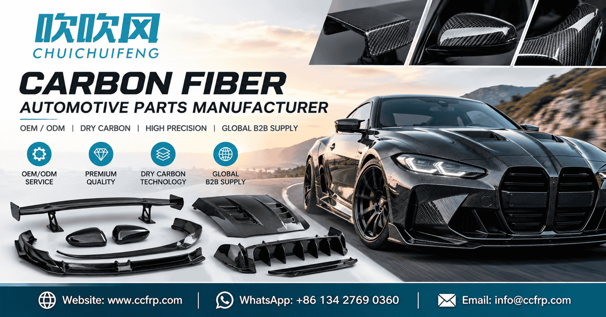
For distributors and automotive retailers looking for a Chinese manufacturing partner, CCF provides a factory-focused sourcing option for exterior carbon fiber components.
CCF is the B2B brand of Guangzhou Chui Chui Feng Automotive Products Co., Ltd., headquartered in Guangzhou, with manufacturing operations in Qingyuan, Guangdong.
The company’s composite manufacturing experience dates back to 2006, with a subsequent expansion into automotive carbon fiber products and dry carbon manufacturing.
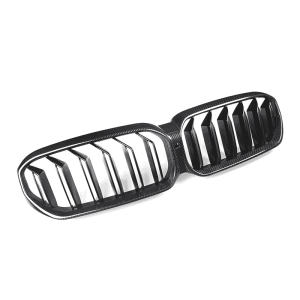
Its product range includes carbon fiber front lips, rear diffusers, side skirts, spoilers, wings, hoods, trunk lids, mirror caps, grilles, and other vehicle-specific exterior components.
Applications include BMW, Porsche, Mercedes-Benz, Audi, Lamborghini, and other performance and luxury vehicles.
Supporting Small and Growing Buyers
One challenge for new automotive retailers is committing to inventory before demand has been established.
CCF supports standard catalog orders starting from one unit, allowing buyers to evaluate selected products before considering larger orders.
For a retailer planning a BMW-focused online store, this can make it easier to test different product categories.
A buyer may begin with a front lip and rear diffuser, assess the local market, and expand into spoilers, hoods, and other components as demand develops.
Stock availability, shipping costs, and lead times are confirmed according to the specific order.
Dry Carbon Manufacturing
CCF focuses on dry carbon production using prepreg materials and autoclave processing.
For buyers, the relevant benefit is access to a supplier that can discuss manufacturing methods and product construction directly.
Material specifications should still be confirmed for each product.
Different components have different structural and installation requirements, and the appropriate construction depends on the intended application.
OEM/ODM Development for Automotive Brands
CCF also supports OEM/ODM project discussions for businesses developing custom automotive carbon fiber products.
Depending on the project, development may begin with CAD files, physical samples, reference components, or vehicle information.
Buyers can discuss tooling, prototypes, branding, packaging, and production requirements before proceeding.
For a growing automotive brand, this provides a potential route from selling established catalog products to developing a differentiated product line.
What Buyers Should Prepare Before Contacting a Factory
A useful initial inquiry includes the intended vehicle models, product categories, approximate order quantities, destination country, and any special material or branding requirements.
For custom products, reference photographs or design files can help clarify the project.
The more accurately the buyer defines the requirement, the easier it becomes for a manufacturer to assess feasibility, pricing, and delivery arrangements.
Frequently Asked Questions
Where do online carbon fiber car parts stores buy their products?
Many online retailers purchase carbon fiber car parts from manufacturers, wholesale distributors, trading companies, or private-label production partners. Some source directly from Chinese automotive carbon fiber factories, while others buy from domestic importers holding inventory.
Can I buy carbon fiber car parts directly from a manufacturer?
Yes. Some automotive carbon fiber manufacturers accept direct wholesale orders from distributors, tuning shops, and online sellers. Minimum order quantities, product availability, and shipping arrangements vary by supplier.
Are carbon fiber parts on different websites made by the same factory?
Sometimes, but not always. Multiple retailers may purchase from the same manufacturer or distributor. Similar-looking products can also come from different factories using different molds and materials. Product photographs alone cannot establish a common manufacturing source.
How do I find a reliable carbon fiber car parts supplier in China?
Begin by identifying the exact products and vehicle applications you need. Verify the supplier’s manufacturing role, request material specifications, review real product photographs, evaluate samples, and confirm quality control, packaging, and shipping arrangements.
Can I start a carbon fiber parts business without inventory?
Yes. Some retailers use made-to-order purchasing or dropshipping arrangements. However, large automotive components create challenges involving shipping costs, lead times, damage risk, and fitment. These responsibilities should be clarified before accepting customer orders.
What is the minimum order quantity for wholesale carbon fiber parts?
MOQ varies by manufacturer, product, and purchasing arrangement. Some suppliers require minimum quantities, particularly for custom products. CCF supports standard catalog orders starting from one unit, while OEM/ODM projects are evaluated separately.
Is dry carbon better for automotive aftermarket products?
Prepreg-based dry carbon manufacturing can offer advantages in process and material control. However, finished quality depends on component design, manufacturing execution, and inspection. Buyers should evaluate the actual product construction rather than relying on terminology alone.
Can I sell factory-made carbon fiber parts under my own brand?
Potentially, yes, with the manufacturer’s agreement and appropriate intellectual property rights. Private-label arrangements may include branding, packaging, or custom development. Exclusive designs and tooling ownership should be addressed in writing.
How much profit can an online carbon fiber parts store make?
Profitability depends on product costs, freight, import charges, advertising, fulfillment, returns, and selling prices. A retailer should calculate landed cost and operating expenses rather than assuming that the difference between factory price and retail price is profit.
Which automotive carbon fiber supplier is suitable for BMW aftermarket parts?
Buyers should prioritize suppliers with verified coverage for the intended BMW chassis and model year, accurate fitment information, appropriate material construction, and dependable product availability. CCF supplies carbon fiber exterior components for multiple BMW generations, including popular M-series applications.
Final Thoughts
Most successful carbon fiber car parts retailers do not need to manufacture every product themselves.
They need a sourcing strategy that matches their business model.
For some businesses, that means purchasing from local wholesalers to ensure quick delivery. For others, it means building direct relationships with manufacturers to improve product access and support future development.
Private-label brands may eventually require custom tooling and exclusive designs, while new online stores may benefit from testing a limited number of established products before expanding.
Whatever model you choose, the fundamentals remain the same: verify the supplier, understand the materials, confirm vehicle fitment, calculate landed cost, and establish clear expectations for quality and delivery.
A reliable supply chain is not built around the lowest quotation. It is built around products that customers can purchase, receive, install, and recommend with confidence.
About CCF — Automotive Carbon Fiber Parts Manufacturer
CCF is the B2B brand of Guangzhou Chui Chui Feng Automotive Products Co., Ltd., specializing in automotive carbon fiber exterior components, wholesale supply, and OEM/ODM development.
With composite manufacturing experience dating back to 2006, CCF focuses on dry carbon manufacturing and vehicle-specific aftermarket products for BMW, Porsche, Mercedes-Benz, Audi, Lamborghini, and other performance vehicles.
For distributors, tuning shops, and online retailers, CCF can assist with product selection, vehicle compatibility clarification, material specifications, sample purchasing, and wholesale sourcing discussions.
For businesses developing their own automotive brands, CCF also supports discussions around custom components, tooling, prototypes, and manufacturing requirements.
Whether you are launching your first carbon fiber product catalog or expanding an established aftermarket business, understanding the manufacturing process and sourcing terms before ordering can help reduce unnecessary risk.
You May Also Like
Top 10 Automotive Carbon Fiber Parts Manufacturers Worldwide in 2026
How to Verify a Chinese Carbon Fiber Factory
Carbon Fiber Manufacturer vs. Trading Company
More Carbon Fiber Buying Guides
Dry Carbon vs. Wet Carbon for Automotive Parts
Carbon Fiber Parts Quality Inspection Checklist
How to Compare Carbon Fiber Parts Suppliers