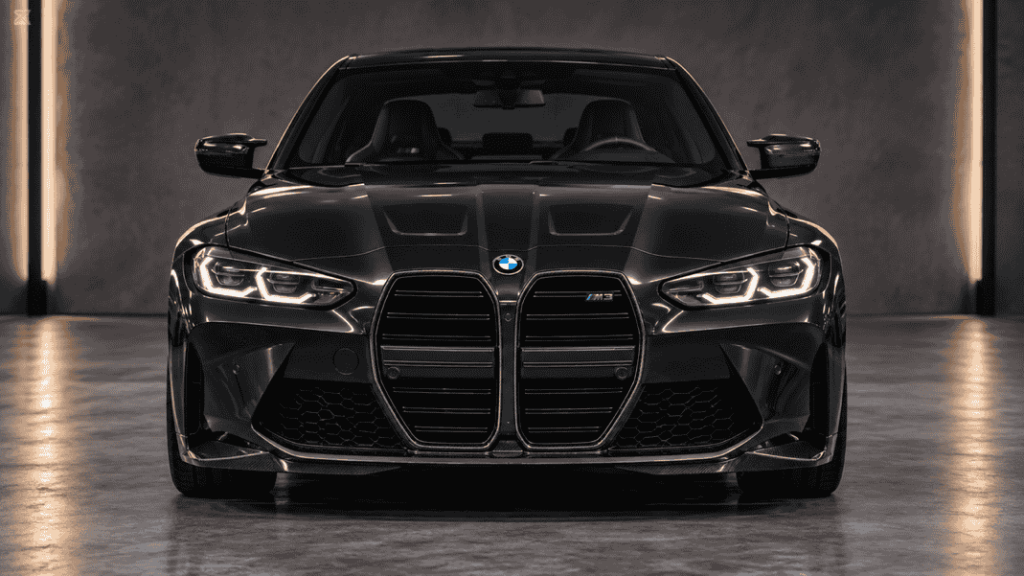
Your customer has chosen a carbon fiber grille for their BMW M3 or M4. The catalog offers versions labeled “with ACC” and “without ACC.” Before placing the order, your shop needs to confirm which version matches the actual vehicle—and what evidence supports that match.
For G80 carbon fiber grille ACC compatibility, check the vehicle’s installed equipment, the exact grille version and the sensor-related interfaces together. A grille that clips into the bumper is not automatically compatible with the vehicle’s driver-assistance functions. The same checking approach applies when selecting a grille for a G82 M4.
Our catalog contains ACC and non-ACC descriptions for selected G80/G82 grilles. Treat these as selection labels that require product-specific confirmation, not a blanket guarantee of functionality across all years, markets or bumper configurations.
AI-generated styling concept. This image does not identify an ACC configuration or demonstrate sensor compatibility.
The checklist before ordering
| Check | What to collect | What it resolves |
|---|---|---|
| Vehicle identity | G80 M3 or G82 M4, model year, production date if known, market and steering side | Defines the vehicle being matched |
| Installed equipment | Vehicle-specific equipment information confirming whether ACC is fitted | Avoids guessing from the exterior |
| Actual front end | Current grille and bumper photos; details of previous modifications | Identifies differences from the original configuration |
| Selected grille | Exact product reference, version and ACC/non-ACC designation | Prevents style-only ordering |
| Interfaces | Actual rear-view photos, mounting details and component-transfer requirements | Shows how the replacement relates to existing equipment |
| Verification | Supported application, installation requirements and relevant functional evidence | Separates a catalog claim from a documented compatibility assessment |
View the G80/G82 grille options and include the exact product link or marked catalog image in your enquiry.
1. Confirm ACC from the vehicle’s configuration
ACC refers here to adaptive cruise control; BMW uses the name Active Cruise Control for relevant systems. It is not the same as ordinary speed-holding cruise control. BMW’s explanation of Active Cruise Control describes using vehicle detection to adjust speed and maintain following distance.
Ask the customer for vehicle-specific equipment information, and confirm it through the appropriate BMW records or service channel where needed. BMW provides a VIN-based owner’s manual lookup to access information relevant to a vehicle; a manual’s description of an optional feature should not alone be treated as proof that the car has it.
Steering-wheel buttons, a visible front sensor area or a package name can help with investigation, but they should not replace equipment confirmation. Do not use one option-code rule across every market and model year without checking its applicability.
If the car has been modified, compare the original equipment information with its current configuration. Record uncertainty as “ACC status unconfirmed” rather than choosing the non-ACC version by default.
2. Do not confuse ACC, parking sensors and camera provisions
A customer may describe a car as “having front sensors” without knowing which system they mean. Ask separately about ACC, front-camera equipment and parking assistance.
BMW describes ultrasonic parking sensors separately from its radar sensors. A visible parking sensor or camera does not establish that the vehicle has ACC or that a replacement grille accommodates all its equipment.
Similarly, a grille advertised with a camera opening is not necessarily the correct ACC version. Ask which interfaces the product retains, which original components must be transferred and which accessories are included. Confirm each relevant function separately.
3. Ask what “with ACC” means for the specific grille
A useful supplier response should go beyond repeating the catalog label. Request:
- The exact vehicle and bumper applications covered, including exclusions.
- Photos of the actual front and rear of the selected version.
- Details of any sensor-related opening, cover or mounting interface involved.
- Which original covers, brackets or other components are retained or transferred.
- Whether additional parts are required and whether they are included.
- Installation documents and relevant verification records for that version.
A visible opening may address physical clearance, but it does not establish sensor alignment or functional compatibility. Equally, a product’s name does not prove what materials or geometry are present around the sensor’s operating area.
BMW notes that radar functionality can be limited by factors including coverage and improper work around sensors in its radar-sensor guidance. For an aftermarket grille, request evidence for the finished design rather than assuming that a carbon fiber surface, coating or cover is suitable in any location.
Do not add trim, paint, film or mesh around sensor-related areas without confirming compatibility with the applicable requirements.
4. Send photos that show the actual configuration
AI-generated documentation concept. The background vehicle and trim are generic and are not G80/G82 sensor-location references.
Send a small, organized photo set:
- Full front view: show the complete grille and bumper.
- Close-up of the current grille: include any visible covers or openings without labeling an unidentified component as ACC.
- Both front three-quarter views: show the current grille-to-bumper relationship and modifications.
- Selected replacement reference: include the product link, order reference or marked catalog screenshot.
- Existing part references, where accessible: provide label or part-number photos if already available during workshop inspection.
Do not remove or adjust sensors merely to obtain an enquiry photo. If additional rear-side views are needed, have the installer determine the appropriate access procedure.
Share configuration records through the supplier’s private enquiry channel and remove unrelated personal details. Provide the VIN privately only when it is needed for a vehicle-specific check.
5. Separate physical fitment from functional verification
Ask what the supplier’s evidence actually demonstrates. These are different levels of information:
| Evidence | What it can support | What it does not establish by itself |
|---|---|---|
| Catalog “with ACC” label | Intended selection category | Confirmed interfaces or system operation |
| Product front and rear photos | Visible geometry and construction details | Installed alignment or functional performance |
| Installed vehicle photos | Physical installation on the identified car | Complete driver-assistance verification |
| Documented functional checks | Results for the stated product and vehicle under the recorded procedure | Universal compatibility with other configurations |
Request the vehicle details, grille revision, transferred components and verification scope alongside any test result. “No warning light in the photo” is not equivalent to a completed functional check.
If only physical-fit photos are available, record functional compatibility as unverified. Discuss the remaining checks before promising a customer that all functions will be retained.
6. Plan installation and post-installation checks
Have a qualified installer review the applicable BMW service information and product instructions before work begins. Determine whether the planned work requires diagnostic checks, adjustment or calibration for that vehicle and the components being disturbed. Do not assume either that every grille change needs calibration or that none does.
Record existing faults or relevant warning messages before replacement. Follow the specified handling and mounting procedures; do not relocate a sensor, improvise its bracket or change a sensor cover simply to make an incompatible grille fit.
After installation, complete the required checks under the applicable procedure and retain the results with the job record. Do not use an improvised on-road test involving deliberate close following or an obstacle to “prove” ACC operation.
If a new assistance-system warning appears, investigate the installation and follow the appropriate diagnostic process. Clearing a code or disabling a feature is not a compatibility solution. Resolve the issue before representing the installation as functionally verified.
A simple ordering decision
- ACC confirmed, matching version documented: confirm the remaining application and installation details, then specify that exact version on the order.
- No ACC confirmed: select the documented non-ACC application while checking camera and other equipment requirements separately.
- Equipment or product compatibility uncertain: send the records and photos for review before ordering.
- Supplier evidence conflicts with the vehicle: resolve the discrepancy; do not select a version based only on its appearance.
For repeat shop orders, keep the confirmed product reference and vehicle configuration together. Two cars with the same chassis code may still require different versions.
Frequently asked questions
Can I identify ACC from a front photo alone?
A photo can show visible features, but it may not establish the installed equipment or current system configuration. Use vehicle-specific records alongside photos.
Does a front camera mean the car has ACC?
No. Confirm camera provisions and ACC separately. A camera opening in a replacement grille does not prove ACC compatibility.
Does buying the “with ACC” grille add ACC to a non-ACC car?
No. The label describes an intended grille application; it does not supply the complete hardware, software or vehicle integration needed to add a driver-assistance function.
Can I use a non-ACC grille on a car with ACC?
Do not assume it is suitable. Request the version documented for the actual equipment and bumper configuration. Cutting an opening or bypassing the system is not a substitute for compatibility confirmation.
Will a carbon fiber grille always interfere with ACC?
Do not make a blanket judgment from the material name. The finished design, sensor-related interfaces and installation need product-specific assessment and evidence.
Is the absence of a warning message enough to confirm success?
No. Complete the checks required by the applicable service procedure and document their scope and results.
Send your configuration and grille photos for version confirmation
Request a G80/G82 grille version check before placing the order. Include:
- Workshop name and delivery country:
- G80 M3 or G82 M4, model year and production date if known:
- Vehicle market and steering side:
- ACC status: confirmed fitted / confirmed not fitted / unconfirmed:
- Source of equipment confirmation:
- Front-camera and other relevant equipment details:
- Original or aftermarket bumper, with reference if known:
- Current grille photos and details of previous modifications:
- Preferred grille product link or catalog screenshot:
- Required quantity:
Ask for the exact recommended product reference, confirmed application, included and transferred components, installation requirements and available functional evidence. Any unresolved item should be identified before purchase.
For other parts on the same build, browse the BMW G80/G82 range and check compatibility for each component separately.