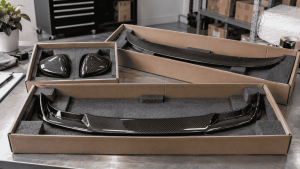
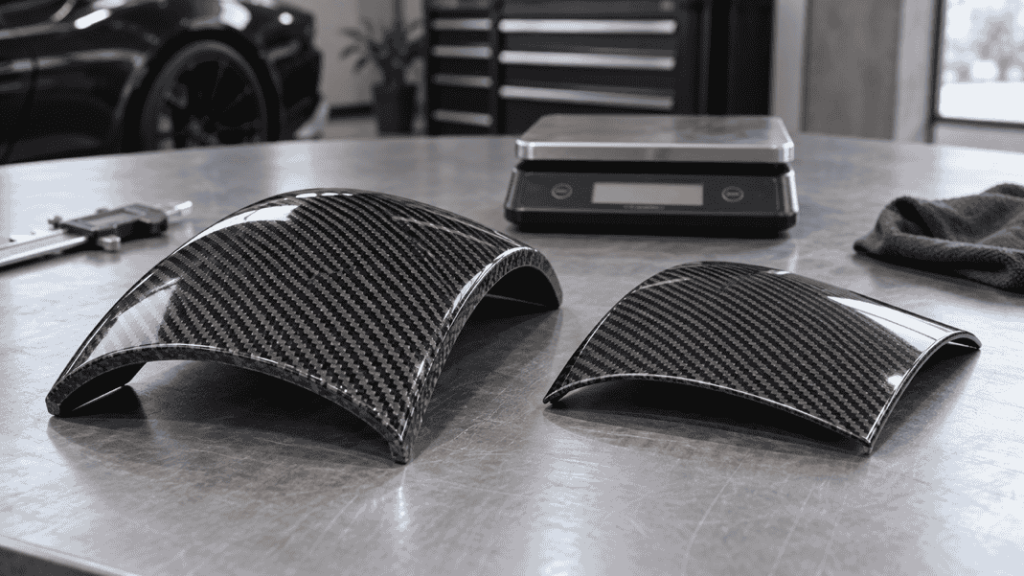
A customer points to two similar front lips and asks why one costs more. Both have a visible carbon weave, both suit the look of the build, and one is described as “dry carbon.” What does that difference actually buy them?
When explaining dry carbon vs wet carbon, separate the manufacturing process from the finished product’s measured weight, construction, fitment and price. The label alone does not establish how much lighter a part is, how well it fits or whether it is the right choice for the customer.
For tuning shops, the useful answer starts with the customer’s goal. Are they buying the appearance, reducing weight, matching existing trim or selecting a part for a documented performance requirement? Each calls for a different comparison.
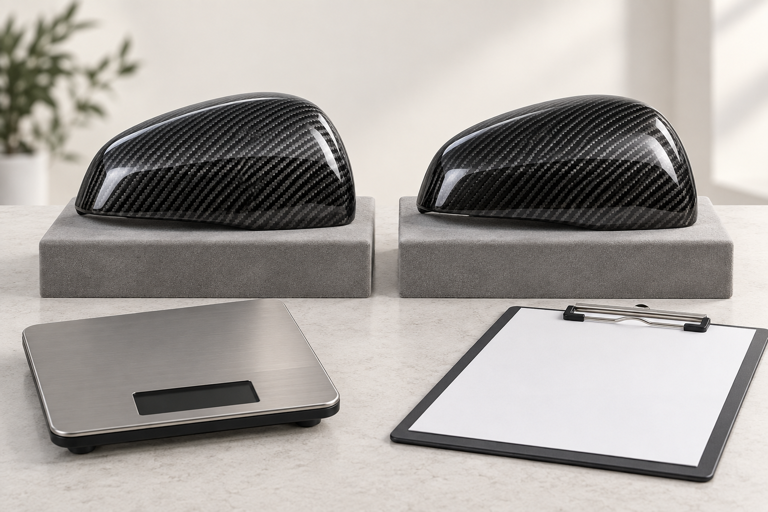
AI-generated comparison concept. These are not measured product samples, and their appearance does not identify a manufacturing process.
What do “dry carbon” and “wet carbon” mean?
In aftermarket product descriptions, “dry carbon” commonly refers to a part made using prepreg carbon fiber. Prepreg is reinforcement that already contains resin before it is laid into the mold. The word “dry” does not mean the finished composite contains no resin.
“Wet carbon” commonly refers to wet lay-up, where liquid resin is applied to the reinforcement during manufacture. Gurit’s Guide to Composites describes hand impregnation and notes that resin content and laminate quality depend strongly on the process and operator.
Treat the retail terms as a starting point. Ask what manufacturing method and construction the supplier actually means. Resin infusion is another process and should be identified explicitly rather than forced into a simple dry-versus-wet label.
Prepreg does not automatically mean autoclave-cured
Suitable prepreg systems can be cured using an oven and vacuum rather than an autoclave. Easy Composites explains this distinction in its introduction to out-of-autoclave prepreg.
If a customer specifically wants an autoclave-cured part, request confirmation for that product. “Dry carbon,” “prepreg” and “autoclave-cured” should not be treated as interchangeable claims.
A practical comparison for the sales counter
| Customer question | What to explain | Evidence to request |
|---|---|---|
| What is the process difference? | Prepreg contains resin before lay-up; wet lay-up introduces liquid resin during manufacture. Confirm the actual method. | Product-specific process declaration |
| Which is lighter? | Compare finished parts with equivalent geometry, construction scope and supplied components. | Measured weights and measurement scope |
| Which is stronger? | A process label alone cannot rank finished parts. | Relevant test results and stated use requirements |
| Will they look different? | Weave, coating and finish need their own comparison. | Current photos or samples under comparable lighting |
| Which fits better? | Fitment must be checked for each product version. | Bumper application, mounting information and test-fit evidence |
| Why is one more expensive? | Ask which differences are included in the quote. | Confirmed construction, process, finish, hardware and pricing basis |
Avoid presenting this as a universal ranking of “good” and “bad” carbon fiber. Recommend the product that meets the agreed requirements with evidence to support the claim.
1. Explain weight using comparable finished parts
If weight reduction matters, ask for measurements of the exact versions under consideration. Comparing a replacement shell with a decorative cover, or a bare part with a kit containing brackets, can produce a misleading result.
Check that the comparison identifies:
- The same intended vehicle application and comparable design.
- Whether each part is a replacement component or an add-on cover.
- The construction, including any backing materials or core.
- Whether clear coat, mounting hardware and accessories are included in the weight.
- Whether the figure is an actual sample measurement or a stated specification.
Where the scope differs, explain it before using the number in a recommendation. Do not promise a fixed percentage weight saving for every dry carbon part.
A useful customer response is: “If weight is your priority, let’s compare the finished weights of these two versions with the same included components. The material label alone does not give us that difference.”
For a small decorative piece, the customer may value appearance or fit more than a modest measured weight difference. For a larger component, the same comparison may carry more weight in the buying decision. Let the actual figures guide the discussion.
2. Explain strength and performance without overclaiming
“Stronger” needs a defined meaning. Stiffness, resistance to a particular load and impact behavior are different requirements. A part’s design, reinforcement arrangement, resin system, construction and mounting all need consideration; the retail process label is not a performance test.
For a customer asking about track use or aerodynamic loads, request evidence relevant to the actual product and mounting arrangement. Do not infer downforce, speed capability or damage resistance from a carbon weave or a prepreg description.
If the available information covers appearance and fitment only, say so. A clear statement of what is verified is more useful than a performance promise that your shop cannot substantiate.
3. Separate finish from manufacturing process
Dry carbon does not mean matte, and wet carbon does not mean glossy. Surface appearance is not a reliable way to identify how the laminate was made.
When matching a customer’s existing parts, compare the visible weave pattern, direction, coating appearance and gloss level. Ask for current photos under comparable lighting, or evaluate samples where matching is important.
Also confirm what sits behind the visible carbon surface. A carbon-faced component with another backing material, an overlay and a replacement laminate are different constructions. The visible weave alone does not tell the buyer which one they are receiving.
For exterior parts, ask separately about the specified coating and care instructions. Do not promise a universal resistance to yellowing, scratching or weathering based on “dry” or “wet.”
4. Explain the price difference in terms the customer can assess
Prepreg processing can involve controlled material storage and handling, suitable tooling, vacuum equipment and a controlled heat cure. An autoclave, where used, adds a different equipment requirement. These are possible cost drivers—not proof that every higher-priced part uses the same process. Easy Composites’ process overview describes these manufacturing requirements.
For the actual quotation, ask what differs between the two products. The price gap may also reflect design, construction, finish, included hardware, order quantity or commercial terms.
Compare the same purchasing scope: product price, included accessories, shipping and installation requirements. A cheaper part that needs different installation work is not the same offer as a more expensive complete kit.
A useful explanation is: “This version costs more, but we should identify what the extra price covers. If the confirmed weight, construction or finish matters to your build, we can assess the premium against that benefit.”
Match the recommendation to the customer’s goal

AI-generated product-selection concept. The objects are not actual catalog specimens or evidence of a particular process.
| Customer priority | What your shop should compare first |
|---|---|
| Carbon appearance within a budget | Correct fitment, finish, construction disclosure and complete installed price |
| Matching existing carbon parts | Weave appearance, coating and finish consistency using comparable references |
| Measurable weight reduction | Equivalent finished-part weights and the scope of each measurement |
| A specified manufacturing process | Written confirmation of prepreg, cure method and relevant construction details |
| A performance-focused build | Product-specific engineering or test evidence and mounting requirements |
| Repeat customer installations | Version consistency, installation documents, sample findings and reorder identification |
For an appearance-led customer, either process may be worth considering if the finished product meets the requirements. For a weight-led customer, use measured differences. For a buyer who specifically requires a documented process, confirm that process before recommending the item.
Availability matters too. Do not assume every style is offered in both dry and wet carbon. Review the relevant product options and specifications before promising a comparison or alternative.
What our catalog labels can—and cannot—tell you
Our catalog uses dry carbon and wet carbon labels on selected product entries. Those labels help identify options for enquiry; they are not a substitute for a product-specific process description or a measured comparison.
A catalog entry does not, by itself, establish finished weight, laminate construction, cure method or tested performance. Nor does it prove that two similarly named entries are identical apart from the process.
Send the exact product links or marked catalog references when requesting a comparison. If only one version is available, evaluate that product against your customer’s requirements rather than inventing a second option.
A short explanation your team can use
“Dry carbon usually refers to prepreg manufacturing, while wet carbon usually refers to wet lay-up. Both terms need confirmation for the particular product. For your car, we’ll compare the actual fitment, construction, finish, measured weight where available, and complete price. If weight saving is your goal, we’ll need comparable measurements; if appearance is the priority, we’ll focus on fit and finish within your budget.”
Follow that explanation with the customer’s specific question. Avoid turning a short buying conversation into a manufacturing lecture when the decision is really about a matching finish or an installation budget.
Frequently asked questions
Is wet carbon real carbon fiber?
A wet lay-up part can contain genuine carbon fiber reinforcement. Ask for the actual construction, including any other reinforcement or backing materials. A wet-carbon label alone does not describe the complete laminate.
Is dry carbon always lighter?
Do not assume that across different designs or constructions. Compare the exact finished versions under the same measurement scope before quoting a weight advantage.
Does dry carbon always mean autoclave production?
No. Prepreg systems suitable for out-of-autoclave processing exist. Request the cure method for the selected product if it is a buying requirement.
Can I tell dry and wet carbon apart from a photo?
Not reliably. Gloss, weave and surface appearance do not establish the manufacturing route. Ask for product-specific information.
Should every customer choose the more expensive version?
No. Recommend according to the customer’s goal and the verified differences. An unmeasured or irrelevant benefit is a weak basis for an upgrade.
Request a process and price comparison for your selected parts
Send a product comparison enquiry with the exact versions you are considering. Ask for confirmed information and have missing data identified clearly.
Copy and complete:
- Workshop name and delivery country:
- Vehicle model, year and relevant configuration:
- Part type and product links or catalog references:
- Customer priority: appearance / weight / specified process / budget / other:
- Preferred weave and finish:
- Required quantity:
- Requested comparison: construction, process, cure method, finished weight, fitment evidence, included hardware and price:
If evaluating samples before a larger order, use our carbon fiber sample inspection guide to document the checks. A useful recommendation connects the customer’s goal to confirmed product differences—and makes any remaining uncertainty clear before purchase.