
The first sample looks good. The quotation fits your budget. But can the supplier deliver the same version again, explain a fitment issue and give you a realistic replenishment date when a customer is waiting?
When choosing a carbon fiber parts supplier for dealers, evaluate repeat supply, product documentation and issue resolution alongside price and sample quality. A broad catalog helps you find options; it does not prove current stock, production capacity or consistent delivery.
This guide is for tuning shops, independent parts dealers and distributors building an aftermarket range. It explains what to request, how to assess the evidence and how to use an initial order to decide whether a longer-term relationship makes sense.

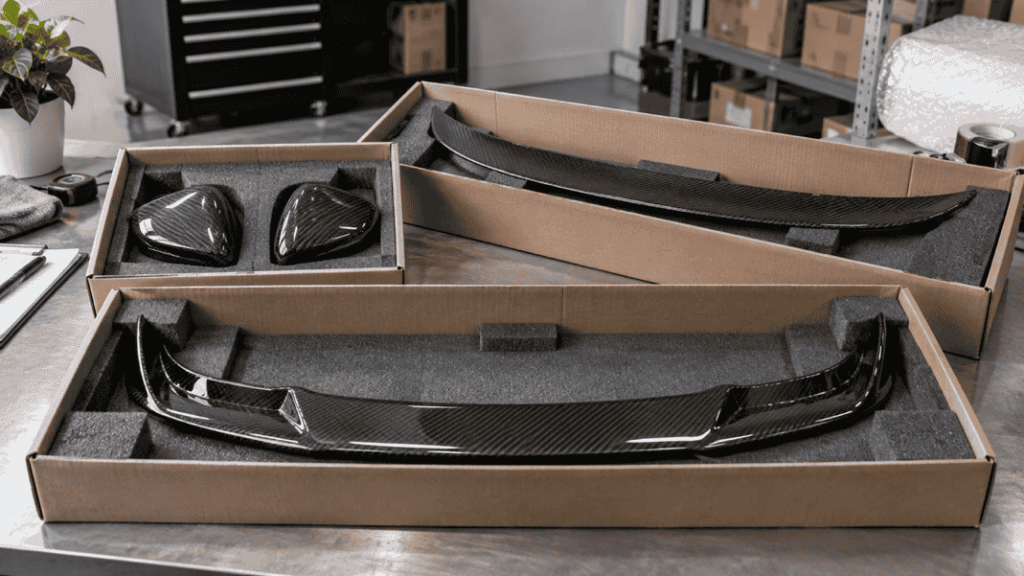
AI-generated supplier-review concept. This is not a photograph of our facility, inventory or capability records.
Start with your own purchasing requirements
Before contacting suppliers, define the products and support your business needs. A shop buying parts for scheduled customer builds has different priorities from a distributor maintaining inventory across several platforms.
| Buyer | Priorities to establish |
|---|---|
| Tuning shop or installation studio | Exact fitment, installation information, job-specific timing and technical support |
| Parts dealer or online reseller | Accurate listing data, approved marketing assets, stock information and a clear claims process |
| Distributor | Repeat-order consistency, replenishment terms, traceability and agreed channel arrangements |
Prepare a shortlist of vehicle platforms and part types, likely order quantities, delivery destinations and the information your customers expect. Treat forecasts as planning estimates rather than commitments unless you explicitly agree otherwise.
Review the available product catalog and use exact product references in your enquiry. Comparing suppliers against the same shortlist is more useful than comparing the number of pages in their catalogs.
1. Verify the company and its actual role
Ask for the legal business name, operating address, sales contact and the entity that will issue the quotation and invoice. Clarify whether you are dealing with a manufacturer, a trading company or a business combining both roles.
Neither a factory claim nor a trading-company label settles the decision. What matters is knowing who is responsible for production, inspection, export coordination and resolving problems with your selected products.
Request a current capability overview explaining which activities are performed in-house and which are outsourced. A facility visit, relevant live walkthrough or independent assessment can help investigate important claims when justified by the planned relationship. A promotional factory video alone does not establish who operates the equipment or makes the parts you are buying.
The U.S. International Trade Administration recommends due diligence on prospective foreign business partners. For a supplier review, combine business-identity checks with product and order evidence rather than relying on one document or presentation.
2. Check whether the catalog is usable for real orders
A reliable ordering reference needs more than a vehicle name and a front-facing photo. For the products on your shortlist, request:
- Stable product references and a way to identify revisions.
- Confirmed vehicle applications and relevant exclusions.
- Material and construction descriptions, including finish options.
- Actual product photos, including mounting areas where relevant.
- Included components and available installation information.
- Current availability status and the date it was confirmed.
Distinguish listed in the catalog, currently in stock, available to produce and under development. Those are different answers to a customer’s delivery question.
Also ask how changes and discontinued products are communicated. If two versions share a similar name, your team needs a way to order the approved one again. A screenshot can help identify a product initially, but a confirmed reference and written specification make reordering clearer.
3. Match capability claims to your product range
A supplier may be able to make one type of carbon component without having equivalent evidence for every other category. Ask about the selected parts, rather than accepting a single factory-wide claim as proof of everything in the catalog.
| Claim | Useful supporting information |
|---|---|
| “We manufacture these parts” | Relevant process description, production responsibility and product-linked evidence |
| “We can support your volume” | Capacity basis for the selected products, current scheduling constraints and proposed order timing |
| “Fitment is confirmed” | Vehicle configuration, product revision and relevant test-fit documentation |
| “Quality is controlled” | Inspection scope, acceptance criteria, example records and traceability method |
| “Repeat orders will match” | Version identification, approved reference and change-notification process |
If a supplier provides a capacity figure, ask what it measures: which products, what period and what assumptions. A company-wide output number does not establish how many of your chosen front lips can ship next month.
For material claims, request product-specific information. Our dry vs wet carbon fiber guide explains why a material label alone cannot establish finished weight, construction or performance.
4. Evaluate quality records as well as the sample
Request a sample plan with agreed checks for the products you intend to stock or install. Use the sample to examine appearance, interfaces, accessories and the fitment scope you can actually evaluate.
Then ask how those findings will become requirements for production orders. Look for a clear link between the approved sample or specification, the order reference and the inspection record.
If certifications are presented, check the named organization, site, scope and current status through the issuing body or an appropriate verification channel. ISO explains that management-system certification is distinct from product certification. An ISO 9001 claim does not by itself certify a particular grille’s fitment or a spoiler’s performance.
For a structured evaluation record, use our carbon fiber sample inspection guide. An attractive sample is useful evidence about that sample; it is not a substitute for an agreed bulk inspection process.
5. Test the replenishment process

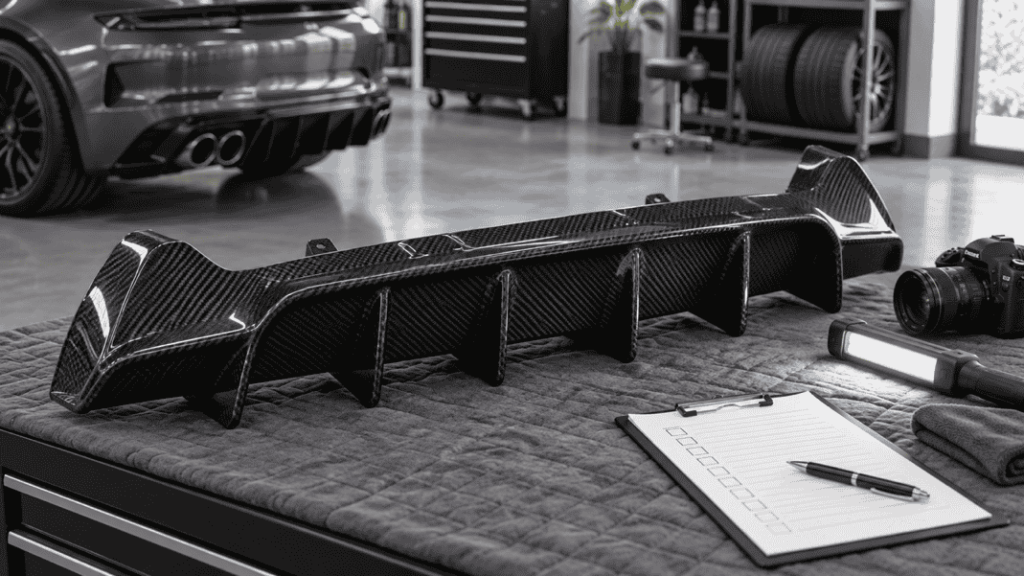
AI-generated comparison concept. These are not documented production batches or evidence of repeat-order consistency.
Before committing to a wider range, ask how a repeat order would be handled. Specify the approved product reference and find out whether the same construction, finish, included parts and packaging will be supplied.
Confirm:
- Whether the product is stocked or made to order.
- What triggers the quoted lead time, such as order confirmation or another agreed milestone.
- Whether the date refers to production completion, dispatch or delivery.
- How delays and proposed substitutions will be communicated.
- Whether split shipments are possible and how extra costs would be quoted.
- How changes to the product or its availability are approved before supply.
Where practical, evaluate a repeat purchase before making a large stock commitment. Compare the second delivery with the agreed reference and record any differences. One repeat order does not prove future reliability, but it gives you more information than a single sample.
Do not promise your customer a delivery date based on a general website statement. Obtain a current commitment for the selected products and quantity.
6. Agree what happens when something goes wrong
Ask the supplier to explain the process for shipping damage, missing items, finish concerns and suspected fitment problems. These issues may need different evidence and different responses.
A useful written arrangement identifies:
- The contact responsible for receiving the report.
- The information and photos required, and any reporting deadline.
- What should happen before modifying, installing or returning the part.
- How the issue is assessed and how the response is communicated.
- Available remedies and who pays associated shipping or other agreed costs.
- How a recurring problem is recorded and addressed in later orders.
Do not assume that a replacement part also covers installation labor, return freight or a customer’s downtime. Clarify those boundaries before selling the product under your own promises.
If the supplier can share an anonymized example of a resolved issue, review the sequence and evidence. You are looking for a workable process, not a claim that problems never occur.
7. Check the support needed to sell the range
For a dealer or distributor, product information becomes part of your own customer experience. Ask whether the supplier can provide current specifications, fitment exclusions and updates in a format your team can maintain.
Confirm permission to use product photos, videos and descriptions. Do not assume images supplied in a catalog are cleared for every advertising or resale use. Establish who will notify you when a listing needs correction.
Discuss any required packaging, labels, replacement sections or direct-to-customer shipping separately. Availability should be confirmed rather than inferred from a general “dealer support” offer.
If territorial exclusivity or other channel arrangements matter, define the products, territory, duration, purchase obligations and review conditions before relying on the arrangement. Buying wholesale does not automatically make your business an exclusive distributor or an authorized vehicle-brand dealer.
Use a staged supplier decision
| Stage | Evidence to review | Decision |
|---|---|---|
| Initial screening | Company identity, relevant catalog and capability information | Does the supplier merit further evaluation? |
| Product evaluation | Samples, specifications, fitment scope and agreed criteria | Are the selected versions acceptable for the stated purpose? |
| Trial order | Order accuracy, actual timing, packaging and communication | Does the supplier handle an ordinary order as agreed? |
| Repeat purchase | Version consistency, replenishment and issue follow-through | Is there enough evidence to expand the relationship? |
Mark each requirement as supported, needs clarification or not met, with a link to the evidence. Define your must-have requirements before comparing suppliers. A low price should not cancel out an unresolved requirement that is essential to your business.
For quantities, samples and mixed-model terms, see our wholesale ordering guide.
Frequently asked questions
Is buying directly from a factory always better?
Not automatically. Verify the actual role, product control, communication and responsibility for problems. Evaluate the arrangement that meets your requirements with clear evidence.
Does a large catalog mean products are ready to ship?
No. Confirm current availability and lead time for the exact items and quantities. A catalog listing alone is not a stock commitment.
Is one good sample enough to approve a supplier?
It supports evaluation of that item. Review production acceptance, order handling and repeat supply separately before making broader commitments.
What should I request before applying for dealer pricing?
Provide your business type, target vehicles, shortlisted products, expected quantities and destination. Ask for the relevant catalog, specifications, sample terms and the information available to support your supplier review.
How should I compare prices?
Use the same product scope, quantity, included components and delivery basis. Then consider inspection, installation support and issue-resolution terms alongside the quoted price.
Request the catalog and supplier capability information
Send a wholesale cooperation enquiry with the range you want to evaluate. Ask which capability and quality records are available for those products, and have any missing information identified clearly.
Copy and complete:
- Business name, website and country:
- Business type: tuning shop / parts dealer / distributor:
- Target vehicle platforms and part categories:
- Selected product links or catalog references:
- Expected trial quantities and indicative reorder needs:
- Delivery destination and required timing:
- Required fitment, installation and quality information:
- Marketing assets or channel support needed:
Please provide, where available: the current relevant catalog, company and manufacturing-role information, product specifications, sample terms, inspection-record examples, replenishment terms and issue-reporting process.
Use the response to identify what is confirmed, what needs clarification and which products are suitable for a focused first evaluation.