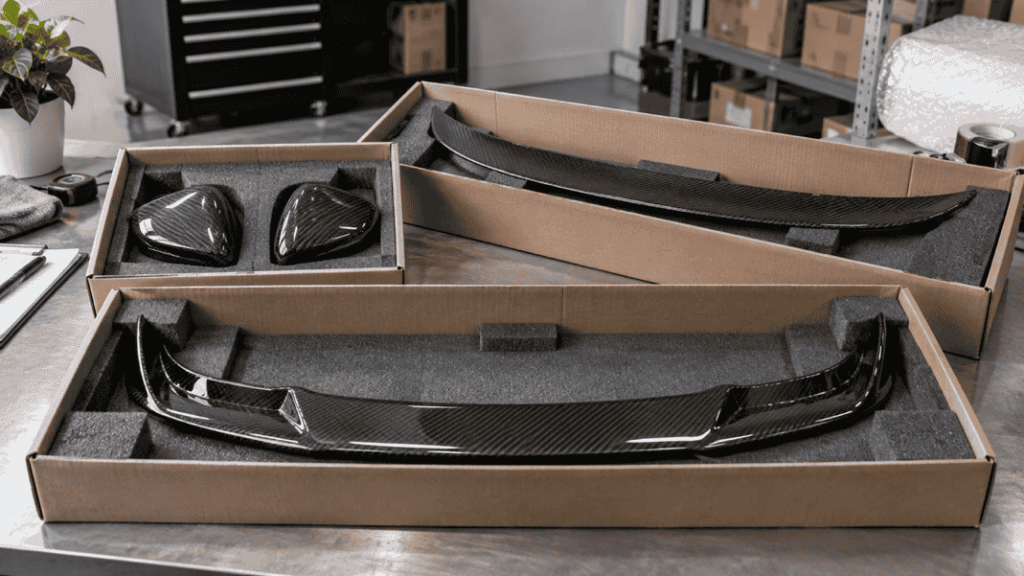
A carbon fiber sample arrives with a glossy finish and an attractive weave. It looks ready for your showroom—but does it match the ordered specification, fit the intended vehicle and include everything your installer needs?
For distributors and tuning shops, carbon fiber sample inspection should cover product identity, appearance, mounting interfaces, accessories and the agreed fitment checks. Record what you checked, how you checked it and what remains unverified. Then agree which findings will become requirements for the wholesale order.
A sample gives you evidence about the item in front of you. It does not, by itself, prove that every part in a future shipment will match it.
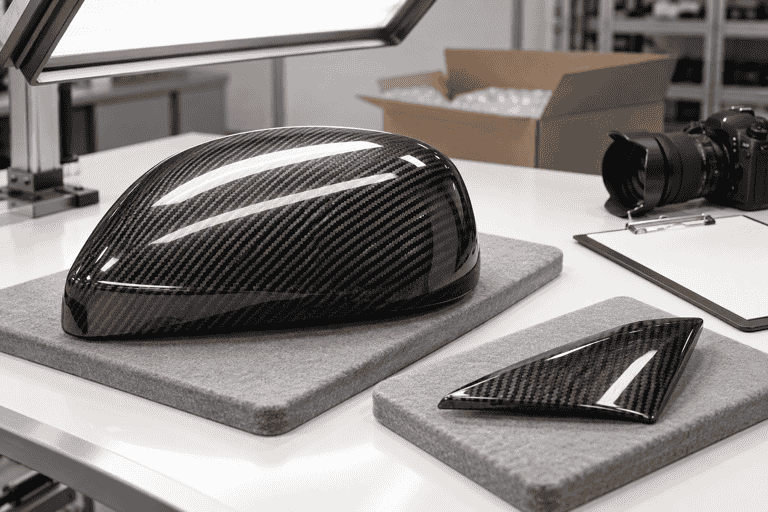
AI-generated inspection concept. This image does not show an actual inspection, approved sample or factory quality record.
1. Define the inspection scope before the sample ships
Start with the exact product you intend to evaluate. Record the product reference, vehicle application, material specification, finish, revision if applicable, and whether the order unit is a piece, pair or complete kit.
Ask whether the sample represents the version intended for future supply and whether any known differences will apply to the bulk order. A demonstration piece or an older revision needs to be identified as such.
Agree the following before inspection:
- Which surfaces and features will be evaluated.
- Which dimensions matter and where they will be measured.
- What vehicle or fixture will be used for fitment checks, if any.
- What hardware, instructions and packaging should be supplied.
- Which acceptance requirements apply and how observations will be recorded.
- How unresolved findings will be handled before approval.
Choose the relevant items from our carbon fiber parts catalog and include their references in your sample request. Each selected product needs its own inspection scope; a mirror-cap sample cannot establish the quality of a front lip or hood.
2. Record the package and product identity on arrival
Photograph the carton, labels, internal protection and sample before discarding packaging or starting installation. If there is visible damage, take both an overall view and a close-up that shows its location.
Match the received part to the quotation or packing list. Check the reference, finish, left/right orientation and number of sections. Keep the packaging record separate from product observations: a damaged carton and a scratched part may be related, but photographs alone may not establish the cause.
Give the sample a unique inspection ID. Use that ID on the report and photo filenames so the findings remain linked to the correct item.
3. Inspect appearance under repeatable conditions
Use consistent lighting, viewing angles and background conditions when comparing samples. Record whether protective film is present and follow the agreed handling instructions before removing it. Avoid polishing or repairing a mark before documenting it.
Review the visible surfaces systematically rather than judging only the most prominent area.
| Area | What to record | What to agree with the supplier |
|---|---|---|
| Surface finish | Scratches, haze, embedded particles, pinholes or uneven appearance | Which observations are acceptable, on which surfaces and under what viewing conditions |
| Weave appearance | Direction, visible joins and appearance around curves | The approved appearance reference and permitted variation |
| Edges and openings | Chips, rough trimming or visible damage | Required edge finish and any areas needing further evaluation |
| Matching pairs or sets | Differences in finish, weave direction or visible color | Whether matching or mirrored appearance is required |
| Rear surfaces | Visible condition and finish of non-display areas | Which areas are cosmetic and which form functional interfaces |
Describe observations precisely: “small mark beside the outer corner, photo 04” is more useful than “poor quality.” Include a scale in a close-up where size matters, without scratching or loading the part.
There is no single cosmetic threshold that can be assumed for every carbon fiber product. Agree the viewing conditions, relevant surface zones and acceptance limits for the specific order. Do not silently treat a visible variation as acceptable—or reject it against a requirement that was never defined.
Visual appearance alone cannot verify laminate integrity, material composition or structural performance. If those properties are part of the purchasing requirement, agree the appropriate documentation or testing separately. Suspected cracks, separation or damaged attachment features need further assessment before approval or installation.
4. Check interfaces and dimensions without modifying the sample
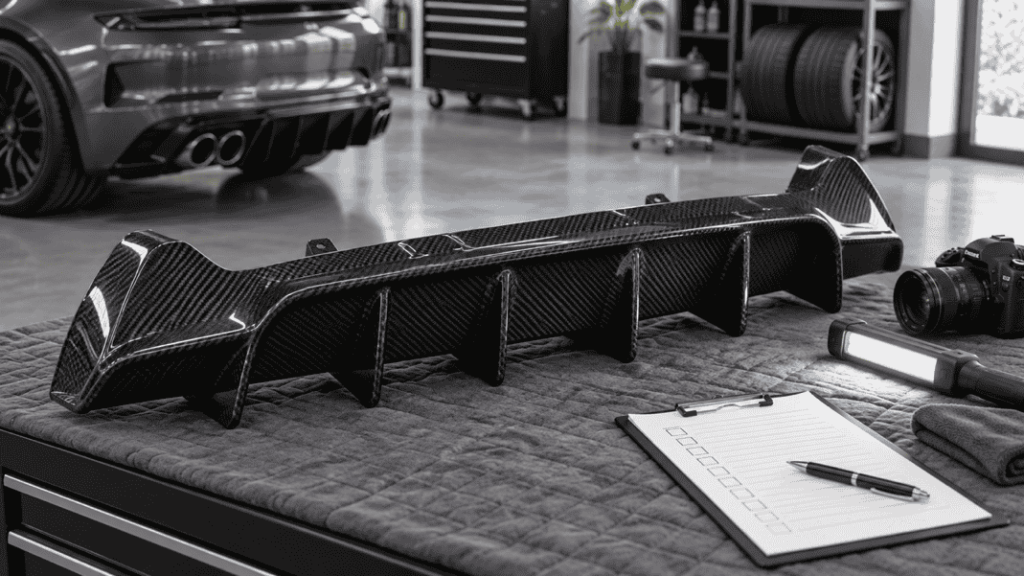
Turn the part over and inspect the areas that contact or attach to the vehicle. Depending on the product, these may include flanges, clips, tabs, holes, inserts or bracket interfaces.
Compare them with the supplier’s product-specific information. Record any missing, damaged or unexplained feature. Do not assume a hole is correctly positioned simply because it is present.
For dimensional checks, use agreed reference points and suitable measuring equipment. Record the actual result, the required value or range, the unit and the measurement method. If the requirement has not been supplied, mark it as unresolved rather than inventing a tolerance.
Avoid forcing a flexible part into a preferred shape to obtain a measurement. For long or curved components, clarify how the part should be supported during checking.
| Product type | Useful checks to include in the agreed scope |
|---|---|
| Front lips and side skirts | Mounting interfaces, section alignment and installed projection or clearance where relevant |
| Mirror caps | Correct side, replacement-versus-cover design, attachment features and relevant housing compatibility |
| Rear diffusers | Intended bumper configuration, attachment interfaces and compatibility with the actual exhaust arrangement |
| Spoilers and wings | Mounting surfaces, supplied bases or brackets and product-specific installation requirements |
| Interior trim | Intended location, contour and specified attachment method |
These are inspection prompts, not universal acceptance criteria or instructions for installation.
5. Verify accessories and carry out the agreed fitment check
Lay out the supplied hardware and compare it with the agreed contents list. Record quantities and part descriptions for fasteners, brackets, spacers, templates or other supplied items. Where tapes or adhesives are specified, confirm the required product and application instructions rather than assuming anything supplied is interchangeable.
For a workshop, arrange a non-destructive trial fit where the product and instructions allow it. Record the vehicle model, year, relevant bumper or component version, and existing modifications. Photograph the center and both ends or sides where applicable.
For a distributor without access to the vehicle, record fitment as not checked. Request relevant supplier evidence or arrange an installer evaluation before representing it as verified.
Do not drill, trim, bond or otherwise modify the sample to resolve an unexplained mismatch before documenting it and discussing it with the supplier. Permanent changes may affect later evaluation and the agreed remedy process.
A successful trial fit supports the recorded vehicle-and-product combination. It does not automatically confirm all years, trims or related models.
6. Turn observations into a sample approval record
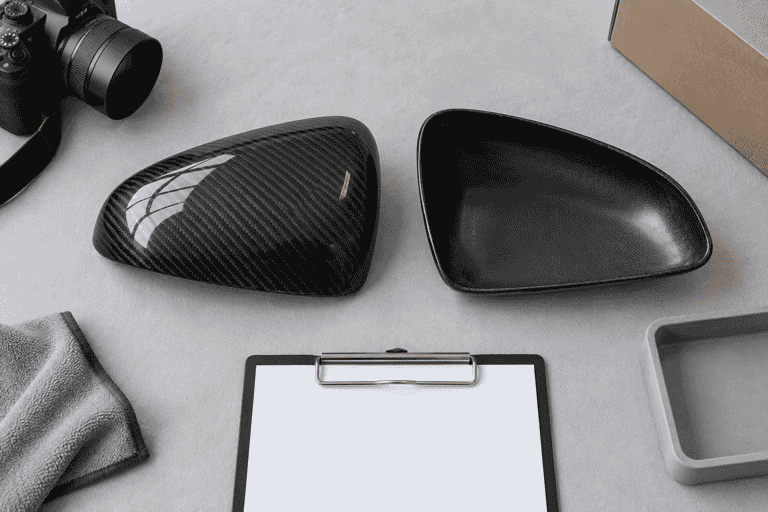
AI-generated documentation concept. The illustrated underside is generic and is not a mounting reference or a completed approval record.
Use a written record that separates the requirement from the observation and the decision.
| Record field | What to enter |
|---|---|
| Sample identity | Inspection ID, product reference, revision, material and finish |
| Agreed requirement | Specification, reference photo or written criterion for the check |
| Method and conditions | Lighting, reference points, equipment or trial-fit vehicle |
| Observation | Actual measurement or description, with photo references |
| Result | Meets agreed criterion / does not meet / not checked / needs clarification |
| Action | Clarification, correction, replacement evaluation or other agreed next step |
| Final disposition | Approved for stated scope / pending / not approved |
| Confirmation | Buyer and supplier names, dates and document revision |
If appearance is acceptable but fitment has not been checked, say exactly that. “Approved for appearance only; fitment pending” is clearer than an unrestricted “sample approved.”
Where practical, retain the identified physical sample as a reference, along with the agreed photographs and specification. Agree who will keep it and how its identity and condition will be maintained. Photos help document appearance, but camera settings and screens can affect comparisons of color and gloss.
Approval should identify any exclusions and outstanding actions. A requested correction is not complete until the revised evidence or replacement sample has been reviewed as agreed.
7. Agree how the bulk order will be inspected
A reference sample helps define the expected product. A bulk inspection plan defines how the shipment will be checked against that expectation. Both are needed when consistency matters to your resale or installation business.
Before the wholesale order, agree:
- The product references, revisions and specifications covered.
- How inspection lots will be identified, particularly for mixed-model orders.
- Which checks apply to every item and which use an agreed sampling plan.
- How nonconformities will be classified and recorded.
- The acceptance and rejection rules and who authorizes shipment release.
- How changes to materials, finish, tooling or supplied accessories will be communicated and reviewed.
- The reporting and resolution process for issues found before shipment or on arrival.
If statistical acceptance sampling is appropriate, specify the actual plan rather than writing only “AQL inspection.” The ISO 2859 series describes acceptance-sampling systems for inspection by attributes. Referencing a standard does not itself establish a supplier’s certification, your chosen inspection settings or a guarantee that every item is defect-free.
Do not use approval of one hand-selected evaluation sample as acceptance of a later production lot. Keep sample approval and shipment inspection as separate records linked to the same agreed specification.
Frequently asked questions
What should I inspect first on a carbon fiber sample?
Confirm identity and shipping condition first. Then check appearance, interfaces, dimensions and accessories against agreed requirements, followed by the fitment evaluation included in your scope.
Can I approve a sample from photos alone?
Photos can support review of visible features. They do not establish dimensions, hidden condition or physical fitment on their own. Record the limits of any photo-only approval.
Does an attractive weave prove the part is high quality?
It supports an appearance assessment, but it does not establish material composition, internal condition, mounting accuracy or performance. Evaluate those requirements separately where relevant.
Should all cosmetic marks be rejected?
Apply the agreed criteria for the relevant surface and viewing conditions. If no criterion exists, document the observation and resolve it before approval rather than assuming a universal pass or fail rule.
Does approving a sample guarantee the bulk order will match?
No. Define the approved specification and change-control requirements, then agree how production shipments will be inspected. The sample is a reference, not a substitute for batch acceptance.
Request a sample and confirm the inspection scope
Ready to evaluate parts for your shop or distribution business? Send a sample enquiry with the product references and checks that matter to your business. Request confirmation of sample availability, charges and the information available for evaluation before ordering.
Copy and complete:
- Business name, country and delivery postal code:
- Product links or catalog references:
- Vehicle application and relevant configuration:
- Requested material, finish and sample quantity:
- Intended checks: appearance / dimensions / interfaces / accessories / fitment:
- Vehicle or fixture available for fitment evaluation:
- Required specifications, reference images or supporting records:
- Proposed acceptance criteria and any unresolved requirements:
- Expected wholesale order scope after evaluation:
Ask which checks and records can be provided, what remains unverified, and how the sample findings will be confirmed before a bulk order. For ordering terms, see our guide to samples, MOQ and mixed-model orders.