
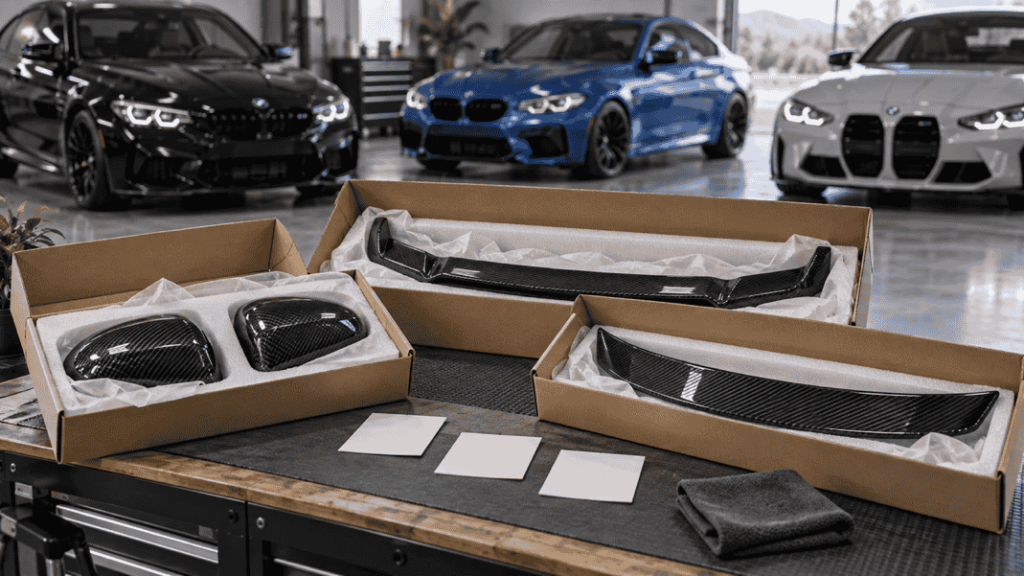
For G80/G82 one-piece vs three-piece carbon front lip sourcing, the key commercial question is whether the supplier actually supports separate replacement sections. A three-piece design does not automatically mean you can buy one section later, and a one-piece design is not automatically cheaper or more expensive over the customer’s ownership period.
Compare the complete order now and the replacement scenario you may need later. That gives tuning shops and distributors a stronger basis for choosing than part count alone—and a more honest answer when a customer asks, “What happens if I damage one side?”
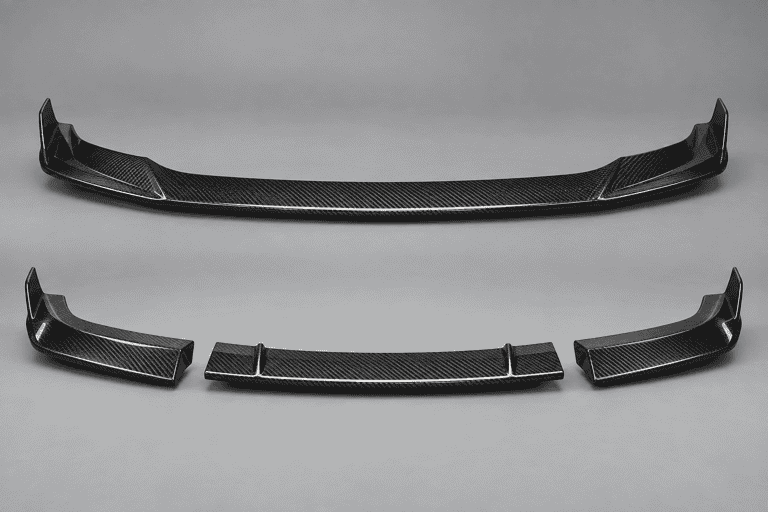
AI-generated comparison of generic designs; not an actual SKU, interchangeability diagram or installation reference.
Treat construction and supply policy as separate facts
Our G80/G82 catalog includes one-piece and three-piece front-lip descriptions, with different style and material labels. Those descriptions identify options to investigate. They do not establish the contents of every shipment, cross-version compatibility or a spare-parts commitment.
Ask the supplier to identify the exact assembly reference, revision, material description, finish and included parts. For a three-piece option, confirm which components make up the complete lip and how each is identified. For a one-piece option, confirm the complete assembly and any separate mounting accessories.
A style nickname is not enough to reorder a component months later. Use an actual supplier reference and record the accepted revision.
Compare the questions that affect a buying decision
| Buying question | One-piece option | Three-piece option |
|---|---|---|
| What is included? | Confirm the complete lip and accessories | Confirm all sections, joining/mounting items and accessories |
| Can one damaged area be replaced separately? | Ask what replacement options exist | Ask whether sections are sold individually; do not assume |
| What must match a previous order? | Application, revision, finish and attachment arrangement | Those details plus the interfaces between sections |
| What will freight cost? | Quote the actual packed assembly | Quote the actual packed kit and any available spare section |
| How much installation work is involved? | Review the specific instructions | Review the specific instructions, including assembly requirements |
| Is one design stronger or easier to install? | Needs product-specific evidence | Also needs product-specific evidence |
Do not turn this into a universal ranking. Choose according to confirmed fitment, the customer’s priorities and the actual terms offered for each product.
Confirm fitment before comparing replacement economics
Identify the customer’s G80 M3 or G82 M4, model year, bumper and existing modifications. Use the front-lip fitment guide to collect the right photos and product information.
A favorable spare-section price is not useful if the original assembly has not been confirmed for the vehicle. Likewise, a replacement section with a similar outline may not join the existing parts correctly.
Ask for the installation information relevant to the selected product. Do not assume three pieces mean faster fitting, or that a one-piece design avoids separate hardware. Quote labor from the actual scope your installer has reviewed.
For customers adding side skirts to the same G80/G82 build, check the side-skirt body version and pair contents separately; front-lip construction does not settle the application of the rest of the package.
Ask these spare-section questions before the first order
Request a written response for each candidate three-piece reference:
- Are vehicle-left, center and vehicle-right sections available separately?
- What are their order references and sales units?
- Are there different minimum quantities or prices for individual sections?
- Does the offered section match the revision of the original kit?
- What finish-matching information can the supplier provide?
- What happens if the original version is changed or discontinued?
Use vehicle-left and vehicle-right as viewed from inside the car facing forward. Avoid ordering only “driver side,” especially when supplying multiple steering markets.
If the answer is “complete kits only,” evaluate it on that basis. The product can still be suitable, but section replacement should not appear in your sales pitch as a benefit you cannot deliver.
Calculate the actual replacement scenario
For a complete replacement, compare the new assembly price, packing, freight and workshop removal/refitting scope. For a section replacement, if offered, compare the section price, its shipment, required accessories and the installer’s work to assess and replace the affected components.
Keep any necessary inspection of adjoining pieces or mounting areas in the scope. A visibly damaged center piece does not prove that every other part remains suitable for reuse. The technician must assess the actual condition using the relevant guidance.
Do not apply an invented damage frequency to make one design look cheaper. If your shop has reliable job records, use those records internally and disclose the basis of any numerical comparison you present.
Compare packed shipments, not bare components
A separate section may fit a different carton, but ask for the real packed dimensions and gross weight. The full three-piece kit may also be packed differently from what you expect.
DHL eCommerce’s chargeable-weight guidance illustrates why both dimensions and actual weight matter to its pricing. Confirm the rules and quote for the service you intend to use. Do not promise that splitting a lip into three sections automatically cuts freight.
Also check how delicate edges and attachment areas are protected. A smaller carton is not an advantage if the packaging is unsuitable for the part. Ask for the agreed packaging approach and issue-reporting process alongside the transport quote.
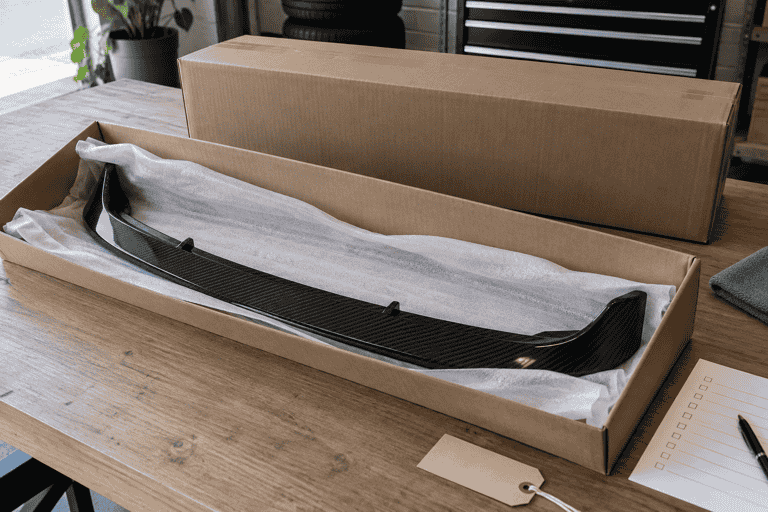
AI-generated packaging illustration; not confirmation that individual sections are available or cheaper to ship.
Plan for revision and finish differences
A section from a later revision may need a compatibility check even when its name is unchanged. Save photos and identifiers from the original order so the supplier can compare the requested replacement with something specific.
Appearance also matters. A newly supplied section should not be promised as a perfect visual match to an older installed assembly without review. Ask for current finish evidence and discuss any visible difference with the customer before ordering.
For distributors, link spare-section listings to the exact supported assembly references. If that relationship is not confirmed, do not create a generic “fits all G80/G82 lips” replacement listing. Your retail partners need a traceable application, not another ambiguous carbon part.
Copy this structure-and-spares inquiry
We are comparing one-piece reference [ ] and three-piece reference [ ] for BMW [G80 M3 / G82 M4], vehicle/bumper details attached. Please quote complete contents, material description, finish, mounting documents and packed shipment to [destination]. For the three-piece option, state whether left/center/right sections can be ordered separately, with references, minimum quantities, prices, revision compatibility and current supply estimates. Please identify any limitations on future matching or spare supply. Initial quantity [ ].
When comparing these designs in a first wholesale purchase, record each reference as a separate evaluation line using the BMW M mixed-model trial-order guide. Confirm the actual sample and minimum-order terms rather than assuming both structures share the same policy.
Frequently asked questions
Can every three-piece front lip be repaired by buying one section?
No. Separate sections must be offered for that exact product, and the remaining assembly must be suitable for the proposed replacement. Confirm both supply and installation requirements.
Is a one-piece lip stronger than a three-piece lip?
Part count alone does not establish strength. Compare documented product construction and relevant evidence rather than making a category-wide claim.
Can sections from different styles be mixed?
Do not assume compatibility. The interfaces, mounting arrangement and appearance need confirmation for the exact combination.
What should a shop save after the first installation?
Keep the supplier and assembly references, revision, finish, component identifiers, installation documents and actual photos. Those records make a later spare inquiry far more precise.
Ask about replacement support while you still have a choice
Compare the G80/G82 front-lip options, then request complete-kit and spare-section terms through our trade inquiry page. Get the answers before placing the first order. That is when your shop can choose a product around both today’s build and the support your customer may need later.