
Plan a BMW M3, M4 and M2 carbon fiber parts wholesale trial order around identifiable customer demand and specific products you need to evaluate. Ask for minimum quantities by product and finish, then confirm whether those lines can be combined. A mixed-model trial is a purchasing request—not a policy you should assume a supplier offers.
Your first order should answer useful business questions: Can the product be identified and supplied consistently? Does it suit the intended vehicle? Are the finish, contents and packaging acceptable? Can your team quote and install it with the information provided? Buying more styles than you can evaluate makes those questions harder to answer.
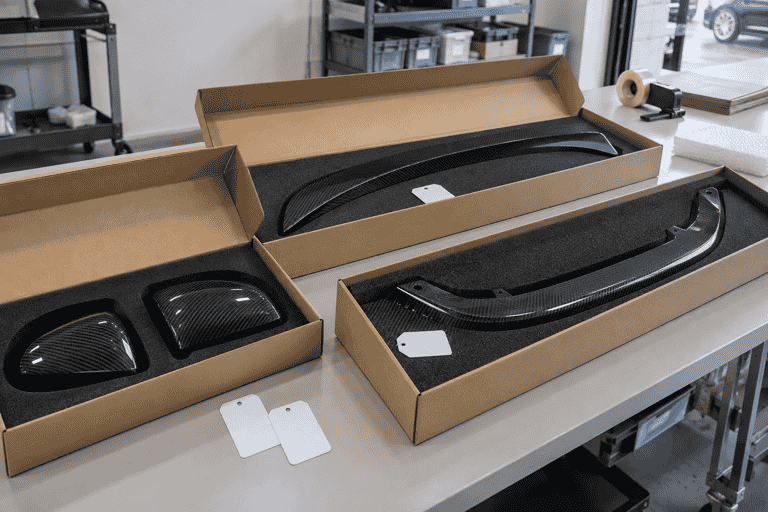
AI-generated packaging scene; not a real order, packaging commitment or confirmed mixed-order offer.
Give the first order one clear purpose
A tuning shop may be buying for several customer jobs already in its pipeline. A distributor may be checking product quality and listing information before launching selected references. Both can request a mixed-model order, but their evaluation priorities differ.
For customer jobs, begin with vehicle-specific fitment and complete delivery requirements. For a distributor trial, decide which products your team can actually inspect, photograph, document and—where needed—evaluate on an identified vehicle.
Do not treat one sample as proof of an entire BMW range. Keep the conclusion tied to the reference, revision and configuration you reviewed. Expanding a range can follow as evidence and customer demand build.
Sort candidate products by demand status
Use your own inquiries, quotes and order history rather than an invented universal best-seller list.
| Demand status | Example of the business question | First-order treatment |
|---|---|---|
| Named customer project | Which confirmed part completes this vehicle’s job? | Prioritize identification, timing and complete contents |
| Repeated qualified inquiries | Is this reference worth validating for several prospects? | Evaluate a specific product against recorded interest |
| Supplier or finish evaluation | Does this sample meet the agreed review criteria? | State what the sample is intended to test |
| General curiosity about a style | Is there any evidence we can sell it? | Keep it separate from customer-backed purchasing |
This is a planning method, not a recommended inventory ratio. You do not need to buy one of every BMW M part to create a useful trial.
Make every order line specific enough to quote
“M3 lip” or “M2 spoiler” leaves too much unresolved. Identify the chassis, body variant, product reference, finish, sales unit and requested quantity. Include customer vehicle details where the purchase is for a particular job.
The BMW M catalog contains several chassis groups. Do not combine G80/G82, G87, F8x and F87 into one compatibility statement. Even within a group, different bumpers, exhausts, trunks or steering configurations may matter to the selected part.
Ask the supplier to replace informal catalog names with current order references in the quotation. If two catalog entries appear similar, do not assume they are duplicate stock, different vehicles or different versions until the supplier identifies them.
Before submitting the list, resolve the variant questions for the products you selected. For G80/G82 lines, use the side-skirt application checklist and LHD/RHD mirror-cap checklist; for an F87 lip, check the original M2, Competition and CS bumper identification guide. These are separate fitment reviews, not evidence that the products share an application.
Ask MOQ questions at the right level
“Your MOQ?” is often too broad. Return this table for the actual candidate list:
| Condition | Supplier response needed |
|---|---|
| Minimum per product reference | Quantity and sales unit |
| Minimum per finish or material version | Whether variations have separate conditions |
| Overall order minimum | Any value or quantity requirement |
| Mixed-model eligibility | Which proposed lines may be combined |
| Sample terms | Price, availability and any separate conditions |
| Repeat-order minimum | Whether later purchases use the same terms |
| Replacement-part minimum | Conditions for ordering a needed component later |
A supplier may apply different rules to different lines. A small order accepted once should not be represented to your customers as a permanent supply policy. Obtain the actual quotation and conditions in writing.
Check whether combining items helps this order
One purchase order does not necessarily mean one carton or one dispatch date. Ask how items will be protected, identified and grouped, and whether an unavailable line would hold the whole shipment.
Request options if timing matters: a single shipment when all lines are ready, or separately quoted shipments for ready and later items, if offered. Compare the actual cost and customer impact. Do not assume a mixed order is automatically cheaper to ship or faster to receive.
Keep model and reference labels visible in the packing list. Your receiving team should be able to allocate each item to a job or evaluation record without identifying products from shape alone.

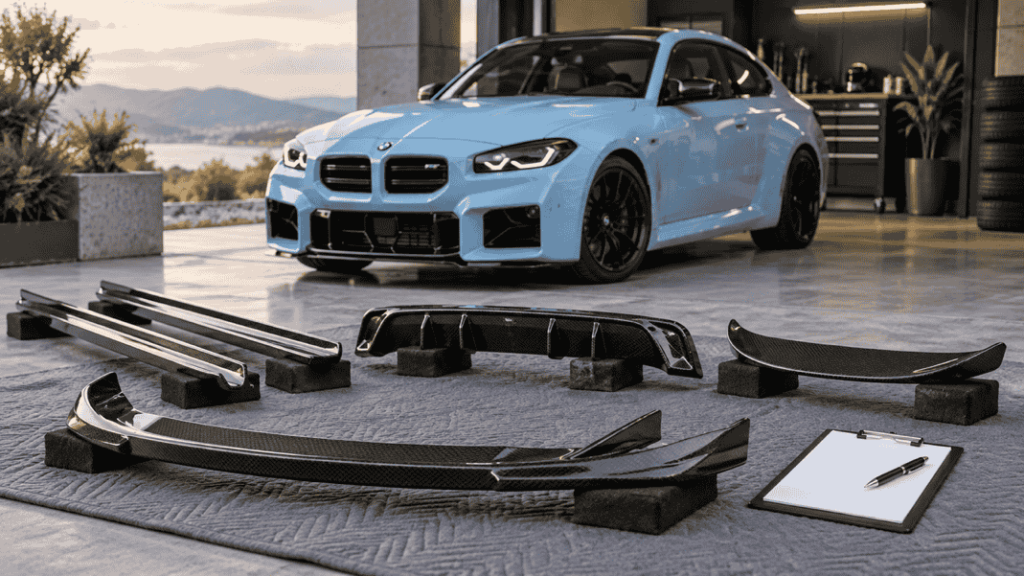
AI-generated vehicle scene; not an actual customer project or evidence of product fitment.
Decide how the trial will be judged before paying
Use a written review plan with the supplier. Include identity and contents, finish criteria, visible condition, relevant dimensional or interface evidence, packaging and documentation. Use the carbon sample inspection guide as a starting point.
Where physical fitment is part of the trial, identify the vehicle and installer, obtain the correct instructions and agree how questions will be reported. A photo review of the outer surface does not replace that assessment. Avoid altering a questionable part before documenting the issue and following the agreed process.
Also clarify issue-reporting windows, the information required and the possible resolution process. Do not assume that a sample order includes free replacement, return freight or credit against a future order. Those are commercial terms to request, not benefits to invent.
Record the outcome in a reusable product file
For each reviewed line, retain the supplier reference, revision, finish, packing list, photos and outcome. Distinguish “accepted for this confirmed application,” “needs more information” and “not suitable for our intended use.”
That record supports a more useful second order. You can repeat an accepted reference or request a specific correction rather than saying “send the same carbon parts again.” Use the reorder guide to maintain the history, including any revision changes disclosed by the supplier.
For distributors, do not publish a broad availability promise based on a sample shipment. Confirm current supply terms and the product information your retail partners will need before listing.
If one trial line is a complete G87 build, attach the itemized G87 carbon-package quotation worksheet. If future front-lip replacements matter to your business, use the G80/G82 one-piece versus three-piece sourcing guide to ask about actual section availability before selecting the sample.
Copy this mixed-model trial RFQ
We are a [tuning shop / distributor] planning a BMW M trial order. Attached are the chassis, vehicle details where relevant, exact candidate references, finish, requested quantities and purpose of each line. Please confirm per-reference and per-finish MOQ, any overall minimum, mixed-model eligibility, sample pricing, current supply estimates, packaging and freight to [destination]. State payment, issue-reporting and repeat-order terms, and identify any line that cannot meet the request. We want to evaluate [criteria] before expanding the range.
Frequently asked questions
Can M3, M4 and M2 parts be mixed in one wholesale order?
Ask against the actual list. Eligibility and minimums must be confirmed by the supplier; this guide does not promise acceptance of every combination.
Should the first order contain the widest possible range?
A focused list is easier to evaluate and connect to demand. Start with products your business has a reason and a practical way to assess.
Does an accepted sample prove future batch consistency?
It establishes a reference for review, not a guarantee. Keep the agreed specification and acceptance criteria available for subsequent orders.
What is the most useful information to send first?
Exact product candidates, quantities, finish, target vehicles, destination and what you need the trial to establish. This supports a more meaningful answer than asking for a general lowest price.
Turn your shortlist into a real first-order proposal
Send the shortlist through our wholesale inquiry page and request a response line by line. You do not need to guess an opening-stock budget from a catalog. Start with the customer demand you can identify, the references you can evaluate and the terms you can verify.