A carbon fiber installation job should be evaluated by its contribution and the workshop capacity it uses, not just its invoice total. When your bays are fully booked, a large job can displace several smaller ones. When capacity is available, the same job may be worthwhile. The scheduling context changes the decision.
This guide is a management worksheet for tuning shops, not a labor-time manual. Use your own completed-job records and product-specific installation instructions. No time in the example below is a CCF installation estimate.
Define the costs before dividing by hours
Start with net sales excluding taxes collected for authorities. Subtract the costs that vary with the job: supplied parts, incremental consumables, outsourced work, relevant transaction charges and genuinely incremental labor. Apply a consistent method to product freight and handling.
A technician’s fixed salary does not automatically become an additional cash cost for every job. If you include allocated labor in an internal costing model, label the measure accordingly and do not subtract the same payroll again elsewhere. Contribution remains different from final net profit, which must also cover fixed overhead and other expenses.
Measure occupied bay time, not only hands-on time
A vehicle can occupy a bay while the technician works elsewhere. Preparation, approval delays and product-specified curing or settling periods may constrain throughput even if they are not continuous labor. Record these separately. Never shorten a required process to improve a spreadsheet metric.
Track arrival, actual work, waiting and release. If a car can safely move to another area under the applicable procedure, document that workflow rather than assuming all waiting time consumes the same constrained resource.
Compare two hypothetical jobs
| Measure | Job A | Job B |
|---|---|---|
| Net sales | $1,200 | $900 |
| Job-variable costs | $780 | $540 |
| Contribution before fixed costs | $420 | $360 |
| Occupied bay hours | 6 | 3 |
| Contribution per occupied bay hour | $70 | $120 |
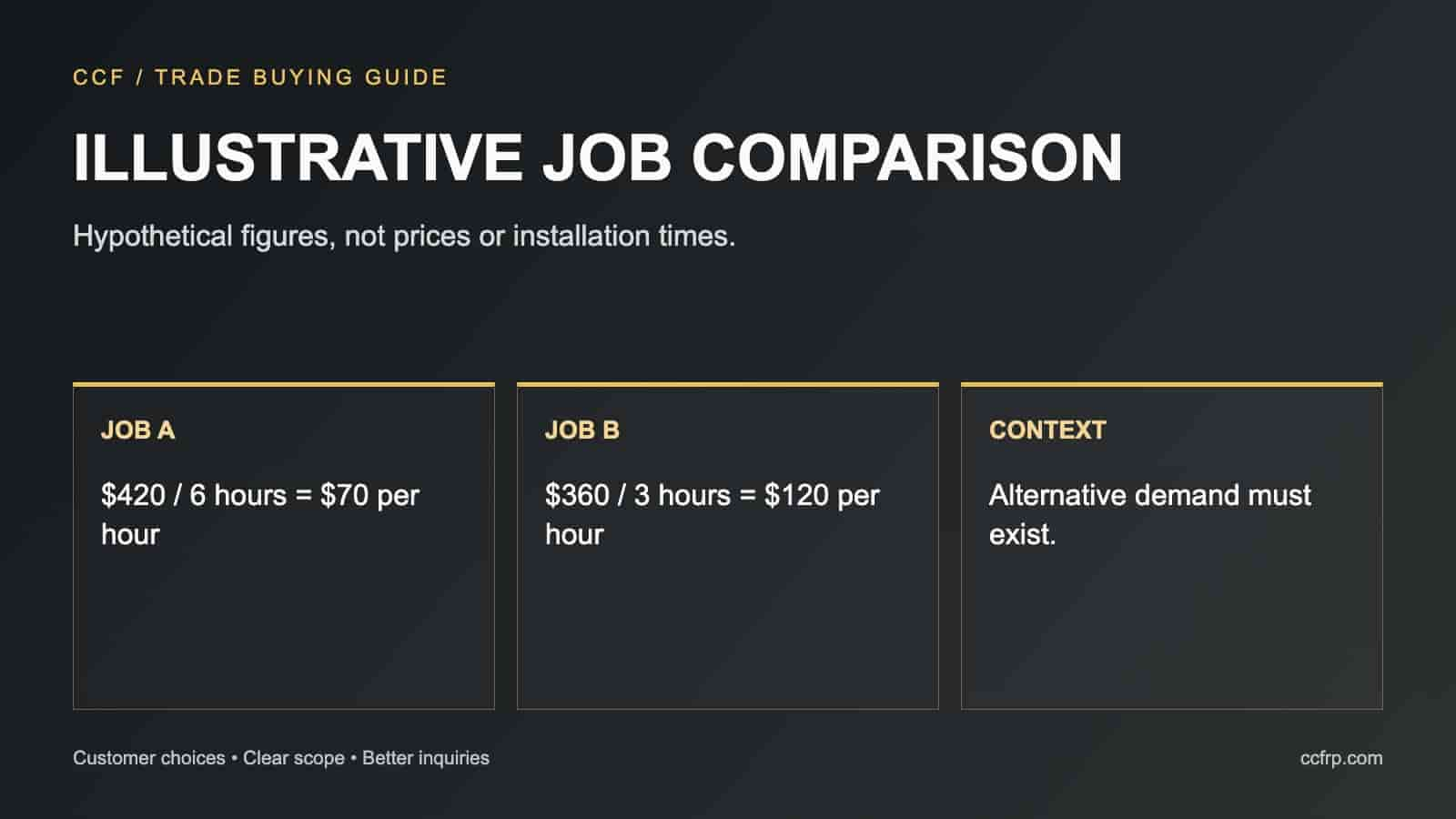
Job A produces more contribution per order. Job B produces more per occupied bay hour. If demand, staffing and all other constraints allow two Job B appointments in six hours, they would contribute $720 compared with $420 from one Job A. That comparison is useful only if those two alternative jobs actually exist and can be scheduled.
If the bay would otherwise be empty, rejecting Job A does not magically create $720. Review total contribution, customer commitments, technician skills and support risk together. The example illustrates opportunity cost, not a rule to refuse every longer installation.
Expose rework rather than hiding it in the next job
Record additional inspection, removal or refitting time against the original reference. If a hypothetical Job A needs two additional bay hours with unchanged revenue and costs, its contribution per bay hour becomes $52.50. If rework also adds variable costs, deduct those before dividing. Do not count a pending supplier reimbursement as money already recovered.
Use the returns-and-rework contribution guide for the broader calculation. Keep cause separate from observation: an unexpected fitment issue can arise from application, installation, vehicle changes or the supplied part and needs review.
Use a simple job-review card
- Vehicle, supplied reference and confirmed scope.
- Net sales and the variable-cost basis used.
- Planned and actual occupied bay hours.
- Hands-on work, waiting and unplanned work recorded separately.
- Contribution and contribution per constrained hour.
- The next operational improvement, with an owner.
For a new product without your own job history, quote subject to an appropriate inspection and scope review. Use the installation quotation workflow; do not convert the example hours here into a customer promise. A reliable pre-fit and escalation process is part of controlling the job.
Improve the workflow before simply increasing prices
Look for avoidable delays: missing supplied-content information, the wrong customer vehicle details, incomplete approvals or a part arriving after the booked slot. Confirm the order milestones before booking capacity against a supplier estimate.
Separate work that can be prepared before the vehicle arrives from work requiring the actual car. Define when the team must stop and ask for guidance. Use the customer handover checklist so the installation is closed with a clear scope and care instructions. A better commercial result should come from an accurate offer and controlled work, not skipped checks.
Frequently Asked Questions
Is contribution per bay hour net profit?
No. It is an operating comparison before fixed overhead and other applicable costs.
Should I always choose the highest hourly figure?
No. Consider total demand, commitments, other constrained resources and the quality of your estimates. An empty bay and a full schedule create different choices.
Discuss Parts for Your Workshop
Send the vehicle and exact component references before booking an installation slot. Ask CCF to clarify the supplied scope and current order milestones so your shop can prepare its own estimate.
Tell Us About Your Business
Include your market, customer vehicles, selected parts and trial quantities.