The amount you can afford to acquire a carbon fiber parts customer depends on the contribution from the order and the amount you need to retain afterward. A high selling price does not automatically justify a high advertising budget. Product cost, shipping, fees and support can consume much of the revenue.
Use this worksheet to set a planning ceiling before expanding paid traffic. It is not an industry cost-per-click benchmark or a recommendation for a particular advertising budget. Replace every example number with your own records and keep tax and inventory treatment consistent with your accounts.
Calculate contribution before acquisition spend
Start with net sales after discounts and refunds, excluding taxes collected for authorities. Subtract variable product, fulfillment, transaction and support costs attributable to the order. Do not subtract advertising here if you intend to compare it with the remaining contribution afterward.
| Illustrative first order | Amount |
|---|---|
| Net sales | $900 |
| Landed product cost | $450 |
| Incremental fulfillment | $70 |
| Net transaction/selling fees | $30 |
| Planning allowance for variable support and losses | $50 |
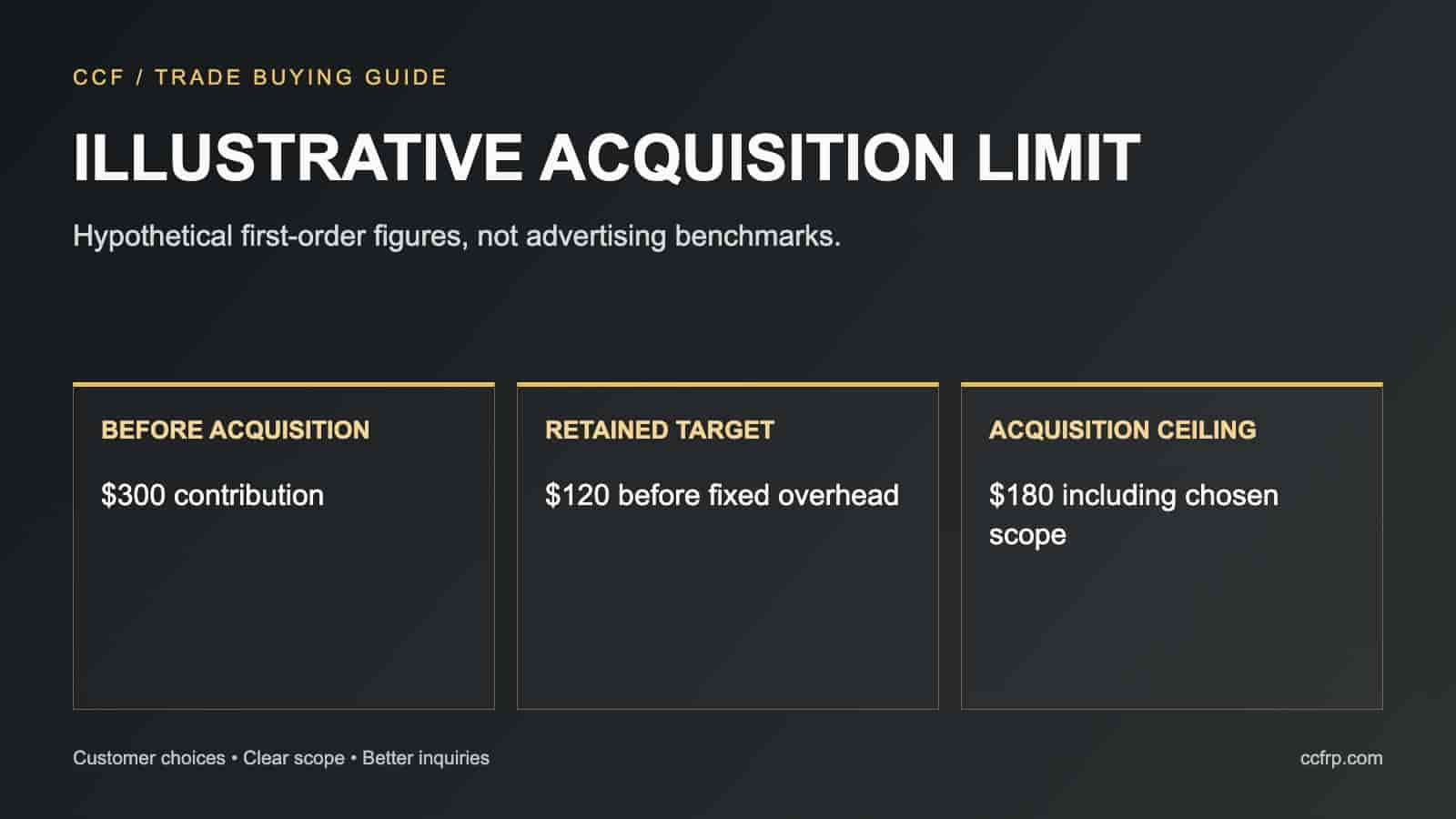
| Contribution before acquisition | $300 |
| Desired contribution retained after acquisition | $120 |
| Acquisition-cost ceiling for this scenario | $180 |
The $50 allowance is an assumption for planning, not a second deduction to make if the same loss is already captured in net sales or costs. The $120 retained amount is not net profit; fixed overhead and other costs still need coverage. These figures are hypothetical, not CCF prices or promised dealer results.
Distinguish a click, a lead and a customer
Cost per click is spend divided by clicks. Cost per lead is spend divided by the defined leads. Acquisition cost is acquisition spend divided by new customers acquired under your chosen attribution method. Keep the time period and attribution basis consistent.
If a planning assumption says 20% of qualified leads become new customers, a $180 acquisition ceiling implies at most $36 per qualified lead before any additional acquisition costs: $180 × 20%. If only 2% of paid clicks become customers, the implied click allowance is $3.60. Neither conversion rate is a benchmark. Both must be replaced by measured data before they guide sustained spending.
For WhatsApp-led sales, a button click is not a completed lead and a conversation is not necessarily a new customer. Record valid vehicle requirements, quotes and purchases separately. Do not optimize the business around a low cost for events that never become suitable orders.
Include costs outside the ad platform
If the acquisition ceiling is $180 and you allocate another $30 per new customer to variable acquisition work, the remaining ad allowance is $150. Your platform-reported acquisition figure will not automatically include every cost your business incurs.
Use a clear boundary for agency fees, creative production and staff costs. Some are fixed period costs, some vary with spend or customers, and some serve multiple channels. Report the chosen method rather than quietly switching definitions when one campaign looks expensive.
Do not fund today’s losses with unproven repeat purchases
Repeat orders can change the economics, but expected lifetime contribution is not the same as observed repeat contribution. Separate first-order economics from later cohorts. Review how many customers return, how long that takes and what additional service or marketing is required.
If you are testing a new range, work from a cautious first-order scenario until evidence supports another model. The order contribution guide and landed-cost worksheet help establish the underlying cost basis.
Improve the cause before increasing the budget
When acquisition cost is too high, investigate traffic relevance, application clarity, delivery scope and the ordering process. A misleading fitment promise may increase initial orders while worsening returns. Use the product-page conversion diagnosis to identify where relevant buyers get stuck.
Compare channels with the marketplace-versus-store worksheet. Then run a bounded test with a budget your business can absorb and a defined review point. No calculation guarantees that a campaign will reach its target, but a defined ceiling prevents you from confusing revenue growth with a sustainable result.
Frequently Asked Questions
Is return on ad spend enough to judge profitability?
No. Revenue divided by ad spend does not account for product, fulfillment and other costs. Compare contribution under a consistent method.
Can I count every WhatsApp click as a lead?
Treat it as a channel action. Track whether it becomes a relevant inquiry and then an acquired customer before using it as acquisition evidence.
Get the Product Costs Behind Your Sales Plan
Send CCF your shortlisted products, quantities and destination. Request a defined supply and delivery quote before using a guessed product cost to justify advertising spend.
Tell Us About Your Business
Include your market, customer vehicles, selected parts and trial quantities.