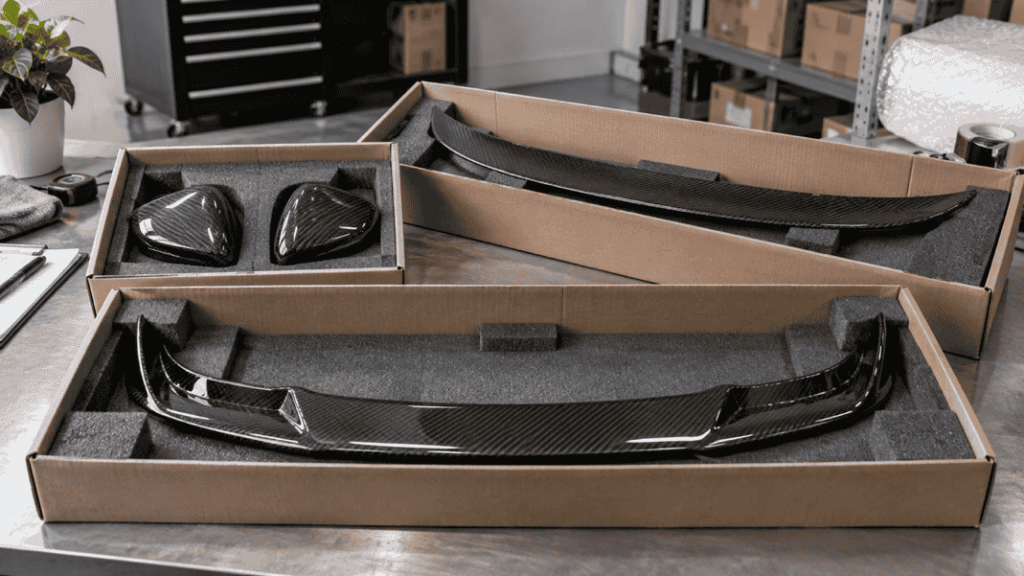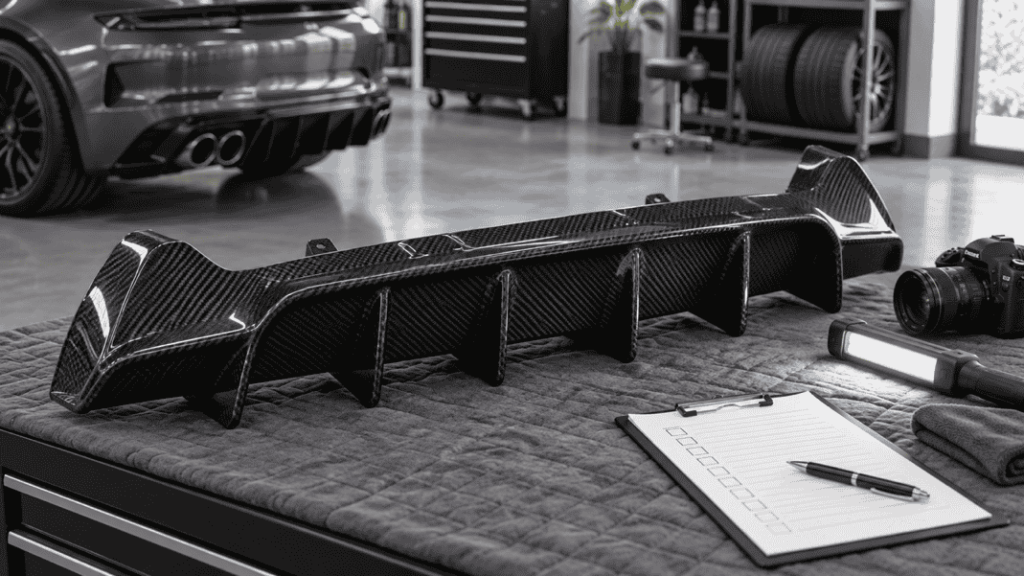
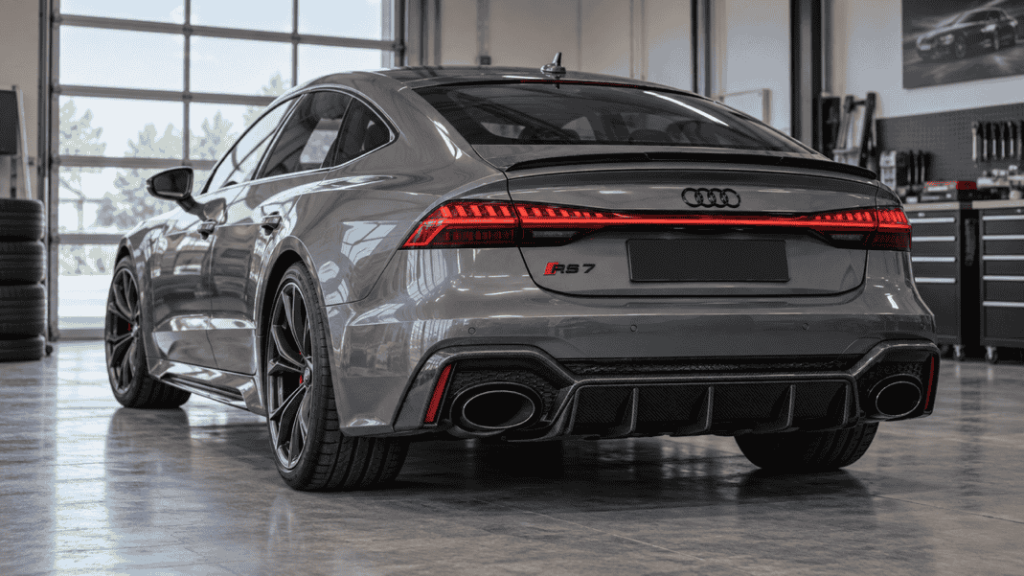
Successful automotive carbon fiber wholesale sourcing starts with vehicle coverage, fitment and SKU planning—not with buying the largest possible catalog.
For distributors, tuning shops and online sellers, the biggest sourcing risks usually come from stocking the wrong vehicle applications, buying too many slow-moving SKUs, misunderstanding fitment, comparing different product constructions only by price, or ignoring packaging and landed cost.
A practical wholesale strategy should therefore follow a clear sequence:
Target customer → Vehicle platform → Product category → SKU → Fitment → Sample → Initial order → Market validation → Repeat order
This guide explains how B2B buyers can use that approach to build a more manageable and scalable automotive carbon fiber product line.
How to Source Automotive Carbon Fiber Parts Wholesale
A professional wholesale sourcing plan should answer the following questions before the first large order is placed.
| Step | What to Decide | Why It Matters |
|---|---|---|
| 1 | Target customer | Determines product positioning |
| 2 | Vehicle coverage | Determines which market you serve |
| 3 | Product categories | Determines SKU strategy |
| 4 | Carbon construction | Determines price positioning |
| 5 | Fitment verification | Reduces returns and complaints |
| 6 | Samples | Confirms product before inventory |
| 7 | MOQ / SKU mix | Controls initial investment |
| 8 | Wholesale price | Determines commercial viability |
| 9 | Packaging | Reduces shipping damage |
| 10 | Inventory strategy | Reduces dead stock |
| 11 | Private label | Builds brand differentiation |
| 12 | Repeat-order planning | Supports scaling |
The purpose is not to make every product decision in advance.
The purpose is to create a repeatable sourcing system that can expand when real sales data supports expansion.
1. Define How You Plan to Sell Carbon Fiber Parts
Your business model should influence what you source.
A product mix that works for a tuning shop may not work for an online seller or national distributor.
Automotive Distributor
A distributor usually needs broader vehicle coverage, structured SKUs and reliable repeat supply.
The emphasis is often on:
vehicle coverage;
multiple product categories;
predictable reorder availability;
structured product data;
wholesale pricing;
logistics;
after-sales support.
Performance / Tuning Shop
A tuning shop may carry fewer SKUs but place greater emphasis on:
accurate fitment;
visually strong products;
installation compatibility;
higher-value aero upgrades;
repeatable quality.
The shop may also be able to test-fit products directly on customer vehicles.
Body Shop
A body shop may prioritize replacement-style parts and clear identification.
OE references, position, model year and chassis data can become more important than having a large number of design variants.
Online Automotive Parts Seller
An online seller needs more than the physical product.
They also need:
accurate fitment data;
strong product photos;
clear installation information;
organized SKUs;
packaging suitable for fulfillment;
dimensions and shipping information.
Cross-Border E-Commerce Seller
Cross-border sellers also need to consider:
parcel size;
dimensional weight;
shipping cost;
damaged-goods risk;
return complexity;
product listing compatibility across markets.
Automotive Brand / Private Label
A private-label buyer may care more about:
stable specifications;
packaging;
SKU structure;
branding;
product differentiation;
exclusivity;
future OEM/ODM development.
The first wholesale sourcing question should therefore be:
Who is the end customer, and how will the product be sold?
2. Choose Vehicle Platforms Before Choosing Products
Wholesalers should generally select vehicle platforms first, then build products around those platforms.
Buying random products from a supplier catalog often creates fragmented inventory.
A more structured approach is:
Vehicle-first sourcing → Product selection → SKU expansion
For example:
BMW M3 G80
→ Front lip
→ Rear diffuser
→ Side skirts
→ Rear spoiler
→ Mirror caps
Then, once the platform performs commercially, additional designs or related models can be added.
When selecting a vehicle platform, evaluate:
aftermarket community;
vehicle age;
modification activity;
target geography;
competition;
customer price tolerance;
number of available carbon fiber components;
facelift / LCI changes;
regional vehicle configurations.
Platforms such as BMW M2 G87, M3 G80 and M4 G82 may be relevant in some markets, while Mercedes-AMG or Porsche 911 applications may be more important in others.
The correct choice depends on your actual customers.
Do not assume a vehicle platform is commercially attractive simply because it is popular on social media.
3. Which Carbon Fiber Parts Should Wholesalers Stock First?
Different product categories create different commercial and logistics requirements.
| Product Category | Shipping Size | Fitment Sensitivity | Inventory Commitment | Suitable for Initial Testing? |
|---|---|---|---|---|
| Mirror caps | Small | Medium | Lower | Often easier to test |
| Front lips / splitters | Medium / long | High | Medium | Yes, with fitment verification |
| Rear diffusers | Medium / large | High | Medium | Yes, if configuration is clear |
| Side skirts | Long | High | Medium | Requires shipping planning |
| Rear spoilers | Medium | Medium / High | Medium | Often practical |
| Grilles / fender parts | Small / medium | High | Medium | Application dependent |
| Hoods | Large | High | High | Greater logistics commitment |
| Trunks | Large | High | High | Greater logistics commitment |
| Full aero kits | Large / multiple cartons | Very high | High | Better after demand validation |
There is no universal “best” category.
However, a wholesaler should consider three things together:
Demand + Fitment Risk + Shipping Economics
For example, mirror caps may be easier to store and ship than a hood.
A front lip may have strong visual appeal but requires accurate fitment and careful packaging.
A hood may produce a high ticket value but occupies more warehouse space and can be expensive to transport.
The right category is the one that fits your customer base and business model.
4. Start With a Focused SKU Strategy
A new distributor does not necessarily need hundreds of SKUs immediately.
A focused SKU strategy can reduce inventory risk.
Hero SKUs
These are the vehicle/product combinations that form the core of your initial offering.
They should receive the strongest attention for:
fitment;
product photography;
listings;
inventory;
marketing.
Expansion SKUs
These are added after demand is validated.
For example, a distributor may start with front lips and diffusers for one platform, then add spoilers and side skirts later.
Long-Tail SKUs
These are lower-frequency applications that may be stocked in smaller quantities or purchased only when orders are received.
A useful SKU structure can follow:
Vehicle platform
→ Exterior area
→ Product
→ Style/design
→ Carbon construction
→ Finish
→ LHD/RHD where relevant
→ Model year / facelift
→ SKU
For example:
BMW
→ G80 M3
→ Rear
→ Diffuser
→ OEM-style
→ Prepreg dry carbon
→ Gloss
→ Pre-LCI
→ SKU
This structure supports:
website filters;
inventory management;
quotation sheets;
product feeds;
repeat orders;
fitment control.
A clear SKU system becomes more important as the catalog grows.
5. Use OE References to Improve Fitment Identification
OE references can help professional buyers identify exactly which component they are sourcing.
A useful workflow is:
OE Reference → Vehicle / Component Identification → Compatible Aftermarket Carbon Fiber Replacement
For distributors, tuning shops and body shops, OE references can reduce ambiguity.
But:
An OE number alone does not always guarantee fitment.
Buyers should also verify:
vehicle model;
chassis code;
model year;
production date;
VIN where appropriate;
pre-LCI / LCI;
left / right / center;
factory option;
bumper specification;
exhaust configuration;
original-part photos.
This is particularly important on platforms with multiple revisions or factory options.
BMW G80, G82 and G87 applications are good examples of why a product should not simply be described as:
“Fits BMW M3”
A more professional fitment record may include:
BMW M3 G80 / production period / OE reference / bumper configuration / installation position
For deeper OE-reference research, a dedicated BMW M2, M3 and M4 carbon fiber OE guide can support this process.
6. Match Carbon Construction to Your Market Position
Wholesalers should decide what product level they are trying to sell.
Common categories may include:
prepreg dry carbon;
wet carbon;
carbon overlay / cosmetic carbon.
The question is not simply which one is “better.”
The more useful question is:
Which construction fits the target customer, selling price and product positioning?
For example, a premium tuning brand may prioritize prepreg dry carbon for weight, construction and positioning.
Another market may be more price-sensitive.
When comparing quotations, make sure suppliers are quoting the same basic specification.
Do not compare a prepreg dry carbon part against a lower-cost construction based only on unit price.
They are not equivalent products.
7. Test Samples Before Building Inventory
Samples are an important step between quotation and inventory.
A useful B2B workflow is:
Sample → Test Fitment → Product Content → Initial Order → Market Validation → Repeat Order
A sample can be used to check:
fitment;
mounting points;
weave;
clear coat;
surface finish;
product weight where relevant;
installation method;
packaging quality;
product photography;
listing content.
For online sellers, the sample can also be used to produce original product content before committing to inventory.
For fitment-sensitive products, actual vehicle installation is particularly valuable.
A visually attractive sample is not enough if the product cannot be installed correctly.
8. Understand MOQ at the SKU Level
MOQ becomes more complex when buying automotive parts because wholesalers rarely purchase only one product.
You may want:
BMW G80 front lip
BMW G80 diffuser
BMW G82 spoiler
BMW G87 mirror caps
Porsche component
In that situation, ask:
What is the MOQ per SKU?
Is MOQ calculated per design?
Can different SKUs be mixed?
Is there a minimum total order value?
Is private-label MOQ different?
Does custom packaging affect MOQ?
Does new tooling require a separate quantity commitment?
For a new distributor, SKU flexibility can sometimes be as important as unit price.
A low price may not help if the supplier requires excessive quantities of every individual fitment.
Conversely, very small orders may increase cost and reduce efficiency.
The objective is to find an order structure that matches your market-validation stage.
9. Compare Wholesale Prices on the Same Specification
Before comparing prices, normalize the specification.
| Item | Supplier A | Supplier B | Supplier C |
|---|---|---|---|
| Carbon construction | Confirm | Confirm | Confirm |
| Finish | Confirm | Confirm | Confirm |
| Fitment standard | Confirm | Confirm | Confirm |
| Hardware included | Confirm | Confirm | Confirm |
| Packaging | Confirm | Confirm | Confirm |
| MOQ per SKU | Confirm | Confirm | Confirm |
| Private label | Confirm | Confirm | Confirm |
| Tooling | Confirm | Confirm | Confirm |
| Incoterm | Confirm | Confirm | Confirm |
| Shipping volume | Confirm | Confirm | Confirm |
| Defect handling | Confirm | Confirm | Confirm |
A lower unit price does not automatically mean a lower business cost.
If one product creates more:
fitment complaints;
returns;
shipping damage;
customer-service work;
replacements;
the downstream cost can exceed the original saving.
At the same time, the most expensive product is not automatically the correct choice.
Compare equivalent specifications and total commercial cost.
10. Calculate the Real Cost Before Setting Your Retail Price
Wholesale buyers should calculate landed cost, not just product cost.
A practical formula is:
**Product Cost
Packaging
Origin Transport
Export / Import Costs
International Freight
Duties / Taxes
Local Delivery
Warehousing
Payment Fees
Expected Returns / Damage Allowance
= Estimated Landed Cost**
Then:
Selling Price − Landed Cost − Selling Expenses = Gross Contribution
Selling expenses may include:
marketplace fees;
advertising;
payment fees;
local shipping;
installation support;
customer service;
warranty handling.
There is no universal “correct” margin.
The required margin depends on:
sales channel;
product size;
inventory turnover;
return rate;
advertising cost;
local competition;
warranty burden.
This is why an FOB quotation alone cannot tell you whether a product is commercially viable.
11. How to Reduce Dead Inventory When Starting a Carbon Fiber Product Line
More SKUs do not automatically mean more sales.
A better approach is to expand based on demand.
Practical strategies include:
choose a limited number of vehicle platforms;
avoid too many similar designs initially;
test products before stocking;
use customer-request data;
separate stock products from order-on-demand products;
monitor model-year changes;
expand after repeat sales;
track inventory turnover;
review slow-moving SKUs regularly.
A useful inventory structure may be:
Stock SKUs
Frequently requested products that justify local inventory.
Low-Stock SKUs
Products with moderate demand.
Order-on-Demand SKUs
Long-tail products that can be supplied without permanent inventory.
This approach helps reduce capital tied up in slow-moving fitments.
12. Existing Products or Custom Development: Which Is Better for Wholesale?
Both can make sense.
| Factor | Existing Products | New OEM/ODM Development |
|---|---|---|
| Time to market | Faster | Longer |
| Tooling investment | Usually lower | Higher |
| Fitment validation | Existing application | Must be developed |
| Market testing | Easier | More commitment |
| Differentiation | Lower | Potentially higher |
| Exclusivity | Usually limited | Possible depending on agreement |
| Development risk | Lower | Higher |
| Branding opportunity | Moderate | Stronger |
Existing Products
Existing products are useful when:
entering a new vehicle platform;
testing demand;
building catalog coverage;
reducing initial tooling investment.
New OEM/ODM Development
Custom development can make sense when:
your brand needs unique styling;
you want to reduce direct product duplication;
you have proven demand;
you want exclusive fitment or design control.
But custom development also introduces:
tooling cost;
development time;
fitment testing;
engineering changes;
mold ownership questions;
higher commitment.
For deeper project-development planning, this topic should be handled separately in an Automotive Carbon Fiber OEM & ODM Guide.
13. When Does Private Label Make Sense?
Private label can help distributors build their own market identity.
Possible private-label elements include:
product labels;
SKU labels;
barcode labels;
branded packaging;
instructions;
cartons;
product documentation;
logo application where technically appropriate.
However, private label is usually more useful after:
demand has been validated;
SKUs are stable;
quality standards are clear;
repeat orders exist;
branding strategy is defined.
Applying expensive customized packaging to an unproven SKU can increase inventory risk.
Private label should support a proven product strategy, not replace one.
14. Product Data Is Part of Wholesale Supply
For an online seller or distributor, the product is not only the physical carbon fiber component.
It is also the data required to sell it correctly.
Useful product information may include:
product name;
SKU;
vehicle make;
model;
chassis;
model year;
pre-LCI / LCI;
OE reference;
installation position;
material;
finish;
package contents;
installation notes;
product dimensions;
packaging dimensions;
product weight;
shipping weight;
product photos;
installation photos.
Structured data reduces:
listing errors;
incorrect fitment claims;
customer-service questions;
warehouse picking mistakes.
This is particularly important for online automotive sellers managing many similar parts.
A distributor may eventually have several products that all appear to be “BMW G80 carbon front lip” internally.
Without proper SKU and fitment data, mistakes become more likely.
15. Plan Packaging Around the Product Category
Shipping economics should influence product selection.
Different products have different packaging risks.
Mirror Caps
Small and relatively easy to warehouse, but the visible surface must still be protected.
Front Lips
Long and vulnerable to corner impact and bending pressure.
Side Skirts
Long dimensions can increase dimensional shipping cost.
Diffusers
Complex geometry can create fragile points.
Spoilers
Mounting areas and exposed edges need protection.
Hoods and Trunks
Large size significantly affects freight, storage and damage risk.
Buyers should evaluate:
dimensional weight;
carton dimensions;
internal movement;
edge protection;
clear-coat protection;
stacking pressure;
export handling;
downstream fulfillment method.
A product that looks attractive at factory price may become less attractive after shipping cost is included.
16. Build a Repeat-Order System Before You Scale
Wholesale sourcing should be designed around repeat orders, not only the first purchase order.
Track:
SKU;
vehicle;
sales velocity;
inventory;
reorder point;
supplier lead time;
open orders;
fitment complaints;
defects;
returns;
packaging problems;
customer feedback.
This creates a useful feedback loop:
Sales Data → Inventory Decision → Reorder → Product Expansion
For example, if one BMW platform consistently produces repeat orders while another platform receives little interest, future inventory should reflect that information.
Growth should come from data rather than catalog size.
17. What Information Should You Send for a Carbon Fiber Wholesale Quotation?
A vague inquiry produces a vague quotation.
Instead of:
“Send me your best price for carbon fiber parts.”
provide:
company name;
country / target market;
business type;
target vehicle brands;
models;
chassis codes;
product categories;
specific products;
OE references where available;
quantity per SKU;
total expected quantity;
dry carbon / construction requirement;
finish;
private-label requirements;
packaging requirements;
required Incoterm;
destination;
expected purchasing schedule.
Example Wholesale RFQ
We are an automotive aftermarket distributor serving the German market.
We are currently sourcing dry carbon fiber exterior parts for BMW G80 M3, G82 M4 and G87 M2.
Please quote your available front lips, rear diffusers, spoilers and mirror caps.
For each item, please provide SKU, vehicle fitment, unit price, MOQ per SKU, packaging information and available private-label options.
Initial quantities will depend on fitment verification and sample approval.
This gives the supplier enough information to prepare a more useful quotation.
18. Common Mistakes When Buying Automotive Carbon Fiber Parts Wholesale
Buying Too Many SKUs Immediately
Large catalogs can lock capital into slow-moving inventory.
Choosing Products Before Defining Target Vehicles
This creates fragmented inventory and weak vehicle coverage.
Comparing Different Carbon Constructions Only by Price
Prepreg dry carbon, wet carbon and cosmetic constructions should not be treated as identical products.
Ignoring Model-Year or LCI Differences
A visually similar component may not fit every production version.
Ordering Without Fitment Verification
Incorrect fitment creates returns and customer dissatisfaction.
Treating OE Number as the Only Fitment Information
OE references are useful, but configuration and production data may still matter.
Skipping Samples
Samples help validate both product and packaging before larger orders.
Ignoring Packaging
Large carbon fiber components can be expensive to replace if damaged in transit.
Ignoring Dimensional Shipping Cost
Large low-weight products can still be expensive to ship.
Not Clarifying MOQ per SKU
A total MOQ does not always explain the minimum quantity per individual fitment.
Investing in Private Label Too Early
Customized packaging on unvalidated products can increase inventory risk.
Failing to Track Repeat Orders
Without SKU-level performance data, product expansion becomes guesswork.
Using Incomplete Product Data
Poor fitment information creates listing errors and customer-service problems.
Automotive Carbon Fiber Wholesale Sourcing Checklist
| Item | What to Confirm | Why It Matters |
|---|---|---|
| Target market | Country / customer segment | Defines product strategy |
| Vehicle platform | Make / model / chassis / year | Controls compatibility |
| Product | Lip / diffuser / spoiler / etc. | Defines SKU |
| Construction | Dry / wet / other | Defines market positioning |
| Fitment | OE / VIN / photos / test fit | Reduces returns |
| Sample | Tested before inventory | Reduces sourcing risk |
| MOQ | Per SKU / mixed order | Controls capital |
| Price | Same specification | Protects commercial margin |
| Packaging | Product-specific | Reduces damage |
| Product data | Complete listing data | Supports resale |
| Private label | Branding requirements | Builds differentiation |
| Inventory | Initial quantity / reorder plan | Reduces dead stock |
| Repeat supply | Lead time / reorder process | Supports scaling |
Frequently Asked Questions
Where can I buy automotive carbon fiber parts wholesale?
Automotive carbon fiber parts can be sourced from manufacturers, specialized suppliers and distributors. Professional buyers should compare vehicle coverage, carbon construction, fitment control, MOQ, product data, repeat supply and B2B services before placing wholesale orders.
What carbon fiber car parts are suitable for wholesale?
Front lips, diffusers, spoilers, mirror caps, side skirts, grilles, hoods and trunks can all be suitable. The right products depend on customer demand, fitment complexity, shipping cost, inventory space and expected resale value.
Should I start with BMW carbon fiber parts?
BMW can be relevant in some aftermarket markets, but there is no universal reason to begin with BMW. Evaluate your actual customer demand. If buyers frequently request G80, G82 or G87 products, those platforms may justify focused coverage. In another market, Mercedes-AMG or Porsche may be more appropriate.
How many carbon fiber SKUs should a new distributor start with?
There is no universal number. A focused selection of validated vehicle/product combinations is usually easier to manage than a very large untested catalog. Expand using sales and customer-request data.
Can I use BMW OE numbers to source aftermarket carbon fiber replacements?
Yes. OE numbers can help identify the original component and improve communication with suppliers. However, model, chassis, production date, VIN, factory options and original-part photos may still be required to confirm fitment.
What is the MOQ for wholesale carbon fiber parts?
MOQ depends on supplier, product, SKU, construction, customization and packaging. Always ask whether MOQ applies per SKU, per design, per vehicle or to the total mixed order.
Can carbon fiber parts be private labeled?
Many suppliers may support some form of private label, such as product labels, branded packaging, barcodes or documentation. Available options and minimum quantities should be confirmed with the supplier.
Should I order samples before placing a wholesale order?
Yes, especially for new products or suppliers. Check fitment, mounting points, weave, finish, packaging and actual installation where practical.
How do I calculate the landed cost of carbon fiber parts?
Use:
Product cost + packaging + origin logistics + international freight + duties/taxes + local delivery + warehousing + payment fees + expected return/damage allowance = estimated landed cost.
What information should I send when requesting a wholesale quotation?
Send the vehicle make/model, chassis, products, quantity per SKU, construction, finish, OE reference if available, packaging/private-label requirements, Incoterm and destination market.
Looking for Automotive Carbon Fiber Parts for Wholesale?
If you are a distributor, performance shop, automotive brand, carbon fiber wholesaler or online automotive parts seller, send us your target product requirements.
Useful information includes:
Vehicle make and model
Chassis code
OE references where available
Required quantity per SKU
Carbon construction and finish
Private-label requirements
Packaging requirements
Destination market
We can review whether your sourcing requirement is better suited to:
existing dry carbon fiber products;
wholesale supply;
private label;
OEM-style replacement products;
new OEM/ODM development.
For fitment-sensitive products, providing vehicle information, OE references and clear product photos at the quotation stage helps improve technical communication.