
A long catalog is not a distribution strategy. If your first order spreads cash across too many unproven variants, you can end up with an impressive product list and the wrong parts on the shelf.
Build a BMW carbon fiber range around your actual customer demand, verified fitment and repeatable supply. Separate core stock, controlled trials and customer-specific orders before choosing quantities. Catalog depth shows what deserves investigation; your own inquiries and completed sales show what deserves investment.
Request a BMW distributor product sheet with product references, fitment scope and current supply information. Do not commit working capital on the strength of thumbnails and a bulk discount alone.

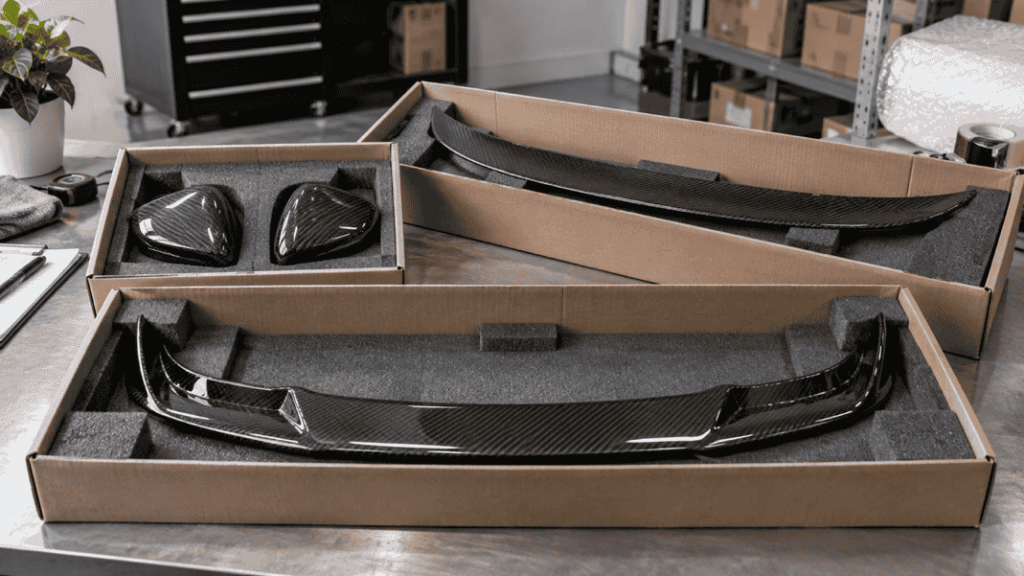
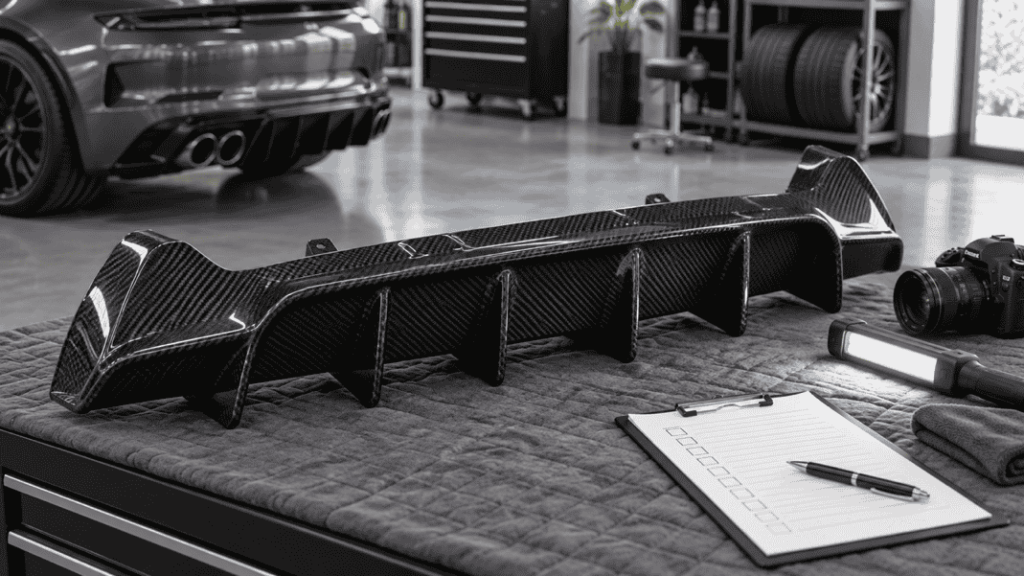
AI-generated assortment concept; not actual inventory, a best-seller ranking or a factory showroom.
Start with the customers you can already reach
Review a defined period of inquiries and orders. Group them by exact chassis, body style, requested part and reason an inquiry did not convert. Separate a casual styling question from a fitment-confirmed request with a budget and intended purchase date.
Count distinct opportunities, not repeated messages from the same person. Record whether a lost sale was caused by price, unavailable fitment evidence, delivery timing or lack of the requested design. Each problem calls for a different response; stocking more products does not solve all of them.
For a new business without sales history, begin with a smaller validation program through your existing workshop relationships or target customer base. Treat their feedback as preliminary evidence, and increase commitment only as real purchasing behavior becomes visible.
Use catalog depth to create a shortlist
The BMW catalog snapshot reviewed for this guide contains 352 records. The following groups offer starting points for review, not a forecast of sales:
| Catalog group | Records in this catalog snapshot | Planning question |
|---|---|---|
| G80 / G82 | 111 | Which exact applications and styles match your existing inquiries? |
| G22 / G23 / G26 | 55 | Can the combined group be split into confirmed body-specific applications? |
| G87 | 52 | Which requested parts have enough evidence for a first trial? |
| F80 / F82 / F83 | 28 | Does your established customer base support repeat demand? |
| Other BMW groups combined | 106 | Which individual applications justify further review? |
| Total catalog records | 352 | How many become distinct, verified, currently orderable items? |
These are catalog records, not verified unique SKUs, stock units, sales volumes or market shares. Similar entries may represent variants or records that need clarification. Ask for the actual supplier references before creating your inventory system.
Use the BMW product catalog to shortlist, then request current availability and documentation. Do not advertise every catalog entry as immediately deliverable.
Assign each candidate to a buying lane
| Lane | Appropriate starting condition | Purchasing approach |
|---|---|---|
| Core stock | Repeated demand, verified application and workable replenishment | Set quantities from observed demand and actual lead time |
| Controlled trial | Credible interest but limited sales or installation history | Agree a small test scope and review criteria |
| Customer-specific order | Uncertain demand, unusual configuration or substantial cash/space requirement | Confirm the customer job and supplier terms before purchase |
These are operating categories, not promises that a supplier accepts any MOQ or order size. Confirm sample, mixed-order and replenishment terms for the actual references.
A visually popular design can remain a trial item if fitment evidence is incomplete. A less dramatic part may justify core stock if it repeatedly serves your customer base with manageable support requirements.
Build coherent bundles without hiding fitment gaps
A front lip, side-skirt pair and rear component may form an attractive customer proposal. Confirm each item’s application, finish and included fittings separately before presenting it as a coordinated bundle.
Avoid buying every available style for a single chassis at once. Start with the designs your customers can distinguish and your team can explain. Too many near-identical options can complicate quoting, photography and replacement identification without adding meaningful choice.
Our G22/G23/G26 fitment guide shows why a combined model heading must be broken down by part. Apply the same discipline across other BMW groups.
Make margin visible before increasing stock
Track the complete acquisition scope for each candidate: product price, allocated packing and freight, applicable destination costs and any separately required components. Keep sales-related expenses visible as well, including payment charges or support costs that apply to your operation.
An illustrative calculation: if an item sells for $500 and the agreed landed goods cost is $300, the difference is $200, or 40% of the selling price, before other expenses. That is not a 40% net profit, and it is not the same calculation as markup on cost. These figures are invented examples, not expected returns.
Use the landed-cost guide to make comparisons consistently. Do not buy additional pieces solely because a lower unit price makes an incomplete margin calculation look better.
Set a repeat-order rule you can explain
For items with enough demand history, a basic starting rule is expected demand during replenishment time plus a buffer appropriate to your uncertainty and service target. Compare that requirement with available stock and reliable incoming supply, taking committed customer orders into account without double-counting them.
For example, four units per month over a six-week replenishment period is roughly six units of expected demand before any buffer. That hypothetical calculation is only useful if both the demand and replenishment assumptions are credible.
Review actual performance before increasing the buffer. Separate production readiness, dispatch and arrival information; an optimistic shipping estimate should not become a guaranteed replenishment date.

AI-generated planning concept; no sales, margins or stock figures are represented.
Keep a short operating scorecard
Track inquiries, quotations, completed sales, stock age and the reasons for fitment or support issues. Review results by actual product reference rather than a broad “BMW carbon” category.
A product with inquiries but few orders needs a diagnosis: unclear fitment, uncompetitive total cost, weak images or the wrong style can all affect conversion. A product with sales but repeated installation questions may need better documentation before broader distribution.
For aging stock, review the listing, application accuracy and genuine demand before reordering. A larger range is useful only when your business can explain, supply and support it.
Frequently asked questions
Should I start with the BMW group that has the most catalog records?
Use it as a research candidate. Record count does not establish local demand, product quality or profitability. Your customer evidence should decide the commitment.
Are mirror covers always the best starter product?
No universal starter part suits every distributor. Check demand, application complexity, landed cost and support requirements for your market.
Can I mix several BMW chassis in the first order?
Ask for the actual mixed-order and minimum-quantity terms. Do not assume a catalog listing guarantees a particular trial-order policy.
How often should I review the range?
Use a regular review interval suited to your sales volume and replenishment cycle. Review sooner when fitment issues, supply changes or unexpected stock aging appear.
Stop buying breadth. Build a range you can sell again
Do not let your next wholesale order become expensive shelf decoration. Send your target BMW chassis, requested parts, destination and trial-order priorities now. Request the distributor product sheet and a focused quotation.
Ask for exact references, confirmed applications, current supply status, ordering terms, packing information and available installation evidence. Build the first order around clear demand and unresolved questions you have actually closed. Then expand from results—not from the number of pages in the catalog.