
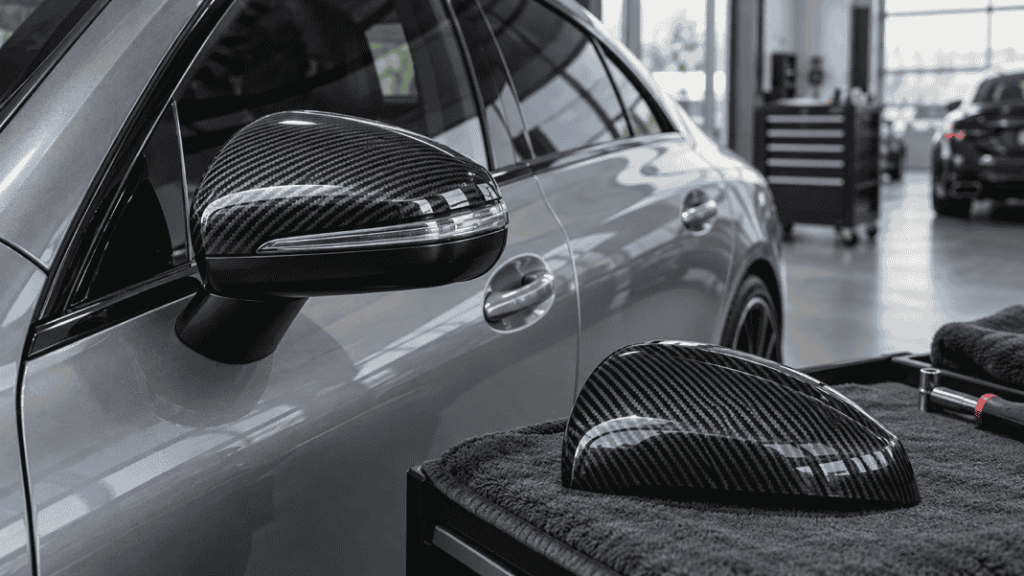
Two carbon mirror covers can look almost identical from the outside while requiring different products, labor and installation checks. One is intended to fit over the original cover. The other replaces a component of the existing mirror assembly.
When buying W117/W118 carbon fiber mirror caps, first confirm the actual CLA vehicle and mirror housing, then establish whether the selected item is an overlay or a replacement cover. Exterior styling, a carbon label and a combined catalog heading cannot answer those questions on their own.
Send the vehicle details and mirror photographs for version confirmation before pricing the installation. A small part deserves a clear application statement just as much as a full body kit.
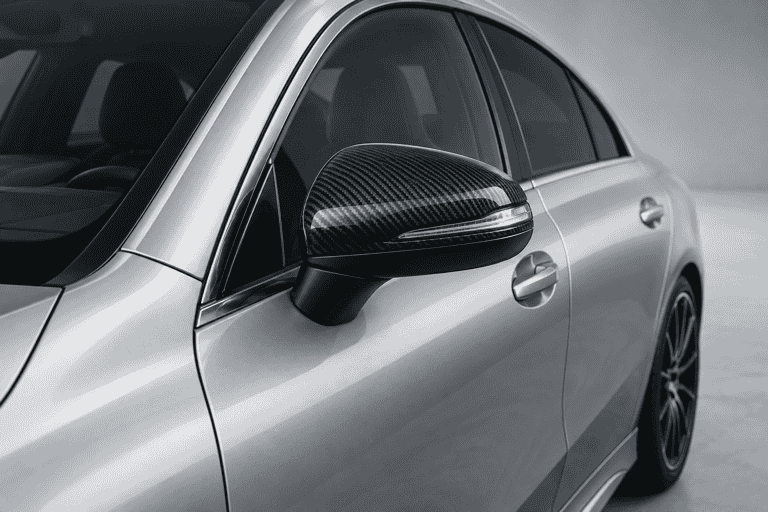
AI-generated styling concept; not a verified CLA application, mounting arrangement or equipment-clearance test.
First, clarify what the catalog means by W117 and W118
Some aftermarket catalogs use W117/W118 as shorthand for CLA applications. Mercedes-Benz materials identify the CLA Coupé with designations including C117 and C118. Record the actual model and body designation instead of treating the catalog shorthand as the final specification.
If the vehicle is a Shooting Brake, provide that information explicitly and ask for its application to be confirmed separately. Do not infer mirror-cover interchangeability from a shared generation or an apparently similar exterior shape.
Record production information, market, steering side and relevant mirror equipment. Current housing photographs are particularly useful where the original mirror or cover may have been replaced. A badge, registration year or promotional image of a similar car is not the complete application record.
Overlay versus replacement: what changes?
| Question | Overlay cover | Replacement cover |
|---|---|---|
| What does it generally do? | Adds a cover over the specified existing outer surface | Replaces the specified original cover component |
| What must be checked? | Contact geometry, edge coverage and the approved bonding arrangement | Attachment interfaces, assembly version and applicable removal/refitting instructions |
| What remains uncertain from an exterior photo? | Whether the inner shape and coverage suit the current housing | Whether the attachment details match the vehicle assembly |
| What affects the job quote? | Preparation, approved materials and product-specific application requirements | Access, disassembly/refitting work and any separately required components |
| What should never be assumed? | That an overlay repairs a damaged or incorrect underlying housing | That a replacement includes glass, indicators, electronics or a complete mirror assembly |
These are purchasing distinctions, not a universal installation procedure. The manufacturer must confirm the exact product’s design and requirements.
Read the original description, then verify it
The catalog snapshot reviewed for this guide contains six mirror-cover records in a combined W117/W118 group. Their original descriptions include terms translated as “replacement,” “add-on” and “stick-on.” That distinction can disappear when every English title is shortened to “rearview mirror housing.”
Use those terms to ask better questions, not to finalize an order without evidence. In particular, an “add-on” label should be clarified with actual product photographs and instructions rather than automatically treated as identical to every overlay.
Ask for a stable supplier reference, the selected version and a written explanation of how it attaches. Repeated listing titles or automatically generated suffixes are not a substitute for the supplier’s actual ordering code.
Ask for inside views before approving the outside
For an overlay, request the interior contact area, edges and relevant product-specific bonding instructions. Confirm that the existing housing is the correct substrate and suitable condition for the intended installation.
For a replacement, ask for clear images of the attachment interfaces and the applicable installation document. Do not rely on counting visible clips in an unrelated online photo. The technician needs evidence for the exact supplied reference and current mirror assembly.
Request left and right identification, sale quantity and finish information. Confirm whether the quotation covers a pair or one side. If only one cover is being replaced, discuss how appearance will be assessed against the existing opposite side.
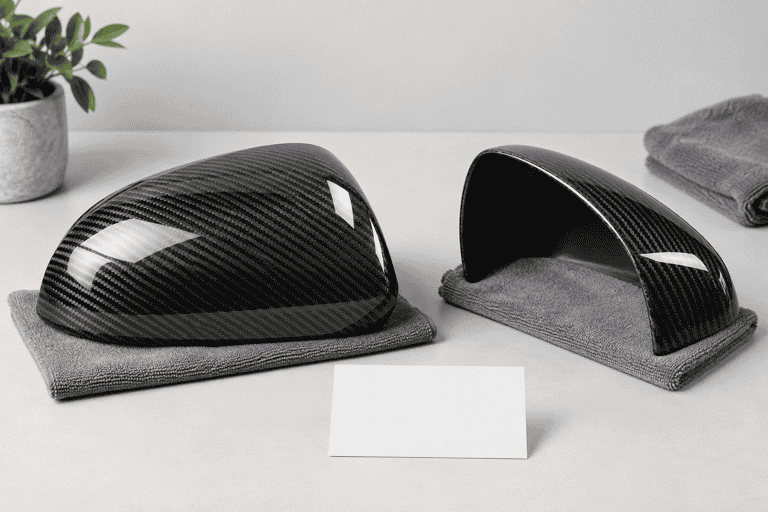
AI-generated selection concept; interior geometry is not an overlay or replacement fitment specification.
Preserve the functions the customer already has
Identify the mirror functions and adjacent equipment relevant to the selected cover: indicators, folding movement, adjustment and any camera or other component in the affected area, where fitted. Ask which checks the installer should perform and what evidence supports the claimed compatibility.
A cover fitting over the outer surface does not automatically prove that all clearances or openings remain suitable. Similarly, a replacement shell that resembles the original does not independently confirm every attachment or equipment configuration.
Do not sell a cover as adding a function or upgrading the complete mirror unless that is explicitly supported by the supplied assembly. Most inquiries here concern an exterior cover; keep that scope clear in the customer proposal.
Match the installation scope to the product
For a bonded overlay, obtain the specified material and preparation requirements, application conditions and any waiting or follow-up instructions. Do not choose a universal tape or primer from the product’s appearance. 3M’s application guidance illustrates why bonding preparation and application matter, but it does not approve a particular system for this mirror cover.
For a replacement, arrange installation using the applicable product and vehicle information. Do not assume every housing opens the same way or that a generic pry-off video applies. If removal or refitting instructions are unclear, obtain them before scheduling the job.
If the part resists seating, leaves an unexplained gap or differs at an attachment point, pause permanent work and follow the fitment troubleshooting checklist. Additional force or adhesive does not resolve an unanswered version question.
If your workshop also serves G-Class customers, use the separate W463 mirror-cap installation-by-product-type guide. The overlay/replacement distinction is useful in both jobs, but CLA and W463 parts and procedures must be confirmed independently.
Compare complete offers, not just cover prices
Ask for the confirmed construction and finish of each candidate. A “dry carbon” label does not by itself define the attachment type, included materials or verified weight. Keep material choice and fitment choice as separate decisions.
List product price, sale unit, delivery scope, required materials and installation labor. An apparently lower-cost cover may create a different job scope, but a replacement is not automatically the better choice for every customer either. Compare the confirmed alternatives against the customer’s preferred appearance, current mirror condition and practical requirements.
For dealer listings, use the product-data guide to preserve the overlay/replacement field instead of hiding it in a paragraph. Your purchasing team and customer-facing page should describe the same item.
For repeat purchases, save the confirmed construction, steering configuration and product reference using the reorder consistency checklist. Do not replace a previously accepted variant with a similarly named cover without review.
Frequently asked questions
Are W117 and W118 mirror covers interchangeable?
Do not assume so. Identify the actual vehicle and mirror assembly, then obtain confirmation for the exact product reference.
Is an overlay the same as a replacement mirror cap?
No. An overlay generally fits over the specified existing cover, while a replacement takes the place of the specified cover component. Confirm the selected product’s actual arrangement.
Does a replacement cover include the complete mirror?
Do not assume glass, indicators, electronics or the full assembly are included. Request an itemized contents list.
Is the model year enough to select the correct cover?
It helps, but the body designation, production information, current housing and relevant equipment should also be checked. Use photographs and a product-specific application statement.
Confirm the structure before the customer books in
Send the actual CLA model, production information, steering side and mirror photographs. State whether you prefer an overlay or replacement, the required quantity and destination, and ask for the corresponding reference and installation scope.
Browse the CLA mirror-cover selection with those details ready. Confirming a small component now is easier than explaining why the delivered cover needs a different installation after the customer arrives.