

A customer has chosen carbon mirror caps for a G-Class, and the workshop has reserved an installation slot. Before anyone starts removing the original cover, confirm a basic detail: is the delivered item designed to go over it or replace it?
W463 carbon fiber mirror cap installation depends on the exact vehicle, current mirror assembly and product type. An overlay requires an approved bonding arrangement; a replacement cover requires the correct attachment interfaces and product-specific removal and refitting instructions. Neither route can be confirmed from the outside appearance alone.
Send the product reference and current mirror photographs for installation support. Resolve the structure and application before the customer arrives, while the job can still be planned accurately.

AI-generated styling concept; not a verified product installation, model-year application or functional test.
Identify the vehicle beyond the W463 heading
A broad W463 catalog label is not a complete application record. Record the exact model, production information, market and current mirror assembly. Include steering side and any relevant equipment, especially where a camera, indicator or moving housing is involved.
Use photographs of the customer’s actual mirrors, including the outer cover, lower area and surrounding assembly where safely accessible. Record whether the mirror or cover was previously replaced. A factory-style appearance does not establish that the current assembly matches the assumed version.
The Mercedes-Benz G-Class owner’s manual is an example of vehicle-specific operating information. Select the manual and service information appropriate to the actual vehicle; an owner’s manual is not an aftermarket mirror-cap removal guide.
Classify the delivered part before opening the toolbox
The catalog snapshot reviewed for this guide contains W463 entries labeled as stick-on covers, replacement covers and an entry without a clear attachment description. Do not assign a fitting method to the unspecified item because nearby listings use one.
| Product type | What needs confirmation | What not to assume |
|---|---|---|
| Overlay / stick-on | Correct existing housing, contact shape and specified bonding system | That it repairs an incorrect or damaged underlying assembly |
| Replacement cover | Matching attachment interfaces, complete contents and applicable instructions | That it includes the complete mirror, glass or electronics |
| Unspecified housing | Actual supplier reference, inside views and written attachment description | That “housing” always means replacement |
Retain the reference and revision in the job file. A translated title such as “rearview mirror housing” can hide an important distinction that appears in the original product description.
For a general explanation of the buying distinction, the overlay-versus-replacement mirror-cap guide uses CLA examples. Apply only that classification principle here; use W463-specific product documentation for the actual application and procedure.
Check the package and document the starting condition
Inspect the delivered covers, edges and accessible attachment features before permanent work. Confirm left and right identification and whether the order is a pair or a single side. Compare included materials and fittings with the approved list.
Record existing damage and relevant mirror functions before installation, using the appropriate vehicle procedure. This provides a baseline for handover and helps separate an existing issue from a new concern.
Keep the original parts protected until the job is accepted. If the new cover is damaged, incorrectly identified or inconsistent with the instructions, pause and request an assessment before modifying it.
Overlay route: confirm the bonding requirements
An overlay generally retains the specified original cover underneath. The installer needs to confirm that the actual substrate, surface condition and contact geometry match the product’s requirements.
Obtain the specified preparation method, bonding material, application conditions and any waiting or follow-up requirements. Do not select a solvent, primer or tape solely because it worked on another part. Existing coatings, repaired surfaces or unknown finishes should be disclosed before an application method is approved.
3M’s tape application guidance discusses preparation and application factors for its tape systems. It does not establish which system is suitable for this particular cap. The product and adhesive suppliers’ applicable instructions must define the method.
Before permanent bonding, review positioning and the relevant edge clearances according to the instructions. Do not add adhesive to compensate for an unexplained shape mismatch. If the cover will not sit as required, return to product identification and fitment assessment.
Replacement route: obtain the actual removal and refitting procedure
A replacement cover substitutes for the specified original component. The required access and attachment method depend on the actual assembly; a generic pry-off video is not enough to define the job.
Ask for product-specific instructions and identify any vehicle service information the technician needs. Confirm required transferred pieces, replacement fittings and any additional inspection or diagnostic work before quoting labor.
Do not force unfamiliar clips, modify an attachment feature or disturb electrical components to make an unconfirmed cover fit. If the supplied interfaces differ from the expected arrangement, record the difference and request a version check.
This guide intentionally provides no universal clip-release direction, fastener setting or disassembly sequence. Those details must come from the applicable instructions for the cover and vehicle being worked on.
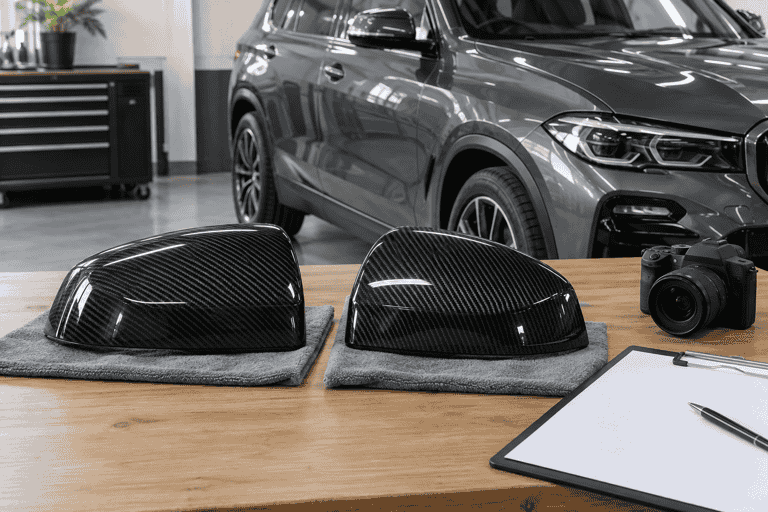
AI-generated inspection concept; the depicted covers are not a confirmed W463 kit or attachment diagram.
Use a functional handover checklist
Physical attachment is only part of completion. Have the qualified installer assess the functions and clearances relevant to the vehicle and work performed. Depending on equipment and scope, this may include mirror adjustment, folding, indicators and affected camera views.
Do not infer camera compatibility from the presence of an opening. If work affects equipment that requires a service procedure or calibration, follow the applicable requirements rather than assuming either that calibration is always needed or never needed.
| Handover item | Record in the job file |
|---|---|
| Product identity | Installed reference, side and revision |
| Attachment | Confirmation against the applicable method |
| Appearance | Agreed positioning and visible condition |
| Operation | Results of the relevant vehicle-function checks |
| Instructions | Care, operating and follow-up information supplied |
| Outstanding issues | Resolution before releasing an affected vehicle |
Explain any product-specific waiting period or recheck requirement to the customer. Do not invent a standard “ready immediately” promise when the installation system specifies otherwise.
When to pause and contact the supplier
Stop permanent work if the product type remains uncertain, an attachment does not match, an edge obstructs another component or a relevant function is affected. Send the order and reference, vehicle information, overview images, close-ups and a clear account of work already performed.
Use the fitment troubleshooting guide to organize that report. A precise description is more useful than repeated attempts to force the cap into place.
After the job is defined, use the dealer product-data checklist to retain the exact application, fitting method and included materials for sales and support staff.
Frequently asked questions
Can the same instructions cover every W463 mirror cap?
No. Confirm the actual vehicle, mirror assembly and overlay or replacement design before choosing an installation method.
Is an overlay always a no-risk installation?
No. Correct geometry, surface condition, bonding requirements and functional clearances still need review.
Does a replacement cover include a complete mirror assembly?
Not unless the contents list explicitly says so. Ask which original components remain and which items are supplied.
How much installation time should I quote?
Base the quote on the confirmed product, vehicle and work scope. Do not copy a generic duration before the required procedure and materials are known.
Get the support information before booking the job
Send your W463 vehicle details, product reference and mirror photographs. Ask for the fitting method, included materials and required verification before committing to a handover time.
Use the W463 mirror-cap catalog to identify the candidate part. Give your technician a defined job and your customer a clear expectation—not an installation plan built from a broad product title.