
A premium showroom does not need a wall of carbon parts for cars its customers do not own. It needs a credible selection that the sales team can explain, the workshop can assess and the business can supply without turning every order into an investigation.
For supercar carbon fiber parts wholesale, build the range around identifiable customer vehicles, confirmed product applications and a supportable installation scope. Separate display samples, controlled stock and customer-specific orders before committing to a broad assortment.
Send your target brands, models and requested parts for a focused range quotation. Do not let a large catalog dictate where your working capital goes. Choose the business you can actually serve.

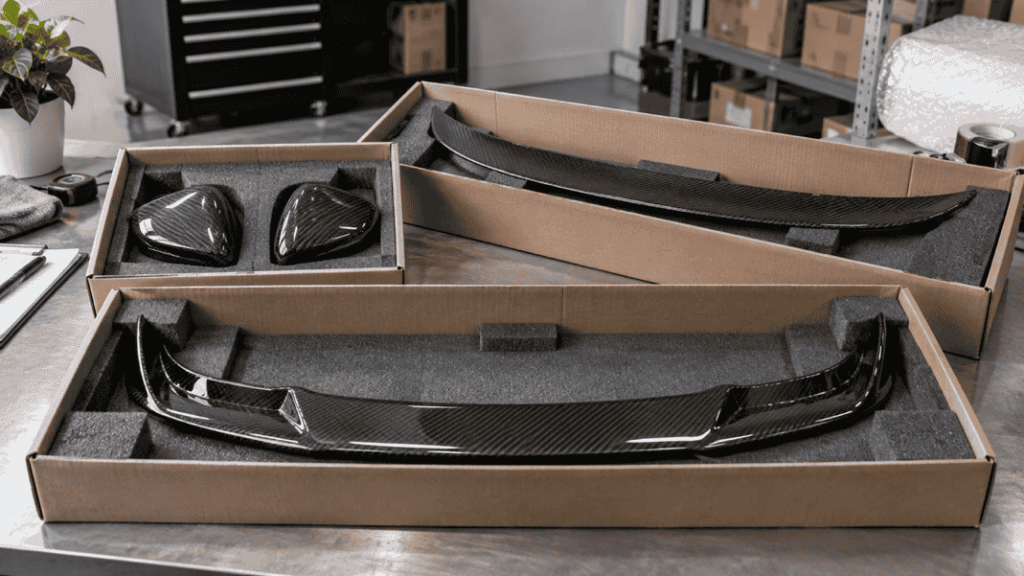
AI-generated showroom concept; not actual inventory, supplier premises or evidence of brand authorization.
Define your customer group before your brand list
Start with the cars you already sell, service or receive genuine inquiries about. Record the exact model, body style, production information and requested upgrade. Count distinct purchasing opportunities, not social-media likes or repeated messages from one prospect.
An independent supercar dealer, a tuning studio and a parts distributor may need different assortments. A dealer preparing a specific vehicle for sale has a known application. A distributor serving multiple workshops needs repeatable product data and replenishment information. A studio selling complete builds needs installation evidence and clear project timing.
If demand is not yet established, use customer conversations and a limited validation program to define the first shortlist. Treat interest as a reason to investigate, not as proof that a large opening order will sell.
Use the catalog to find candidates, not predict winners
The catalog reviewed for this guide includes entries under Ferrari, Lamborghini and McLaren, among other brands. The following are examples of groups to investigate, not recommendations based on sales performance:
| Catalog examples | Question before committing |
|---|---|
| Ferrari 296, F8, 488 GTB and SF90 groups | Which exact model and body version does each product cover? |
| Lamborghini Huracan-related groups, STO and Revuelto | Does the reference cover the actual variant, rather than a visually related model? |
| McLaren 720S, Artura and grouped Sports Series entries | Can combined catalog labels be separated into explicit applications? |
| Audi R8 | Which generation, production version and Coupe/Spyder body are supported? |
Do not convert a combined label into an interchangeability claim. A part listed alongside several model names still needs a written application statement for the vehicle being supplied.
Keep premium SUV opportunities, such as Urus or Purosangue inquiries, in a separately evaluated segment if they are part of your business. Their presence in a high-end brand catalog does not mean they serve the same customers or inventory plan as a mid-engine sports car.
Give every candidate a clear buying role
| Role | Purpose | Evidence needed before purchase |
|---|---|---|
| Display sample | Help customers assess finish and design | Identified reference, actual finish and clear limits on what the sample demonstrates |
| Controlled trial | Test a credible but unproven opportunity | Target application, agreed evaluation and limited commercial exposure |
| Core stock | Serve demonstrated repeat demand | Verified application, usable data and credible replenishment terms |
| Customer-specific order | Fulfill a defined vehicle or build | Confirmed customer scope, fitment, installation requirements and current quotation |
A display sample does not need to become an automatic stocking commitment. Equally, a product can remain customer-specific even if it attracts attention. Expensive inventory should earn its place through evidence relevant to your business.
Agree actual sample and minimum-order terms with the supplier. These buying roles do not imply that every part is available singly or that a trial order has a standard discount.
Prefer a small range your team can explain
For the first assortment, choose a limited set of applications with complete enough information to quote responsibly. An exterior trim piece with clear contents and instructions may be easier to introduce than a complex assembly with unresolved interfaces—but a small part is not automatically simple or universally compatible.
Assess each candidate using the same questions: Is demand identifiable? Is fitment supported? Can the installer define the work? Are the costs clear? Can a problem or replacement request be handled?
Do not let a high score on appearance compensate for an unanswered fitment or retention question. Treat missing technical information as a condition to resolve before purchase, rather than averaging it away in a buying score.
Review installation support before the retail price
Ask for actual product images, back-side or attachment views where relevant, a contents list and the applicable installation document. Identify any adjoining components, operating clearances or equipment that need assessment.
A full-build quotation requires a fitment answer for every line. A spoiler approval does not validate the diffuser, and a coupe installation photograph does not automatically cover a convertible. The Audi R8 fitment guide illustrates that part-by-part approach.
Do not sell measured weight reduction, downforce, cooling improvement or heat capability without relevant product evidence. A premium customer deserves clear specifications, not stronger adjectives attached to an untested claim.
Plan the replacement conversation before the first sale
Ask whether individual components can be reordered, how the supplier identifies revisions and what happens if the original version is no longer offered. Record whether brackets, adjoining trim or one side of a pair can be supplied separately.
Discuss appearance matching when replacing one part beside an existing installation. A new product and a used component may need a different review from two new items ordered together. Avoid promising a perfect match without an agreed basis.
Use the wholesale reorder checklist to define product references, contents and change confirmation. Your customer relationship can outlast the initial purchase; select products with a support process you understand.

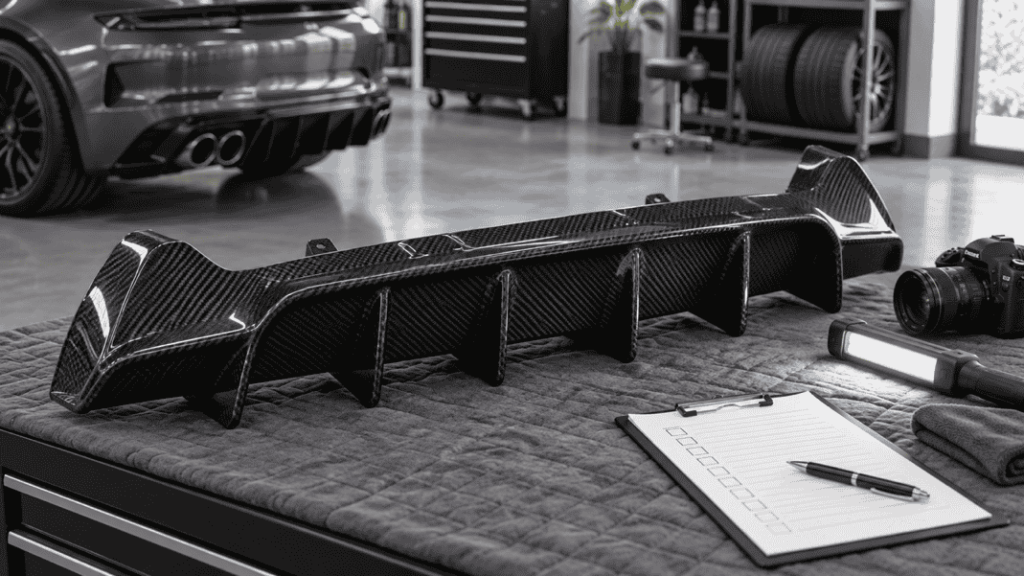
AI-generated planning concept; no sales forecast, verified color standard or market ranking is represented.
Calculate the commitment for the actual order
Compare product price, packing, freight, destination costs and any additional components. Keep installation and other selling expenses visible in your own proposal. Use confirmed values where available and identify the remaining estimates.
Consider storage space, protection requirements and how long the cash may remain tied up if the customer delays. A larger discount does not create demand for an extra hood or wing that has no planned buyer.
For customer-specific orders, agree your customer-facing scope and commercial terms before placing the supplier order. Do not assume a supplier’s return, cancellation or substitution policy matches the promise you made to the end customer.
The kit-versus-individual-parts guide helps compare purchasing formats without mistaking additional contents for additional value.
Launch with accurate product information
Keep a usable record for each selected reference: application, exclusions, construction, finish, contents, instructions, current supply status and approved images. Separate styling concepts from actual product and installation evidence.
The Auto Care Association’s PIES overview describes structured product information such as attributes, kit information and digital assets. You do not need to claim a standards-compliant feed to apply the practical principle: maintain consistent, specific information that your trading partners can use.
Review inquiries, quotations, completed sales, stock age and support issues after launch. Expand applications that your business can sell and support. Pause candidates where the same unanswered technical or commercial question repeatedly blocks a sale.
Before launching the selected references, use the dealer product-data checklist to confirm what your team can publish about fitment, contents, images and packing. A focused range still needs complete records for each product.
Frequently asked questions
Which supercar brand should a new dealer stock first?
Start with the customers and vehicles you can reach, then evaluate the specific products. This guide does not claim one brand is the best seller in every market.
Should a premium range include every available body-kit style?
No. Begin with choices your team can distinguish and support. Add variants when actual demand and complete product information justify them.
Can a shared platform or grouped catalog prove compatibility?
No. Obtain an application statement for each product and vehicle configuration. Shared naming or engineering background is not enough.
Is customer-specific ordering better than stock?
It depends on demand, delivery requirements and working capital. Compare both approaches and confirm the supplier’s actual terms before deciding.
Build a range that earns a second order
Do not buy a showroom story that your workshop cannot deliver. Send your target models, body versions, requested parts, destination and buying priorities now. Request a focused supercar range proposal with exact references, fitment scope, contents and current ordering conditions.
Ask which items are suitable for evaluation, which require more evidence and which can support the customer jobs already in your pipeline. A disciplined opening range gives you a stronger basis for the next order than a broad collection of unverified promises.