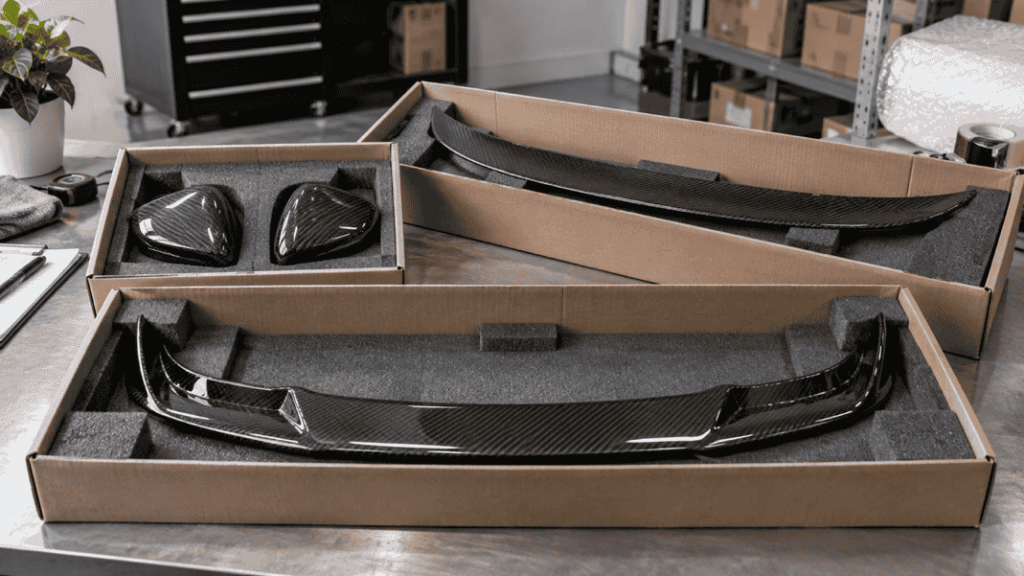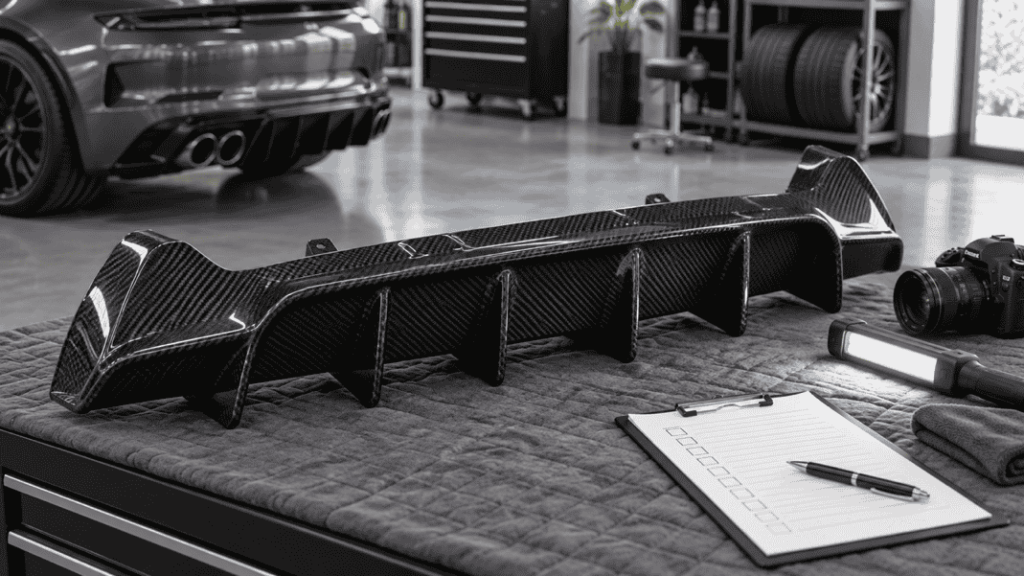

A customer wants a front lip installed before an event. Your distributor order also includes mirror caps and a rear diffuser. The supplier says some items are in stock and others need production. Which date can you give the customer?
For carbon fiber wholesale lead time, separate product readiness from dispatch, transit and arrival. Confirm the status of each exact product version and quantity, then build a delivery plan around the items needed for the job.
Our catalog is a product-selection reference, not a live inventory feed. Stock availability, production timing and shipping arrangements need confirmation against your selected parts and destination before purchase.

AI-generated planning concept. The products and cartons do not represent confirmed inventory or an actual shipment.
What does “in stock” actually mean?
A stock statement is useful only when it identifies the version, quantity, location and date of confirmation. A part may exist physically but still need inspection, finishing, accessories or packing before it can be released.
Ask whether the required quantity is available for your order and what, if anything, reserves it. A quotation is not automatically a stock reservation.
| Status | What to clarify before promising a date |
|---|---|
| Listed in the catalog | Is the selected version currently available to supply? |
| In stock | Is the exact quantity and finish available, and what work remains before dispatch? |
| Made to order | What starts the production clock, and what date is being quoted? |
| Awaiting inspection or packing | What remains outstanding and when can release be confirmed? |
| Ready for dispatch | Are order-release conditions complete, and when is carrier collection expected? |
| Collected by the carrier | What tracking or transport evidence confirms handover? |
| Estimated arrival | What service, destination and assumptions support the estimate? |
Use a dated status for every line. “Available” without a quantity or version can leave your customer waiting for a different part than the one discussed.
Made to order does not necessarily mean custom development
A standard catalog product may be manufactured after an order is placed. That is different from commissioning a new design, tool or private-label packaging arrangement.
For a standard made-to-order part, request the confirmed specification and production schedule. For a custom project, identify the additional approval stages and ask how they affect timing. Do not apply a standard-product lead time to a project with unresolved design or tooling work.
Before accepting a production estimate, confirm:
- The product reference, revision, material and finish.
- Quantity and unit of sale: piece, pair or complete set.
- Any sample, fitment or artwork approval required before production.
- The agreed event that starts the quoted lead time.
- Whether the estimate uses working days or calendar days.
- Whether inspection, finishing and packing are included.
Choose the relevant parts from the catalog and ask for a schedule based on that list, rather than a general lead-time statement.
Build the schedule around clear milestones
A useful order schedule names the event attached to each date. “Ready next month” could refer to production completion or collection, while your customer hears “arriving next month.”
| Milestone | Confirmation to request |
|---|---|
| Specification agreed | Exact versions, quantities and any exclusions recorded |
| Order released or stock allocated | Starting conditions satisfied and allocation or production status confirmed |
| Production complete, where applicable | Selected items completed; remaining work identified |
| Inspection and packing complete | Required release checks complete and shipment details available |
| Carrier handover | Collection or acceptance confirmed |
| Estimated arrival | Current transport estimate, destination and known dependencies |
| Received and checked | Correct parts and accessories available for the customer job |
A tracking number alone does not always mean the goods have left the sender. DHL’s tracking status definitions distinguish pre-transit from carrier acceptance or pickup. Use the actual handover milestone when updating a customer.
Shipping and clearance activities can overlap, so avoid simply adding every estimate as if all stages must happen one after another. Ask the supplier and logistics provider which stages are included in their quoted timing and where uncertainty remains.
Plan mixed orders line by line
A mixed order may contain products with different readiness dates. The item that matters most is not always the most expensive one: a missing mounting component can prevent a complete installation even if the main part has arrived.
Use a simple status sheet:
| Product reference | Quantity | Confirmed status and date | Ready-for-dispatch estimate | Needed for | Shipment group |
|---|---|---|---|---|---|
| [Front lip reference] | [Sets] | [Supplier response] | [Date or pending] | Customer installation | [Group] |
| [Mirror-cap reference] | [Pairs] | [Supplier response] | [Date or pending] | Stock / customer job | [Group] |
| [Diffuser reference] | [Sets] | [Supplier response] | [Date or pending] | Customer installation | [Group] |
This is a planning template, not a stock statement or quoted delivery schedule.
Identify which lines must arrive together and which can be received independently. Then request the available shipping options.
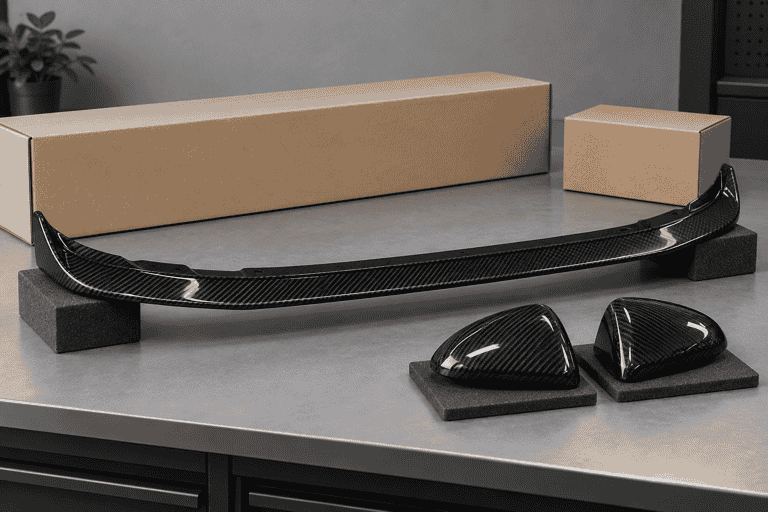
AI-generated mixed-order concept. Packaging and product availability are illustrative, not confirmed specifications.
Consolidate or split the shipment?
Consolidation may simplify receiving, but waiting for an unfinished line can delay the rest of the order. A split shipment may help a time-sensitive job, but it can introduce additional freight and handling costs. Neither option is automatically cheaper or faster for the complete order.
Compare the proposed dispatch dates, carton details and full quoted shipping scope. Ask whether each shipment contains everything needed for its intended installation. Confirm additional charges and any change to the remaining schedule before authorizing a split.
For sample quantities and mixed-order eligibility, see our wholesale MOQ and mixed-model ordering guide.
Work backward from the customer’s required date
Ask for the date the parts must be received and checked at the workshop, not only the date of the event or customer collection. Leave room for your own receiving inspection, trial fit and installation process.
Use this sequence:
- Establish the customer’s required completion date.
- Allow for the actual installation and any product-specific release conditions.
- Set a target date for receipt and inspection of the complete kit.
- Review transport timing and contingency with the logistics provider.
- Obtain a feasible ready-for-dispatch date for every essential line.
- Confirm whether stock allocation or production can support that plan.
Choose contingency based on the route, service, order complexity and consequences of delay. Do not rely on a universal buffer or promise that expedited freight can recover any production delay.
A tentative installation slot may be useful while the order is progressing. Make its status clear and confirm the final booking when your shop has sufficient evidence that the correct parts will be available.
Confirm shipping information early
Provide the destination country, postal code, consignee details and any receiving restrictions when requesting the quotation. Ask who is responsible for supplying the required import information and responding to clearance requests.
DHL identifies missing or incomplete information as a common cause of delay in its customs clearance guidance. This does not create a fixed clearance timeline for your shipment; it shows why document preparation belongs in delivery planning.
Confirm the transport service, quoted delivery scope and who pays any charges excluded from the quote. If the shipping method changes, request an updated estimate and cost before treating the old arrival date as valid.
Agree how schedule changes will be handled
Before placing the order, identify the contact responsible for updates and the milestones at which you expect confirmation. Ask for prompt notice when a change threatens the agreed schedule.
A useful update should state:
- Which line is affected and its current status.
- The revised date or the information still needed to estimate one.
- The next action and responsible person.
- Available alternatives, if any, with their costs and implications.
- When the next update will be provided.
Do not accept a different finish, material or product version as a timing substitute without reviewing and approving it. A part that arrives sooner but does not meet the customer’s fitment or appearance requirements has not solved the delivery problem.
A clear customer update can be short: “The lip is ready for dispatch, but the diffuser is still pending production confirmation. We have requested separate shipping options and will update you when collection and the revised arrival estimate are confirmed.”
Keep a replenishment record for dealer stock
For repeat orders, record when the specification was confirmed, when the order was released, actual dispatch, actual receipt and when the goods were ready to sell or install. Keep those dates separate so you can see where delays occurred.
Review the history by product and route rather than assuming one order represents the entire catalog. Use it alongside current supplier information when planning future replenishment. A previously fast delivery is useful history, not a guarantee of the next shipment.
For a broader assessment of ongoing supply, see our supplier selection guide.
Frequently asked questions
Does a catalog listing mean the part is in stock?
No. Confirm the exact version and quantity, and ask what remains before dispatch. Catalog coverage and live availability are different information.
When does made-to-order lead time start?
It depends on the agreed terms. Ask which event starts the clock and whether approvals, inspection and packing are included in the quoted period.
Is production lead time the same as delivery time?
No. Production timing concerns making the part. Dispatch, transport, clearance and final delivery need their own scope and confirmation.
Can stock items ship before made-to-order items?
Request a split-shipment option. Availability, completeness, cost and the effect on the remaining order must be confirmed before approval.
Does express shipping guarantee the customer deadline?
Do not assume so. It does not remove unfinished production or unresolved order requirements. Check the actual service terms and the schedule for the complete order.
When should a workshop confirm installation?
Base the decision on the parts required, current shipment evidence and the shop’s receiving and inspection needs. Keep provisional bookings clearly identified until the job can be supported.
Send your parts list and target arrival date
Request availability and a delivery plan for your selected products. Include the required arrival date so the enquiry addresses the customer’s job, not just a factory completion estimate.
Copy and complete:
- Business name and delivery country / postal code:
- Product references, quantities and units:
- Required material and finish for each item:
- Target date for receipt at your shop:
- Customer installation or event date, if relevant:
- Which parts must arrive together:
- Preference: consolidated shipment / quote split options:
- Any receiving restrictions:
Please confirm per line: current stock or production status, confirmation date, allocation conditions if applicable, lead-time starting point, expected ready-for-dispatch date, shipping scope and outstanding dependencies.
Use the response to agree the next milestone before making a firm commitment to your customer.