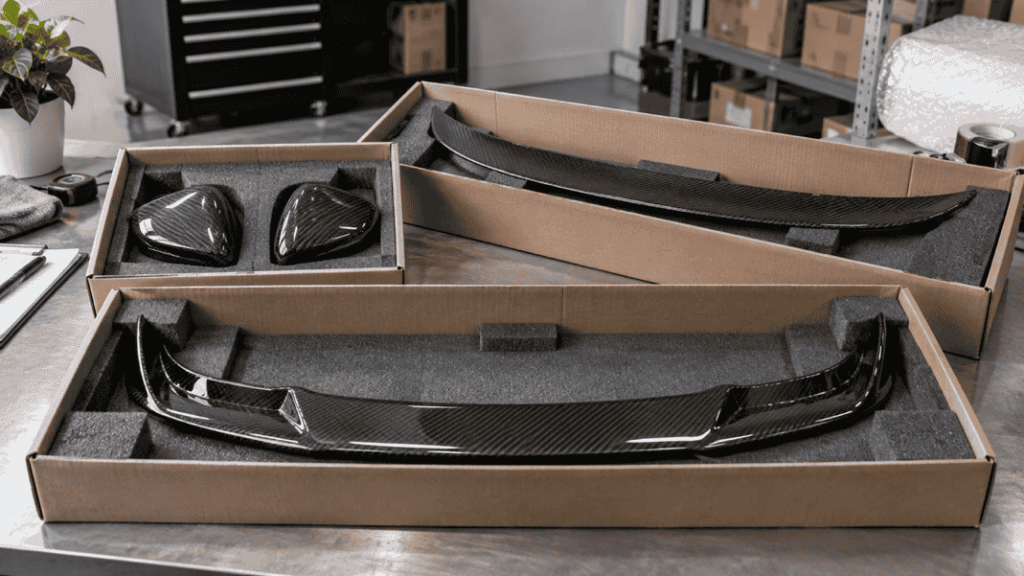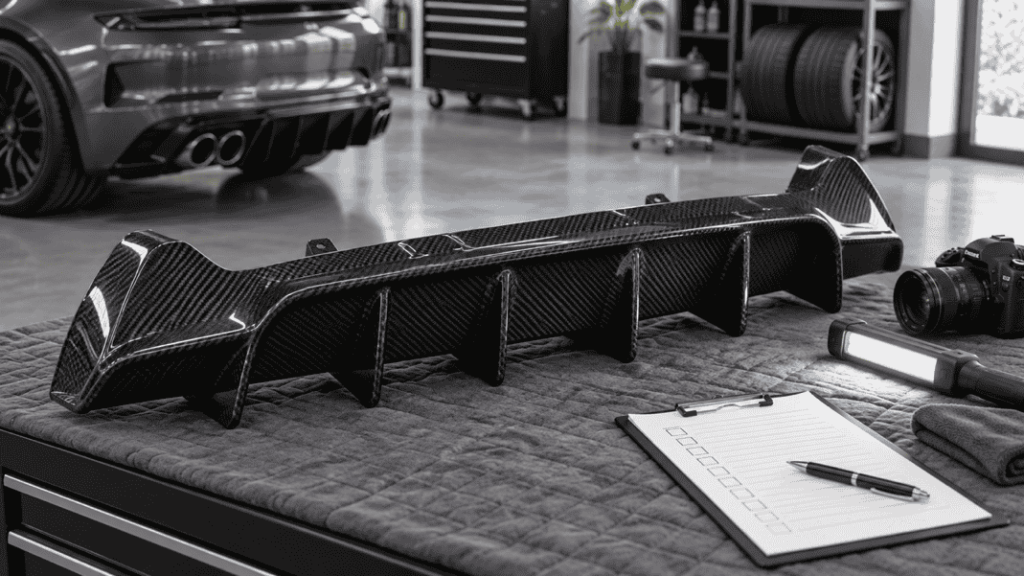

A cheaper front lip can become the more expensive purchase once packing, freight and destination charges are included. If your shop quotes the customer from the product price alone, the missing costs can come straight out of your margin.
Carbon fiber body kit landed cost is the cost of getting the agreed goods to the specified destination, using a clearly defined scope. Compare parts, packing, transport and applicable destination charges together. Keep workshop installation costs separate so you can price the complete customer job accurately.
Before accepting a unit-price offer, request an itemized quotation for your actual parts, quantity and delivery address. A low number is useful only when you know what it includes.

AI-generated cost-planning concept; no prices, inventory or freight quotations are represented.
What belongs in the comparison?
The International Trade Administration’s total export price guidance recommends considering the landed cost and clarifying who bears duties and taxes. For your order, list each cost once and distinguish quoted figures from estimates or unresolved items.
| Cost line | Ask the supplier or logistics provider |
|---|---|
| Products | Exact references, quantities, currency and included hardware? |
| Packing | Standard packing included? Any separately quoted crate or reinforcement? |
| Origin transport and handling | Included in the shipping quote or charged separately? |
| Main freight | Service, route, shipment scope and quote validity? |
| Insurance, if arranged | Premium, coverage scope, exclusions and claim process? |
| Destination handling and clearance | Which charges remain payable locally, and by whom? |
| Duties and taxes | What estimate applies to the actual destination and classification? |
| Final delivery | Delivery to the stated address included? Any receiving restrictions? |
Confirm taxes and classification with the appropriate broker or local adviser. This guide does not supply a universal tariff rate. Treat potentially recoverable taxes separately in your own accounting; cash needed at import and the final economic cost may differ.
Compare the same delivery scope
Two quotations can look different because they stop at different places. One may cover goods ready at the supplier’s premises; another may include transport to your address. Ask for the named delivery term, place and included charges rather than assuming “shipping included” means every cost is covered.
Avoid counting an included freight or packing charge twice. Equally, do not assign zero to a missing charge. Mark it “pending confirmation” until you have an answer.
Use the same currency and exchange-rate assumption when comparing alternatives. Record the rate and date used, along with quote validity, so a colleague can reproduce the comparison.
An illustrative order comparison
The following figures are entirely hypothetical. They are not our prices, a freight offer or a tax calculation.
| Cost category | Offer A | Offer B |
|---|---|---|
| Same specified parts | $2,000 | $2,150 |
| Separately charged packing | $150 | $0 — assumed included |
| Freight to the same delivery point | $650 | $450 |
| Other destination costs | $200 | $200 |
| Comparable subtotal before any unlisted duties or taxes | $3,000 | $2,800 |
Offer A starts $150 cheaper on parts but ends $200 higher on the listed scope. Neither subtotal is a final landed quote until all applicable charges have been identified.
The lesson is practical: compare complete scopes before negotiating the last few dollars of unit price. A missing freight line can matter more than the discount you worked hard to obtain.
Packed dimensions matter—not just the product’s weight
A front lip, hood or pair of side skirts may require a large protective package even when the component itself feels light. Request final external carton dimensions, packed gross weight and the number of packages for the proposed shipment.
Ask the carrier or forwarder how the shipment will be rated, including any dimensional-weight or size-related rules for the chosen service. Do not apply one divisor or surcharge schedule to every carrier and transport mode.
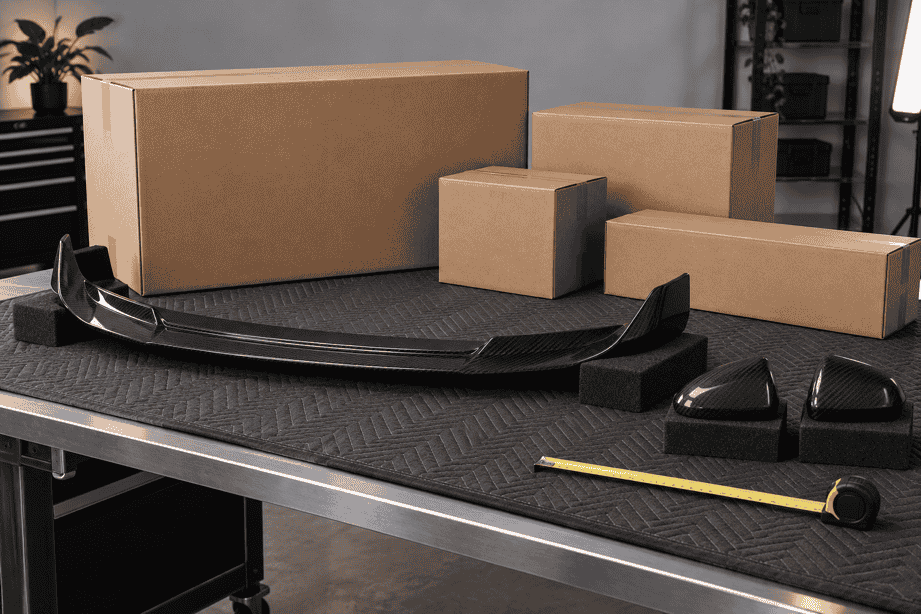
AI-generated illustration; carton sizes and packing arrangements are not measured shipment specifications.
If dimensions are provisional, make that clear in the quotation. Ask when final packing data will be available and how a change would affect price. Do not promise the customer a final delivered cost from an unconfirmed bare-part weight.
Mixed orders: allocate freight sensibly
A flat per-piece split can distort margins when a shipment combines small mirror caps with long aero parts. Choose an allocation method that reflects the shipment: for example, chargeable weight, package-level costs or another documented basis appropriate to the quoted service.
The goal is not a universally perfect formula. It is a consistent, explainable method that does not make the largest item appear artificially profitable by shifting its transport cost onto smaller items.
For a customer-specific bundle, it may be more useful to track the complete bundle cost. For reseller stock, retain item-level allocations so you can see which products support the intended selling price.
Consolidation can help—but test the complete offer
Ask for both consolidated and split options when readiness dates differ. Compare cost, arrival assumptions and whether each shipment contains a usable set of parts.
Do not force extra inventory into the order only to make freight per unit look smaller. Consider cash tied up in stock and the demand you actually have. Likewise, do not delay a booked customer job without checking whether a separately quoted shipment is commercially sensible.
Our dealer delivery-planning guide helps separate production, dispatch and arrival dates. A cost comparison without a feasible schedule is incomplete.
Keep installed-job cost separate
Once landed goods cost is established, your workshop still needs to account for receiving inspection, installation labor and any job-specific materials or services. These are not automatically part of a supplier’s landed quotation.
Do not rely on an advertised margin without checking the complete job. Identify which expenses are confirmed, which are estimates and what would require customer approval if the scope changes.
Before issuing a final customer quote, close the material gaps: exact version, included fittings, freight basis, destination costs and installation requirements. If you cannot close a gap, state the assumption plainly rather than hiding it in an optimistic total.
Frequently asked questions
Is landed cost the same as the product price plus shipping?
Not necessarily. Packing, handling, clearance, applicable duties and taxes or final delivery charges may also apply. Define the scope and confirm excluded costs.
Can you quote freight from the product name alone?
A useful quote needs the selected products, quantities, packing information and destination. A generic estimate should not be presented as a final shipment price.
Does ordering more always reduce my real cost?
It may change unit pricing or freight allocation, but it also increases inventory commitment. Compare the full order against realistic demand.
Should every item receive an equal share of freight?
Not automatically. Use a documented allocation basis suited to the package mix and transport quotation.
Stop guessing the margin—request the breakdown
Do not let an incomplete quote become a customer promise. Send your shortlist, quantities and destination now and request the costs line by line. Ask for a landed-cost breakdown, including what remains payable locally and what is still provisional.
Include product references, desired finish, quantity and unit, country and postal code, target arrival date, receiving restrictions and whether split shipping is acceptable. Ask for packing dimensions, gross weights, quote validity and the delivery scope.
Start with the product catalog. A precise list gives the supplier something concrete to price—and gives your business a stronger basis for the next customer quotation.