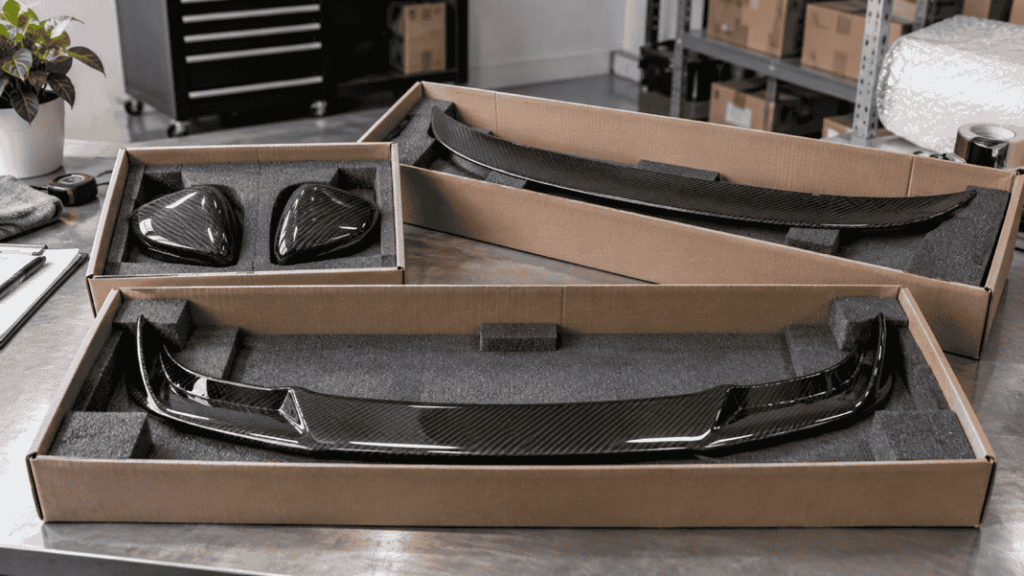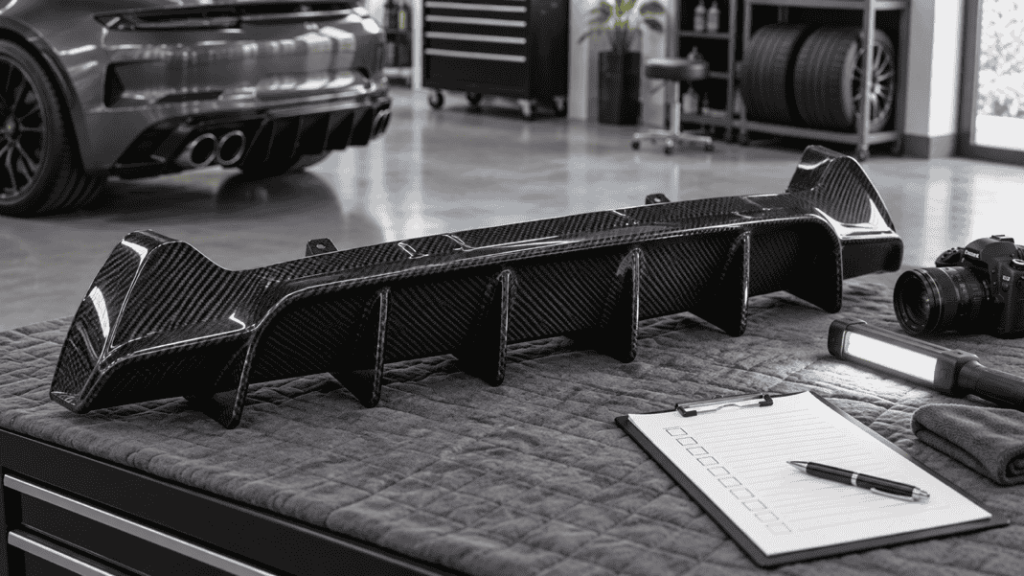
A body-kit freight comparison is unreliable when providers receive different package assumptions. Request the available packing information for the actual order and identify which dimensions or weights remain estimates.
A damaged hood does not arrive alone. It brings a delayed customer job, an inspection request and a discussion about who pays for the next shipment. The time to clarify protection and responsibility is before dispatch—not while your customer is waiting for a replacement. Shipping carbon fiber body kits wholesale requires a product-specific packing plan, confirmed packed dimensions and a documented receiving process. A hood, front lip and pair of side skirts should not automatically receive the same packaging simply because all three are carbon fiber. Request the packing and shipping proposal for your selected parts before approving freight. Ask for actual information, not just the words “strong packaging.”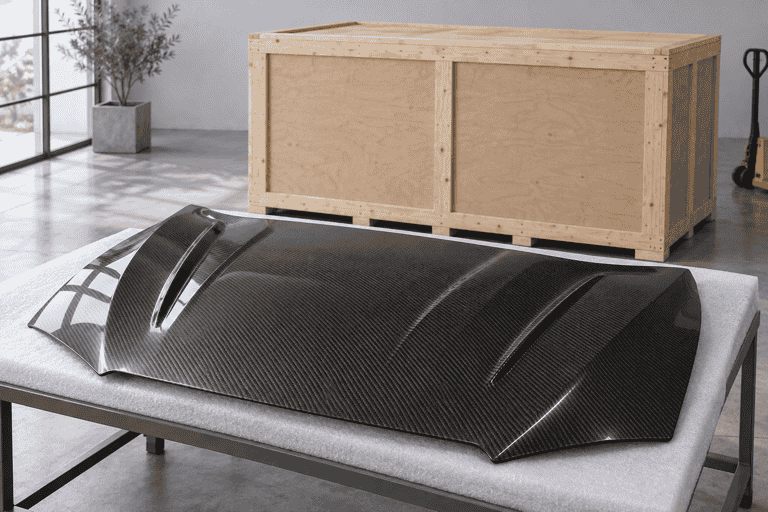 Illustrative buying scenario.
Start with the part’s vulnerable features
Ask how the proposed packaging addresses the actual geometry. Long extensions, narrow edges, mounting tabs and large finished surfaces need attention in the product-specific design.| Product | Questions for the packing proposal |
|---|---|
| Hood | How are the panel, corners and mounting features supported without concentrating loads? |
| Front lip | How are projecting ends and curved sections restrained without distortion? |
| Side skirts | How are long spans supported and left/right pieces separated? |
| Multi-piece aero kit | How are sections, hardware and accessories separated and identified? |
Ask for the package before you accept the freight quote
Request the final or clearly marked provisional external dimensions, gross weight, package count and packing method. Include the destination, planned service and receiving capabilities. A crate may be appropriate for some shipments, but the word “crate” does not prove the internal restraint is adequate. A carton may suit another product when correctly designed. Review the complete packing arrangement rather than making the decision from the outer material alone. Ask whether the proposed method has been evaluated for comparable parts and the intended transport conditions. Where package testing is claimed, request the actual scope and relevance. Do not infer testing from a photograph or a sticker. If a pallet or crate is proposed, have the logistics provider confirm handling and any destination packaging requirements. Check whether your receiving site has the equipment and access needed for delivery.Request a useful pre-dispatch photo record
A photo of a sealed box tells you little about what is inside. Ask which records can be supplied and agree the scope before shipment. Useful images include:- The identified product and included sections before packing.
- Its visible condition and vulnerable features.
- Internal supports and separation before closure.
- Secured accessories and their location in the package.
- The closed package, shipment identification and overall condition.
- Recorded external dimensions and gross weight where needed for the quote.
Do not let consolidation create a new problem
Combining products can alter packing requirements. Ask whether parts will share a package, occupy separate cartons or be consolidated on a pallet. Confirm how movement and contact between components are prevented. Loose accessories should not be able to contact a visible carbon surface during handling. Separate packages also need a contents map so receiving staff can identify which items belong to the same customer job. Compare the complete proposal, including package count, service eligibility, freight and expected handling. The smallest shipping bill is not automatically the best commercial result when it depends on an unreviewed packing arrangement. Use our landed-cost comparison to compare the financial scope without treating unspecified packing as free.Agree responsibility and reporting before dispatch
Ask who arranges transport, who will submit a carrier claim if needed, and how supplier support works alongside the carrier process. Confirm the applicable shipment terms rather than assuming a universal damage policy. Discuss any requested insurance or declared-value arrangement with the provider. Clarify what it does and does not cover; do not treat a value written on a label as an automatic guarantee of full reimbursement. Record the reporting channels and deadlines that apply to the specific service and supplier arrangement. Avoid borrowing a claim deadline from another country, carrier or transport product. Your customer’s remedy and the supplier’s carrier claim may be separate processes. Clarify how the customer order will be handled while an investigation is underway, without assuming immediate replacement or reimbursement of workshop labor.Receiving checklist for hoods and long parts
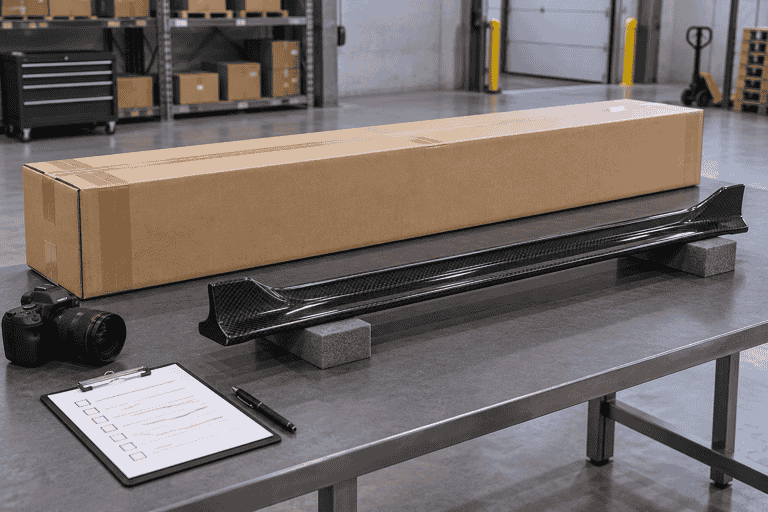 Illustrative buying scenario. Before arrival, assign someone to receive the shipment and provide a protected inspection area. Confirm package count and access needs in advance. At receipt, follow the carrier’s applicable procedure. Record visible package damage and discrepancies accurately; retain delivery documentation. Do not sign a statement that contradicts what you actually observed. When opening, photograph the exterior, supports and contents in sequence. Check product identity, section count, hardware and visible condition before installation. Avoid discarding packaging until the agreed inspection is complete; if a claim is involved, retain it as required. FedEx’s damage-claim guidance specifically instructs customers to keep original packaging for inspection until the claim is resolved. Check the corresponding requirements for the carrier actually handling your shipment.
If damage is found, preserve the evidence
Keep the part unmodified and avoid polishing, repairing or installing it before the issue is documented and the next action agreed. Photograph the whole item and close-ups showing the location and nature of the concern. Send the supplier and relevant logistics contact the order reference, tracking details, package record, product photos and a factual description. Separate observed damage from assumptions about its cause. A dented carton may be relevant evidence, but it does not explain every possible product defect. Ask who needs to inspect the goods and whether the packaging must remain intact or available. Do not return or dispose of items without checking the agreed process.Give the factory and freight provider the same shipment brief
| Decision | Buyer input | Confirm with the supplier |
|---|---|---|
| Packing data | Request carton count, package dimensions and gross weight for the quoted scope. | Ask when estimated packing data can be confirmed. |
| Handling requirements | Identify protection and any special handling information supplied for the parts. | Do not assume all packaging offers have the same contents. |
| Delivery responsibility | State destination and the requested delivery scope. | Identify which charges and handover stages each offer covers. |