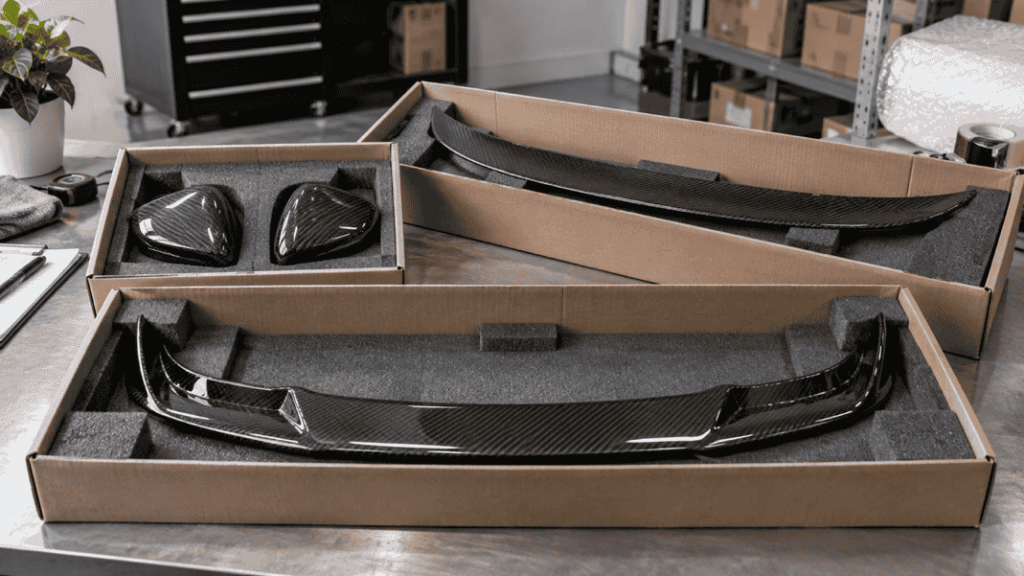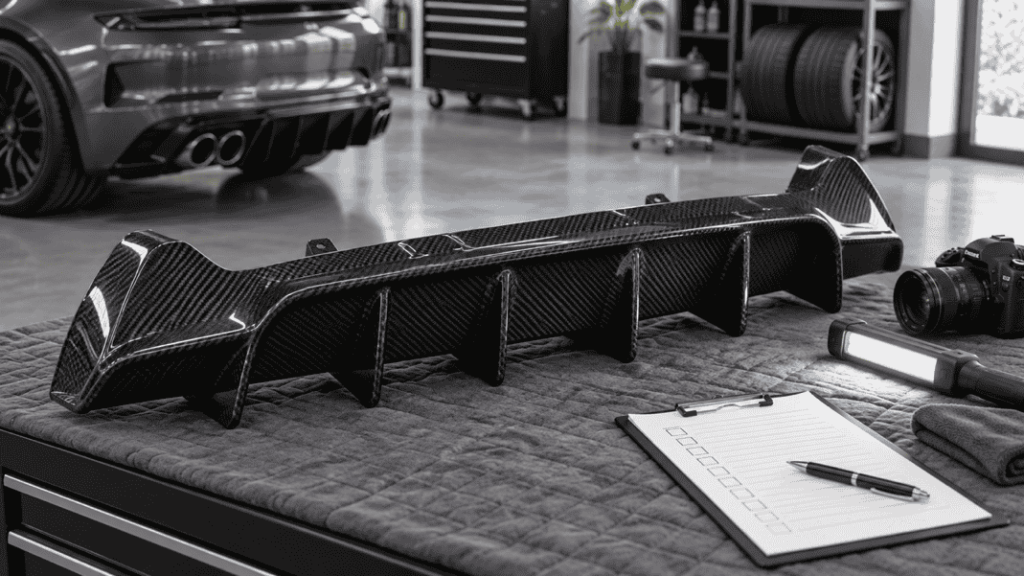

The cheapest quote is not a saving if it buys a different product. A missing mounting kit, an unspecified backing material or freight excluded from the total can turn your apparent discount into a workshop problem.
To compare carbon fiber wholesale quotes, give every supplier the same vehicle specification, product scope, finish, quantity and delivery requirement. Then separate confirmed differences from unanswered questions before comparing price. An unanswered field is not an included feature.
Send your specification for a comparable quotation before committing to your customer’s selling price. Your margin deserves more than a spreadsheet containing three unexplained totals.

AI-generated purchasing concept; not an actual quotation or supplier assessment.
Start with one purchasing specification
Write a short requirement that each supplier can answer without guessing. Include the exact vehicle, production information, current bumper or other mounting surface, product reference, finish, quantities and destination. Attach current vehicle photographs when fitment depends on the installed bodywork.
For a repeat purchase, identify the previously approved product revision. A matching marketing name is not enough to establish that the mold, mounting arrangement or supplied accessories are unchanged.
Keep your customer’s private information out of general requests. Suppliers usually need the technical vehicle configuration and shipment requirements, not your customer database. Share additional identification through an agreed channel only when needed.
Use a comparison table that exposes missing scope
| Comparison field | What needs to match or be explained |
|---|---|
| Vehicle fitment | Exact model, body, production scope and relevant options |
| Product identity | Supplier reference, revision, design and assembly contents |
| Construction | Manufacturing description, reinforcement and backing materials |
| Finish | Weave appearance, gloss or matte finish, visible surfaces and agreed inspection criteria |
| Installation scope | Fittings included, transferred components and required instructions |
| Quantity | Pieces, pairs or complete sets; price-break basis |
| Packing | Protection included, package count and any separate reinforcement charge |
| Delivery | Named delivery term and place, freight scope and excluded charges |
| Timing | Product readiness, dispatch estimate and quotation validity |
| Support | Evidence required for a problem report and agreed remedy process |
Do not convert a vague description into a favorable assumption. If one offer says “carbon” and another specifies the construction, ask the first supplier to complete the field. It may be suitable, but the comparison is not ready yet.
Material labels do not replace a specification
“Dry carbon,” “wet carbon” and “full carbon” can be used inconsistently in sales descriptions. Ask what the supplier means for that particular part: reinforcement, resin process, internal structure, finish and any non-carbon elements.
Request a measured weight only when weight matters to the sale, and confirm what was weighed. A bare shell and an assembly with brackets are not directly comparable. Do not promise strength, weight reduction or heat performance from a label alone.
Our dry versus wet carbon guide can help your team frame the questions. For purchasing, the deciding document is still the confirmed specification for the selected item.
Find out what “complete” actually includes
One supplier may sell the visible outer part while another includes brackets or adjoining trim. Ask for a numbered contents list and clear photographs. Confirm whether fasteners, bonding materials or original vehicle components must be sourced separately.
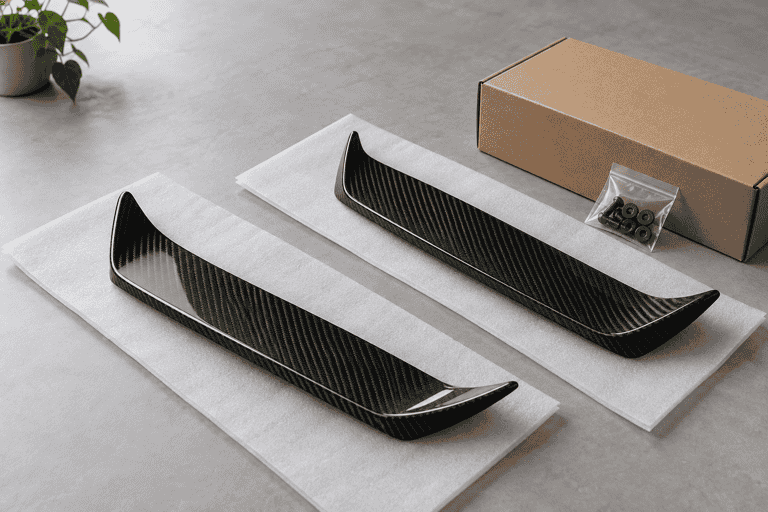
AI-generated supply-scope illustration; accessories shown are not an actual included kit.
A hypothetical example: a $280 part with a separately priced $45 fitting kit totals $325 before other charges. A $310 offer that includes the same required kit is $15 lower on that limited scope. These invented figures illustrate comparison arithmetic, not our pricing or a claim that the two products are technically equivalent.
The opposite can also be true: an included accessory may be unnecessary for your application. Compare what your job requires, not the number of items in the box.
Separate product price from delivery cost
Record currency, payment terms, quotation validity and the named delivery point. Ask whether packing, freight, insurance if arranged, destination handling and final delivery are included or excluded. Use the landed-cost guide for the shipment-level comparison.
The International Trade Administration’s pro forma invoice guidance identifies item prices, weights and dimensions, sale terms, payment terms, estimated shipping date and validity among the useful quotation fields. Those details make a commercial offer easier to review; they do not independently verify product quality.
Compare evidence before negotiating discounts
Request fitment evidence for the relevant configuration and an inspection scope you can actually use. Ask which surfaces are assessed, how appearance is documented and how an approved sample relates to the production order.
A supplier’s quick reply is helpful, but it is not a substitute for a clear answer. Keep a decision column beside the price: confirmed, pending or unsuitable. A quote with unresolved fitment should remain pending even if it is the lowest.
For an initial order, agree how a sample or pilot order will be reviewed before committing to broader stock. Do not assume sample approval guarantees every future shipment; record the specification and acceptance process for repeat orders.
Frequently asked questions
Should I always choose the lowest wholesale price?
Only after confirming that the relevant product, accessories, delivery scope and support terms meet your requirements. Price comparison cannot resolve a missing fitment answer.
Can I compare a pair price with a piece price?
Convert both to the same order quantity and contents first. Record the unit explicitly, especially for skirts, mirror covers and multi-piece kits.
Should I send another supplier’s confidential quotation?
You can usually prepare your own neutral requirements sheet instead. Remove private commercial details and share only information you are authorized to disclose.
What should I do when an offer has missing fields?
Return a short question list. Mark the offer pending and avoid treating blanks as zero cost or confirmed compatibility.
Get a quote your business can actually use
Stop negotiating against an incomplete specification. Send your vehicle details, product list, quantities and destination now. Request a line-by-line offer that states what is included, what needs confirmation and when the quotation expires.
A clear comparison lets you defend your selling price, choose deliberately and place the order with fewer unanswered questions. Resolve the gaps before they become your customer’s complaint.