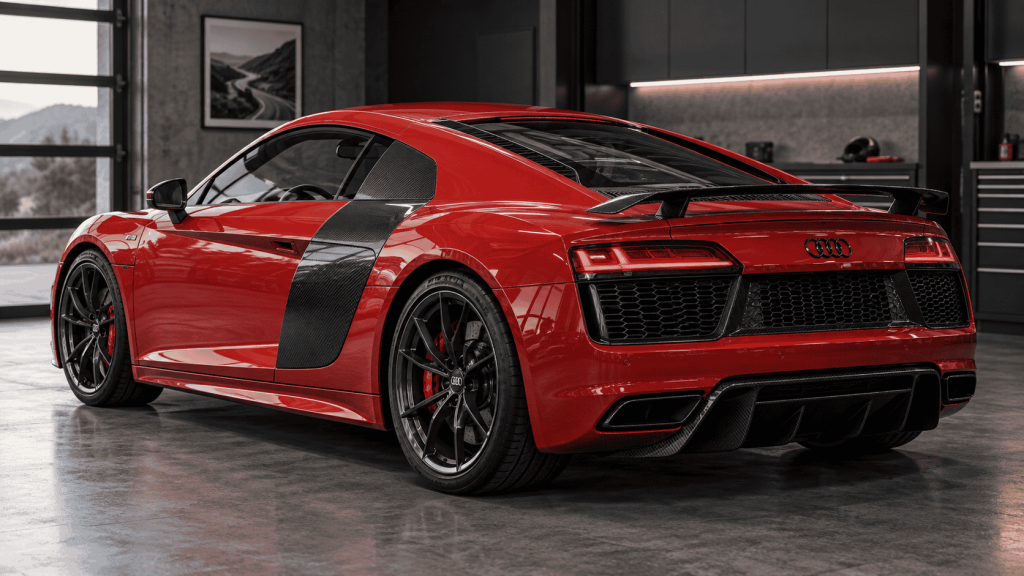
A customer brings in an R8 and asks for a coordinated carbon exterior. The opportunity is attractive, but “R8 carbon kit” is not a complete purchasing specification. A front lip, side intake trim and rear wing can each depend on a different vehicle interface.
Audi R8 carbon fiber parts fitment should be confirmed separately for each product against the vehicle generation, production version, Coupé or Spyder body and current components. One successful fitment answer does not validate every item in the proposed package.
Send the vehicle details and parts shortlist for an R8 application review. Resolve the version questions before your customer approves a final installed quotation.
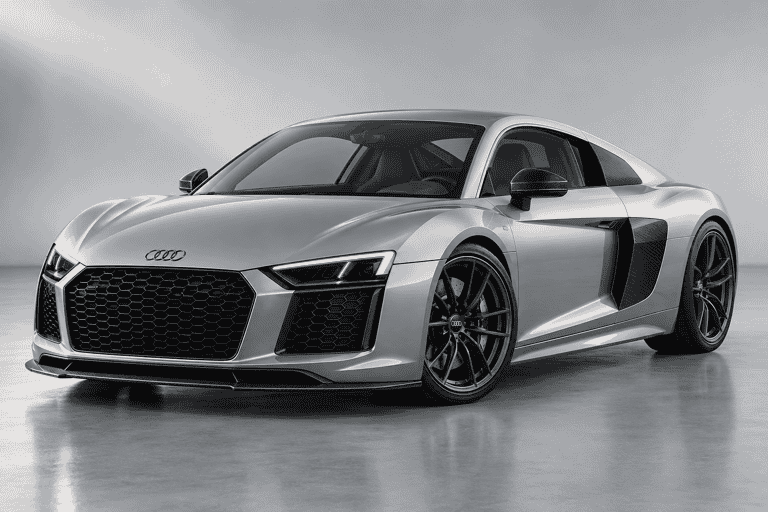
AI-generated styling concept; not a verified product application or model-year fitment reference.
Start with a vehicle record, not a catalog heading
Record the actual model, generation, production information, market and body style. Include the relevant variant designation and any bumper, exhaust or bodywork changes. Registration year alone may not describe the production specification or current mounting surfaces.
Audi’s archived R8 exterior-design information discusses distinct Coupé and Spyder design features, while its updated-model overview describes revisions to the exterior. These references explain why body and production version matter; they do not establish compatibility for any aftermarket component.
The catalog snapshot reviewed for this guide groups 42 records under R8 without a complete generation-by-generation application table. Use that group to shortlist items, then request the actual product references and confirmed applications. Do not infer 42 distinct, currently available or universally compatible products.
Front lips and canards: identify the bumper first
Photograph the customer’s current front bumper straight on and from both front corners. Ask the supplier which bumper and production version the proposed lip or canard is designed for.
Confirm whether the product is a complete lip, one section of a multi-piece assembly or a separate corner element. Request the underside or back-side view, the mounting requirements and the contents list. A styling photograph may show several components that are sold separately.
For a lowered or modified vehicle, discuss the customer’s practical clearance requirements with the installer. Do not promise that a particular design will clear every driveway or that a visual rendering proves acceptable clearance.
Keep any relevant equipment or airflow requirements in the product review. A part that can be positioned against a bumper has not necessarily passed all required installation and functional checks.
Side pieces: distinguish the actual component
“Side carbon” can refer to skirts, intake surrounds, sideblade-related parts or other trim. Ask which surface the item attaches to and whether it is an overlay or a replacement component.
For skirts, confirm the body application, sale unit and mounting arrangement. For intake-area trim, request the actual footprint, back-side detail and instructions. Do not assume two pieces with similar exterior lines have the same interfaces.
Avoid using a photograph of an entire sideblade to approve a smaller intake surround, or vice versa. Put the supplier reference and exact contents on the quotation so both the customer and installer know what will arrive.
Rear diffusers: check the bumper and exhaust together
Record the rear bumper and exhaust configuration, including aftermarket outlets or other modifications. Ask whether the proposed part replaces the lower section, adds to it or requires adjoining components.
Request back-side images, included fittings and the product-specific clearance requirements. An outlet shape that looks similar is not enough to establish its location or relationship to the diffuser.
Do not promise a heat limit or aerodynamic gain from a carbon label. Performance and application claims require relevant evidence for the selected product and installation. The purchasing task is to identify a supported combination, not to improvise around an unknown one.
Wings and engine-area trim need separate review
For a spoiler or wing, identify the exact mounting surface, existing assembly and any affected movement or service access. Ask for the support and attachment arrangement, supplied components and installation documentation.
For engine-area pieces, clarify whether the item is decorative trim, a cover or another component. A broad listing translation may not reveal the complete scope. Ask for photographs that show the actual part and its intended location.
Coupé evidence should not automatically be applied to a Spyder. If a proposed piece is near roof mechanisms, covers or opening panels, request the relevant application and operating-clearance assessment. A stationary image cannot demonstrate the full operating envelope.

AI-generated styling concept; not proof of roof clearance, engine-area compatibility or a completed installation.
Mirror covers and front lids are their own decisions
For mirrors, distinguish overlays from replacement covers and confirm the actual housing configuration, side and relevant equipment. A pair price and a single-cover price must not be mixed in the order.
For a front lid, request the product-specific attachment, closure, supplied-parts and installation requirements. Do not transfer a generic body-trim fitting method to a closing panel. The qualified installer needs the applicable instructions before work is scheduled.
A combined order can still make commercial sense, but every line should have its own application answer. Mark unconfirmed items pending rather than allowing the approved parts to imply approval of the rest.
Use a part-by-part purchasing sheet
| Product area | Vehicle detail | Supplier evidence to request |
|---|---|---|
| Front lip or canard | Current bumper and production version | Reference, back-side views and assembly contents |
| Skirt or side trim | Body style and actual mounting surface | Exact component scope and installation requirements |
| Rear diffuser | Bumper and current exhaust | Interface images, contents and clearance requirements |
| Spoiler or wing | Existing rear assembly and body | Attachment arrangement and relevant functional checks |
| Engine-area trim | Coupé/Spyder and intended location | Actual part images and application statement |
| Mirror cover | Housing, side and equipment | Overlay/replacement confirmation and contents |
| Front lid | Exact vehicle and current assembly | Attachment, closure and installation documentation |
Ask the supplier to identify what each photograph or test record demonstrates. A clear supplier application statement, a documented trial fit and a styling concept are different kinds of information and should not be presented as equivalent evidence.
Save the application and contents for each line using the dealer product-data checklist. This keeps a specific R8 configuration attached to its reference when the same product appears in a larger catalog.
Quote the supported scope
Build the customer quotation from confirmed references, quantities, finish, additional materials and installation work. Ask for current packing and delivery information rather than assuming a catalog entry means ready stock.
Use the wholesale quote comparison guide when evaluating alternatives. If the delivered version or trial fit raises a concern, follow the fitment troubleshooting guide before irreversible modification.
For a coordinated appearance, request actual finish images and agree the review scope. Do not approve production weave, gloss or color matching from the concept images in this article.
If this R8 project is the starting point for a broader sales range, use the supercar dealer-range planning guide to select additional products around customer demand and support readiness.
Frequently asked questions
Does an R8 product title establish the correct generation?
No. Ask for the exact application, production scope and current mounting configuration for the selected reference.
Can Coupé exterior parts be used on a Spyder?
Only where the specific item is confirmed for that body. Do not extend one shared application to every component in a kit.
Does a completed-car photograph prove the supplied kit contents?
No. Obtain an itemized list and identify which references were used in the photograph, including any modifications.
Should I order the complete package before checking individual parts?
Confirm each line first. A package price is a commercial offer, not proof that every component suits the customer’s vehicle.
Confirm the R8 before committing the order
Send the generation, production details, body style and current vehicle photographs, together with each desired part and destination. Request a separate reference, application statement and contents list for every item.
Use the R8 product selection to choose the visual direction. Then turn that direction into a documented parts list your workshop can quote, receive and install with clear expectations.