
For Mercedes CLA carbon mirror caps, identify whether the product is an overlay or a replacement outer cover before discussing finish. Match the actual mirror housing and vehicle configuration to the exact reference. Broad W117/W118 catalog wording should be checked against the customer’s car rather than treated as complete application data.
Two carbon mirror covers can look almost identical from the outside while requiring different products, labor and installation checks. One is intended to fit over the original cover. The other replaces a component of the existing mirror assembly. When buying W117/W118 carbon fiber mirror caps, first confirm the actual CLA vehicle and mirror housing, then establish whether the selected item is an overlay or a replacement cover. Exterior styling, a carbon label and a combined catalog heading cannot answer those questions on their own. Send the vehicle details and mirror photographs for version confirmation before pricing the installation. A small part deserves a clear application statement just as much as a full body kit.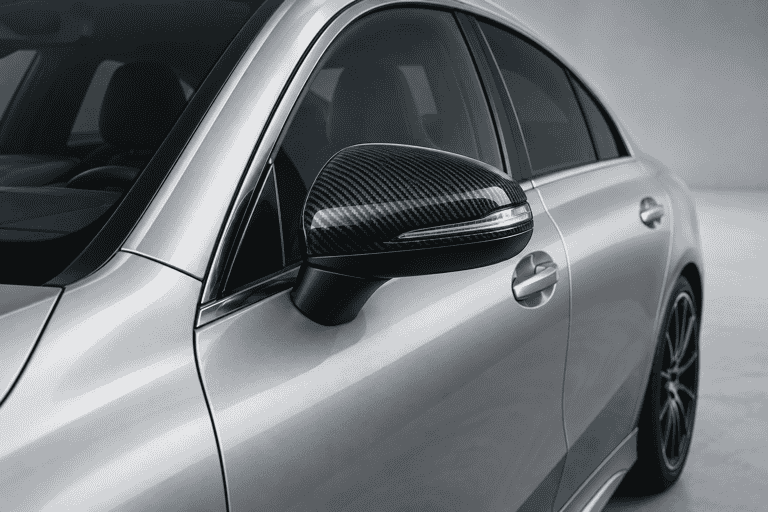 AI-generated styling concept; not a verified CLA application, mounting arrangement or equipment-clearance test.
First, clarify what the catalog means by W117 and W118
Some aftermarket catalogs use W117/W118 as shorthand for CLA applications. Mercedes-Benz materials identify the CLA Coupé with designations including C117 and C118. Record the actual model and body designation instead of treating the catalog shorthand as the final specification. If the vehicle is a Shooting Brake, provide that information explicitly and ask for its application to be confirmed separately. Do not infer mirror-cover interchangeability from a shared generation or an apparently similar exterior shape. Record production information, market, steering side and relevant mirror equipment. Current housing photographs are particularly useful where the original mirror or cover may have been replaced. A badge, registration year or promotional image of a similar car is not the complete application record.Overlay versus replacement: what changes?
| Question | Overlay cover | Replacement cover |
|---|---|---|
| What does it generally do? | Adds a cover over the specified existing outer surface | Replaces the specified original cover component |
| What must be checked? | Contact geometry, edge coverage and the approved bonding arrangement | Attachment interfaces, assembly version and applicable removal/refitting instructions |
| What remains uncertain from an exterior photo? | Whether the inner shape and coverage suit the current housing | Whether the attachment details match the vehicle assembly |
| What affects the job quote? | Preparation, approved materials and product-specific application requirements | Access, disassembly/refitting work and any separately required components |
| What should never be assumed? | That an overlay repairs a damaged or incorrect underlying housing | That a replacement includes glass, indicators, electronics or a complete mirror assembly |
Read the original description, then verify it
The catalog snapshot reviewed for this guide contains six mirror-cover records in a combined W117/W118 group. Their original descriptions include terms translated as “replacement,” “add-on” and “stick-on.” That distinction can disappear when every English title is shortened to “rearview mirror housing.” Use those terms to ask better questions, not to finalize an order without evidence. In particular, an “add-on” label should be clarified with actual product photographs and instructions rather than automatically treated as identical to every overlay. Ask for a stable supplier reference, the selected version and a written explanation of how it attaches. Repeated listing titles or automatically generated suffixes are not a substitute for the supplier’s actual ordering code.Keep CLA mirror-cover structures separate in the order
The combined CLA catalog lists multiple replacement, add-on and overlay descriptions. The row’s structure and actual housing application matter more than similarity in the exterior image.
| Requested component | Catalog reference | Order clarification |
|---|---|---|
| Replacement entries | Page 1, items 1, 3, 4 and 5 | Obtain inside photographs and identify the relevant housing. |
| Add-on entry | Page 1, item 2 | Clarify how the supplied part relates to the existing cover. |
| Overlay entry | Page 1, item 6 | Review the current cover and the overlay mating surface. |
Include the document name, page, item number, vehicle photos, quantity and destination in the inquiry. Ask for the supplier’s confirmed product reference and supplied-contents list before approving the order.
Browse the model catalogs and send your selected references.
Ask for inside views before approving the outside
For an overlay, request the interior contact area, edges and relevant product-specific bonding instructions. Confirm that the existing housing is the correct substrate and suitable condition for the intended installation. For a replacement, ask for clear images of the attachment interfaces and the applicable installation document. Do not rely on counting visible clips in an unrelated online photo. The technician needs evidence for the exact supplied reference and current mirror assembly. Request left and right identification, sale quantity and finish information. Confirm whether the quotation covers a pair or one side. If only one cover is being replaced, discuss how appearance will be assessed against the existing opposite side.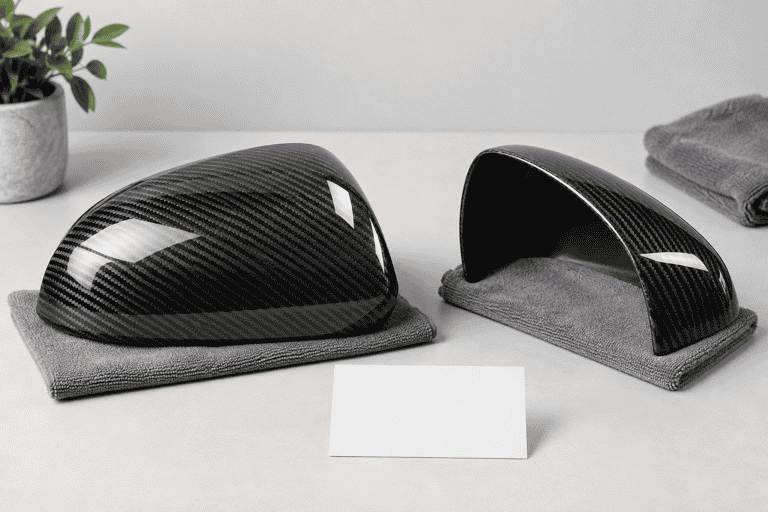 AI-generated selection concept; interior geometry is not an overlay or replacement fitment specification.