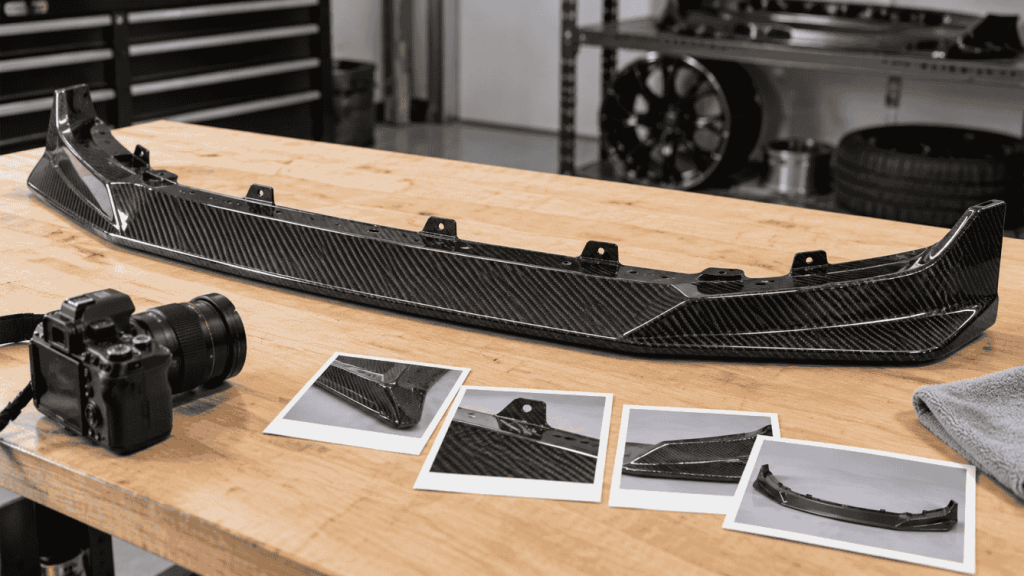
A customer sends a cropped photo and asks, “Can you supply this?” The visible shape may narrow your search, but the image may show a different bumper, a modified mounting arrangement or a part that only resembles one in your catalog.
Use customer photos to identify a candidate product and the information needed next. Do not use visual similarity alone as final SKU or fitment confirmation. A disciplined photo request can turn a vague inquiry into a quoteable specification.
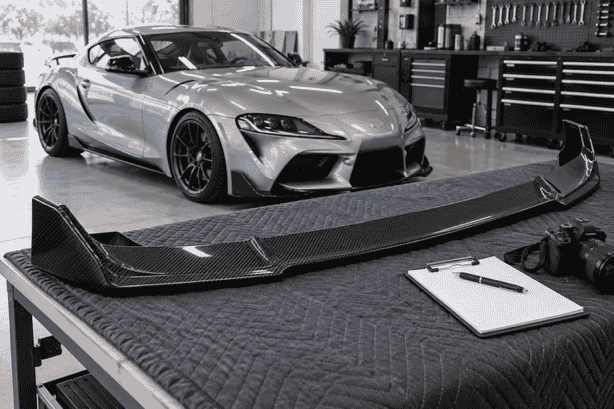
Concept illustration.
Ask for context before more close-ups
Start with the make, model, production details where available and the part the customer wants to change. Ask whether the current bumper, sill, exhaust or mirror assembly is original or modified. Keep the customer's actual vehicle separate from a reference image found online.
If the customer only has an inspiration photo, record it as a style reference. Do not treat it as evidence of what is installed on their car. That distinction matters when the same overall appearance is offered in several mounting versions.
Request a targeted photo set
| Photo | What it helps answer |
|---|---|
| Whole vehicle from the relevant side | Which body area and visible configuration are involved? |
| Full target assembly | Is the request for one piece or a larger group? |
| Both ends and adjoining surfaces | Where does the proposed part meet the car? |
| Rear or underside of an accessible removed part | What interfaces distinguish candidates? |
| Existing label or product reference | Can the product be linked to a known record? |
| Marked inspiration image | Which specific feature does the customer want? |
Do not ask an untrained customer to remove a component merely to obtain a photo. If an interface is inaccessible, note that limitation and agree a suitable workshop inspection when needed.
Compare identity and compatibility separately
A candidate can look like the desired part yet still require another bumper or exhaust arrangement. Conversely, two different styles may share an application while needing different installation instructions. Keep those questions in separate columns in your inquiry record.
For example, label a result “possible three-piece front lip; rear interface not yet reviewed.” That is more accurate than calling it an exact match. Use the G80/G82 front-lip sourcing guide when the number of supplied sections affects the decision.
Use a confirmation ladder
First identify the product category. Next create a shortlist of references. Then obtain the relevant configuration and interface evidence. Finally confirm the proposed SKU and scope in writing before the order is accepted.
Save the original customer photo with the product reference eventually quoted. If the customer later sends a different angle that changes the interpretation, update the inquiry rather than keeping the first assumption alive.
The dealer product-data guide describes the supporting record you should expect. For a suspected installation mismatch after delivery, switch to the fitment troubleshooting process instead of continuing to guess from the original sales photo.
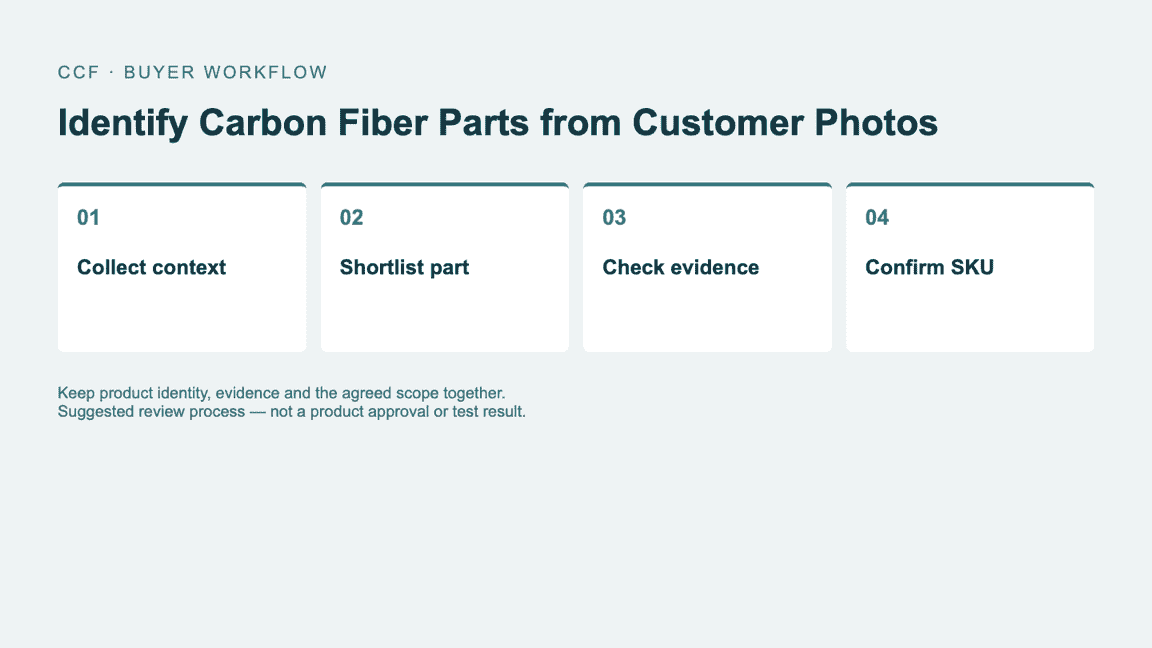
Suggested buyer workflow. Follow the product-specific specification and agreed order terms where applicable.
An identification handover example
Use this record as a buyer working tool. Examples and sample labels below are illustrative, not CCF inspection, order or test records.
| Record | Example or required entry |
|---|---|
| First message | A cropped bumper photograph produces a candidate style only. |
| Next evidence | Whole vehicle context, bumper close-ups and the relevant interface views are requested. |
| Outcome | Return the candidate reference with confirmed observations and unresolved application questions. |
Label the result “candidate for review” until the reference and relevant configuration are established. Keep the original image with the quote so a similar-looking alternative cannot enter unnoticed.
Questions buyers ask
Can a supplier identify a part from one picture? Sometimes it can suggest a candidate. Whether it can confirm the product depends on the visible detail and reliable product records.
Should I send the vehicle registration document? Start with the necessary vehicle details and product photos. Share only information relevant to the review through an appropriate private channel.
For the related buying decisions, see How to Review a Carbon Fiber Sample Remotely Before Ordering and BMW M3 and M4 LCI Carbon Fiber Parts: How Shops Should Verify Carryover Fitment.
Turn the photo into a usable inquiry
Send CCF the reference image, actual vehicle photos and the feature you want to match. Ask for a proposed product reference and any remaining checks. Get the identity clear before you promise the customer an exact replacement.
Send an Inquiry
Include the article title, selected parts, quantity and delivery country.
Customer reference: BMW Carbon Fiber Exterior: A Customer Build Reference for Tuning Shops. Read the actual feedback alongside the product-specific checks above.