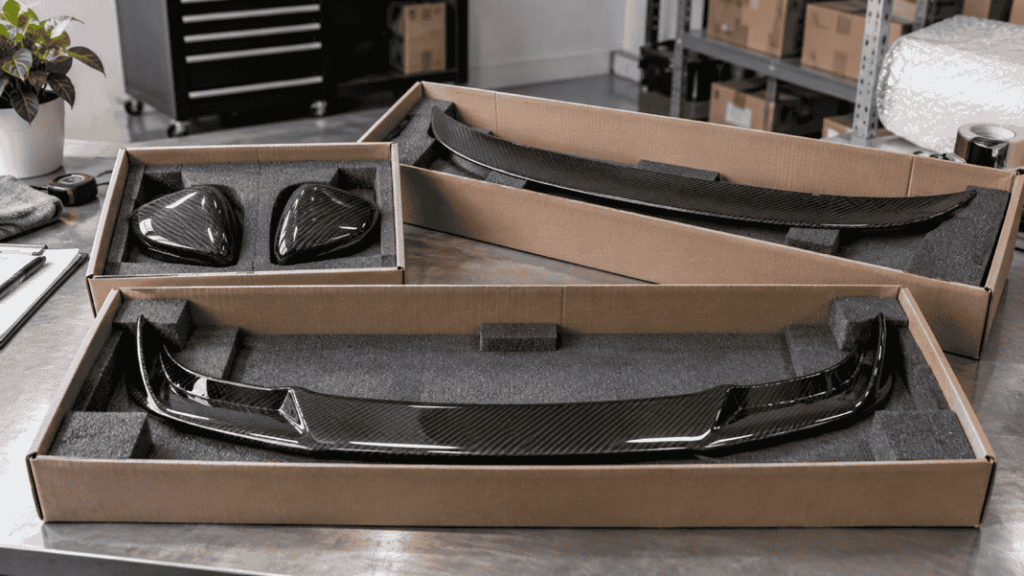
For dealers testing demand without holding stock, a dropshipping discussion should cover the selected reference and the actual fulfillment workflow. Do not treat an available catalog as blanket approval for every product.
Selling a carbon part before you hold inventory can test demand. It also puts your reputation between a vehicle-specific product, an overseas dispatch process and a customer who expects a clear delivery answer.
Carbon fiber dropshipping works best when the exact product, vehicle application, destination and fulfillment responsibilities are confirmed before you accept the customer’s order. A broad catalog is not a live stock feed or a promise that every part can ship directly to every address.
CCF offers direct fulfillment for suitable catalog orders, subject to the selected product and shipping arrangement. Check the current dropshipping supply information before building your offer around it.

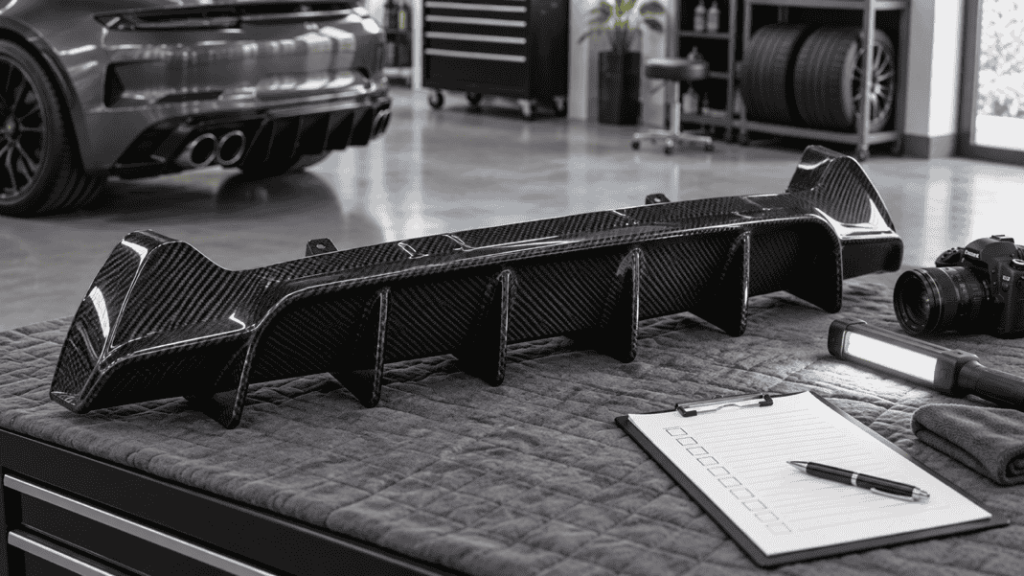
Concept illustration.
Choose a narrow starting range
Begin with products your existing audience actually requests. A short range lets your team learn the vehicle questions, product versions and delivery constraints for each listing. Listing hundreds of unfamiliar applications creates more ways to accept an order you cannot confidently fulfill.
For each candidate, obtain a product reference, accurate sales unit, usable images, fitment information and current availability response. If a supplier cannot confirm one of these fields, keep the listing unpublished or clearly handle it as an inquiry rather than an immediately deliverable item.
Agree who handles each step
| Step | Dealer responsibility to define | Supplier confirmation to obtain |
|---|---|---|
| Product selection | Collect the customer’s vehicle configuration | Identify the proposed SKU and version |
| Order acceptance | Set honest customer expectations | Confirm availability and order scope |
| Shipping | Provide correct recipient details | Confirm destination service and package details |
| Customer communication | Explain timing and answer the buyer | State which dispatch updates can be supplied |
| Problems | Collect evidence and manage the customer conversation | Explain the applicable review process |
Ask separately about paperwork inside the carton, exterior labels and branding. Do not advertise blind shipping or private-label packaging unless that arrangement has been confirmed. Likewise, do not assume a platform inventory connection or automatic tracking integration exists.
Quote the delivery scope before promising a date
Separate product readiness, dispatch and transit. Use the dealer delivery-planning guide to identify what date you can actually communicate. A production estimate does not become a guaranteed customer arrival date simply because the order is small.
Check the full order economics: product, packaging, shipping, applicable destination costs, selling fees and customer-service work. The landed-cost guide helps keep unlike quotations from looking artificially comparable.
Keep a record that supports the next order
For each fulfilled order, record the exact SKU, configuration, destination, promised scope, actual dispatch information and any support issue. Record canceled requests too: repeated interest in one application may matter, but it is not the same as completed sales.
When an item produces repeatable demand, compare continued individual fulfillment with local stock. Holding inventory only makes sense if the service benefit and total economics justify the commitment. You can discuss wholesale purchasing for the products that have earned that review.
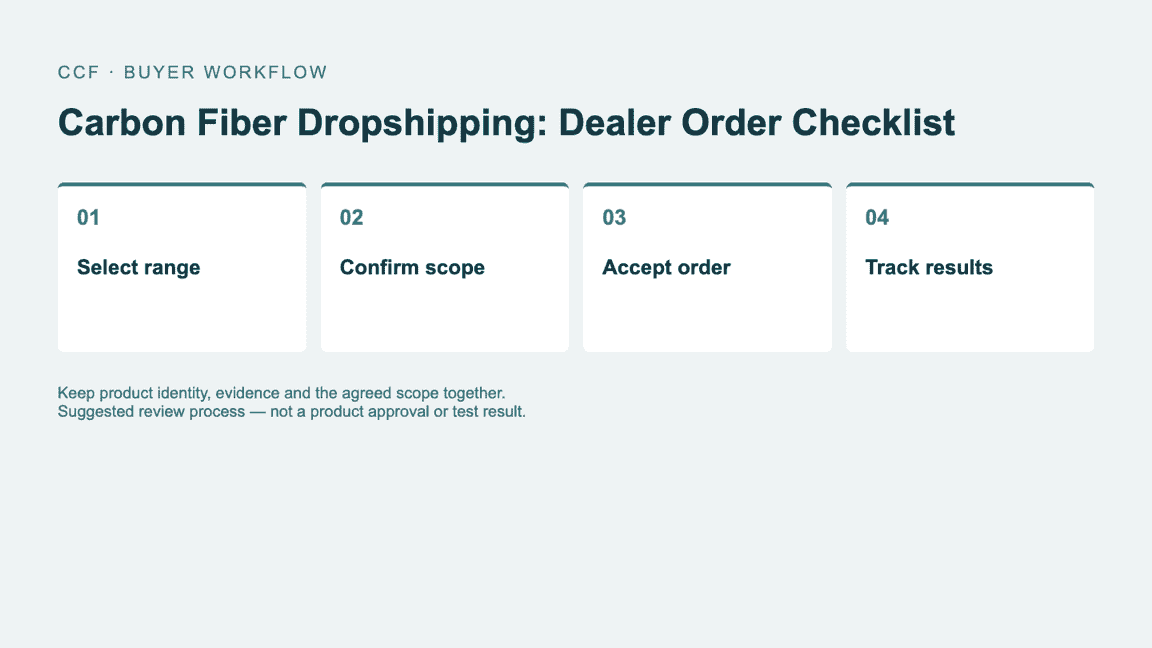
Suggested buyer workflow. Follow the product-specific specification and agreed order terms where applicable.
A direct-fulfillment handover card
Use this record as a buyer working tool. Examples and sample labels below are illustrative, not CCF inspection, order or test records.
| Record | Example or required entry |
|---|---|
| Before payment | Buyer confirms version and destination; seller confirms the offered fulfillment scope. |
| Before dispatch | Identify who receives tracking, which documents accompany the goods and how exceptions are reported. |
| If the recipient reports damage | Preserve packaging and images; route the report to the named order contact without promising an unapproved remedy. |
Use one record per customer shipment. Do not expose wholesale pricing in a recipient document unless that is the agreed arrangement.
Confirm the dropshipping scope before listing an item
| Decision | Buyer input | Confirm with the supplier |
|---|---|---|
| Eligible products | Send the references you want to list. | Confirm whether each can be considered for the proposed fulfillment model. |
| Before accepting orders | Ask how availability and delivery requirements are checked. | Do not present an unconfirmed item as ready to dispatch. |
| After dispatch | Clarify tracking, packaging and issue-reporting responsibilities. | Keep the dealer order linked to the supplier shipment. |
If local stock later becomes appropriate, discuss a separate wholesale replenishment plan. Dropshipping and stocked distribution involve different commitments.
CCF dropshipping supply options: SKU shortlist; sales channel; destination markets; fulfillment requirements.
Questions buyers ask
Does dropshipping remove fitment work? No. Your customer still needs the correct part, and your listing and order process must collect the information needed to identify it.
Can every catalog product be dropshipped? Do not assume universal eligibility. Confirm the exact item, current supply position and destination for the proposed order.
For the related buying decisions, see Before You List Carbon Fiber Parts Online: A Dealer Listing Checklist and When Should Dealers Reorder Carbon Fiber Parts? A Simple Stock Planning Worksheet.
Use a sales pilot to decide when stock makes sense
Dropshipping can help test a range, but an order without local stock still creates customer-service responsibilities. Track the actual reference and destination rather than treating every order as equivalent.
| Pilot record | Why it matters |
|---|---|
| Qualified inquiries and paid orders by reference | Separates broad interest from repeat product demand |
| Delivered cost and support time per order | Shows contribution after the work of serving the customer |
| Delivery variation and customer expectations | Identifies where local availability may add value |
| Returns, damage and unresolved claims | Prevents apparently profitable sales from hiding later costs |
Compare the extra freight or handling of individual dispatches with the full cost of local stock: inbound freight, storage, cash tied up, handling and unsold references. Move a reference into stock only when repeated demand and the service benefit justify those costs. A few unrelated vehicle orders do not establish a repeatable stock line.
Use the acquisition-cost worksheet to include marketing, and the channel-cost comparison when testing multiple sales channels. Confirm the selected items, destinations and fulfillment terms with CCF before advertising delivery promises.
Test a range you can actually support
Do not build your store around an unverified fulfillment promise. Send CCF your target market, sales channel and first product shortlist. Establish a workable order process before taking payment from customers, then expand using actual results.
Send an Inquiry
Include the article title, selected parts, quantity and delivery country.