Custom carbon fiber tooling makes commercial sense when a credible demand plan and the contribution attributable to the project can justify its development cost and risk. The fact that a design is different does not prove customers will buy it at the required price. Separate the business decision from the technical feasibility review.
This guide helps aftermarket brands prepare an investment discussion. It does not quote tooling prices, guarantee development success or replace project-specific financial advice. A manufacturer needs a defined product brief; your business also needs a reason the project should exist.
Define the alternative you are comparing
Is the project a new product with no existing alternative, or a replacement for a catalog item you already sell? If it replaces a current offer, compare the incremental contribution rather than crediting the new tooling with all revenue you would have earned anyway.
Record the intended customer, application, differentiating feature and evidence of interest. Separate stated interest from paid demand. A large audience responding positively to a concept is useful feedback, but not a purchase commitment or a reliable sales forecast.
Count the one-off project investment
- Agreed design and engineering charges.
- Tooling, masters and fixtures within the project scope.
- Prototype work and the included revision allowance.
- Applicable validation and sample logistics.
- Incremental launch materials and other project-specific costs.
Identify exclusions and uncertainties separately. Do not hide unlimited revisions in a single optimistic estimate. Use the tooling ownership and scope checklist to clarify the assets and obligations; ownership terms are not the same as a guarantee of commercial recovery.
Use incremental contribution for a replacement project
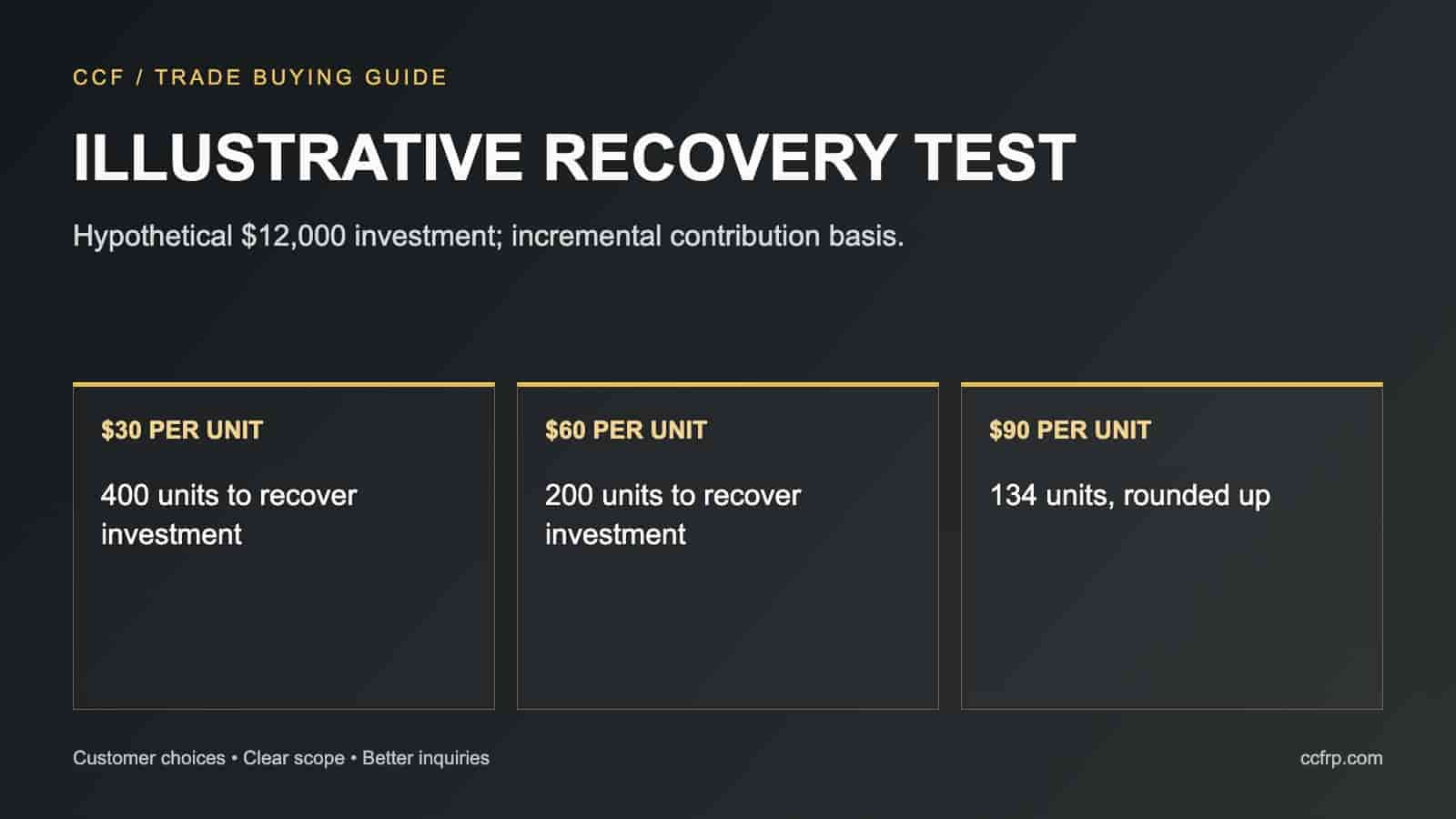
Suppose an illustrative project requires $12,000 of one-off investment. Your current catalog option contributes $90 per completed unit, while the proposed custom option is expected to contribute $150 after comparable variable costs. The incremental contribution is $60. Recovering $12,000 from that difference requires 200 units: $12,000 ÷ $60.
Using $150 as the denominator would produce 80 units, but that would ignore the $90 you could have earned from the alternative. The 200-unit result is a simplified, undiscounted planning calculation. It assumes the contributions are realized and excludes financing, tax and timing effects.
| Scenario | Incremental contribution per unit | Units to recover $12,000 |
|---|---|---|
| Lower outcome | $30 | 400 |
| Base assumption | $60 | 200 |
| Higher outcome | $90 | 134, rounded up |
All values are hypothetical. None represents CCF tooling cost, product margin or an expected sales volume. For an entirely additional product, the relevant contribution basis can differ; define the counterfactual before choosing a formula.
Test whether the volume and timing are credible
Compare the recovery volume with your addressable customer base and actual sales capability. Consider launch delays, application changes, competing products and the useful life of the design. Selling 200 units eventually is not equivalent to selling them within the cash-flow window your business can support.
Keep the cash schedule separate from the recovery calculation. Development payments, production deposits and inventory can require cash before customers pay. A technically positive contribution scenario may still be unaffordable at the required timing.
Use decision gates before spending the next amount
Set a market brief, technical review, prototype review and production decision as separate gates. Record what would make you continue, revise or stop. Do not invent cancellation or refund rights; use the agreed terms for the actual project.
Prepare a feasibility brief, then use the prototype approval checklist to distinguish appearance, fitment and other intended evidence. Approval of one aspect is not approval of every performance claim.
Connect differentiation to a customer reason to choose
A brand story alone cannot repair weak economics. Explain the supported difference: a defined design objective, application focus or service proposition that the customer values. Review brand positioning beyond price before assuming a new mold automatically creates pricing power.
Bring CCF the product brief and the commercial assumptions separately. A scoped OEM/ODM discussion can help identify the technical work to quote. Your demand evidence and investment decision remain essential parts of the project.
For the general distinction between margin, markup and break-even, see Business Victoria’s calculation guide. The scenarios above are illustrative business models, not CCF quotations or earnings forecasts.
Frequently Asked Questions
Does paying for a mold guarantee exclusivity?
No. Rights, ownership, use and access need explicit terms. They are separate from the financial recovery calculation.
Should I proceed if the base-case calculation looks profitable?
Also test lower demand, cost changes, technical uncertainty and cash timing. A spreadsheet is a decision aid, not evidence that the market will buy.
Bring a Defined OEM Business Brief
Send CCF the proposed part, application, available references and expected volume assumptions. Request a feasibility discussion before treating a tooling estimate as an investment plan.
Tell Us About Your Business
Include your market, customer vehicles, selected parts and trial quantities.