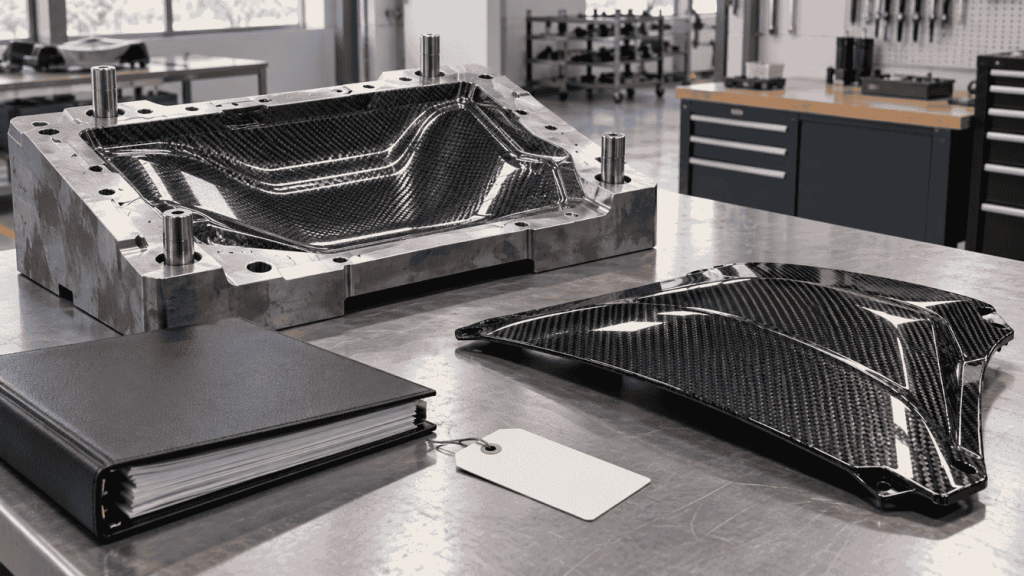
A tooling quotation can name a price without fully explaining what the buyer is paying for. Engineering work, a master model, production molds, fixtures and later revisions may be separate elements. If those boundaries remain vague, a future change or transfer request can become difficult to resolve.
Before funding a carbon fiber tooling project, identify the tooling assets, cost scope, agreed ownership and permitted use, storage responsibilities and the process for changes. Record the project-specific arrangement in writing; payment alone should not be treated as a complete explanation of every right and obligation.
CCF's buyer FAQ states that tooling ownership, permitted use and exclusivity are agreed for the specific project. This article lists commercial discussion points, not legal conclusions or standard terms offered for every project.

Concept illustration.
Identify what the quotation includes
Ask for the development stages and deliverables to be distinguished. A quoted development charge may cover work that is not itself a transferable mold. Likewise, one finished part may involve more than one tool or supporting fixture.
| Topic | What the buyer should clarify |
|---|---|
| Engineering | Which design or preparation work is included? |
| Master and molds | Which physical assets are being created? |
| Fixtures | Are trimming or checking aids included in the scope? |
| Prototype | How many review stages are covered? |
| Revisions | Which changes require a new quotation? |
| Production | What separate order and approval release manufacture? |
Do not compare two tooling prices until their included scope is clear. The OEM/ODM guide provides the broader development sequence.
Separate ownership, possession and permitted use
Ask who owns each identified asset, where it is held and what use is permitted under the proposed arrangement. Clarify whether any exclusivity is limited to a product, market, customer or period. Do not use the words “our mold” to cover several unagreed assumptions.
If a design includes existing supplier knowledge or shared components, ask how that affects the proposed scope. Identify the drawings and revisions associated with the project so both parties know which product the arrangement concerns.
Discuss storage and maintenance before they matter
Ask how the tooling will be identified, stored and maintained, and how damage or deterioration will be reported. Discuss any agreed charges and what happens during a long period without orders. Do not assume indefinite free storage or an unlimited service life.
If transfer is important to your business plan, raise it before commissioning. Ask what assets and records could be supplied, what preparation or transport would be involved and which conditions apply. Any legal rights and enforceability need appropriate professional review of the actual agreement.
Define the change process
A revised vent opening or mounting feature may affect more than the visible surface. Request a review of technical scope, tooling impact, prototype needs, cost and schedule before authorizing a change.
Keep the original approved revision and the proposed revision distinct. A sample approval for one geometry should not silently release another. Record who can authorize work and what document the supplier will use as the current instruction.
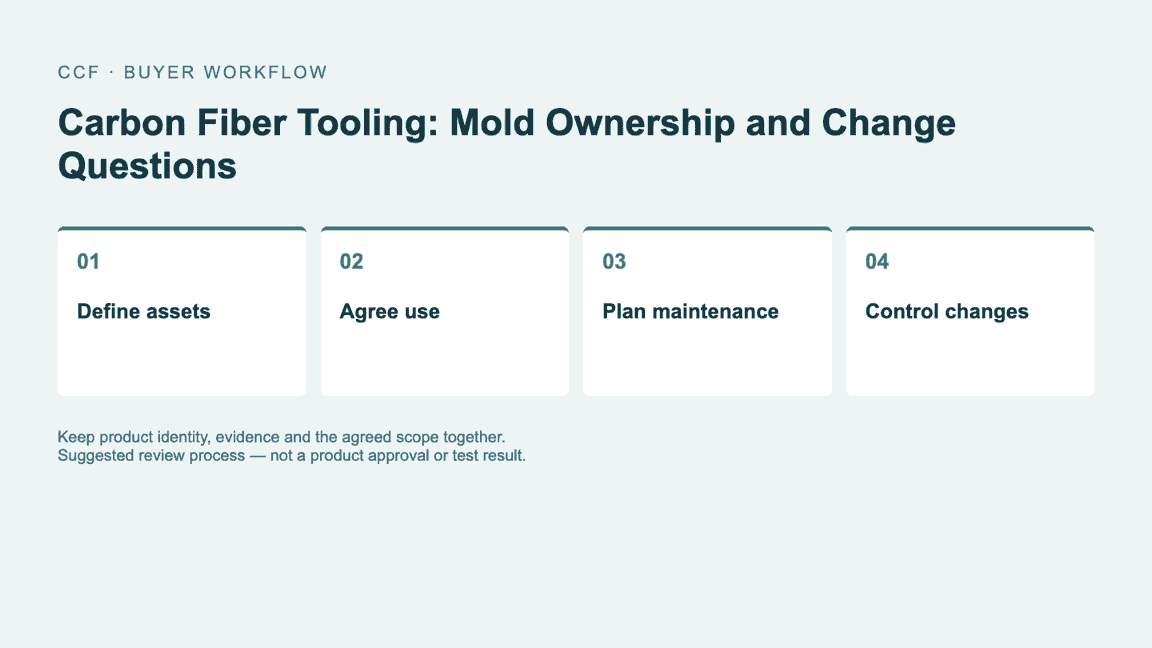
Suggested buyer workflow. Follow the product-specific specification and agreed order terms where applicable.
A tooling scope register
Use this record as a buyer working tool. Examples and sample labels below are illustrative, not CCF inspection, order or test records.
| Record | Example or required entry |
|---|---|
| Assets | List the master, production mold, fixtures and engineering files separately where applicable. |
| Rights and custody | Record the agreed ownership, storage location and permitted use for each asset. |
| Future events | Ask what happens after a revision, inactivity, damage or a requested transfer. |
Mark unanswered items as unresolved before funding the project. This register helps commercial review; it does not itself create ownership or transfer rights.
Questions buyers ask
Does paying a tooling fee automatically establish exclusivity? Do not assume that. Ask for the actual ownership and permitted-use arrangement to be stated explicitly.
Can a mold change be priced from one sketch? A sketch can start a discussion. The team may need additional information to identify the full tooling and validation impact.
For the related buying decisions, see Custom Carbon Fiber Parts: What to Send for an Initial Feasibility Review and Approving a Carbon Fiber Prototype Before Production: A Buyer Sign-Off Checklist.
Clarify the investment before releasing it
Send CCF the intended part, available design references and your tooling requirements. Request a proposal that separates development, physical tooling, prototype review and production. Settle the scope before committing your launch plan to an assumption about what the tooling fee buys.
Send an Inquiry
Include the article title, selected parts, quantity and delivery country.