
Set your trade prices by calculating the cost to serve each order size and the contribution your business needs, then decide which quantity differences justify a different offer. A larger order can spread some costs across more units. It can also increase packing complexity, credit exposure or delivery coordination.
This is a pricing worksheet for distributors and trade resellers. It does not publish CCF’s price tiers, minimum quantities or discount policies. Those must be confirmed for selected references and a defined order.
Identify which costs actually change
Separate the landed product cost per unit, variable selling cost per unit and order-level handling. Use a consistent cost basis. If packing or freight is already included in landed cost, do not add it again as a separate allowance. If delivery is quoted separately to the buyer, make that visible on both sides of the calculation.
Transaction fees charged as a percentage of revenue require special treatment. For a fee rate f, the price available after the fee is P × (1 − f). You cannot assume that the fee remains unchanged while changing the selling price. The basic example below uses dollar costs already calculated for its scope.
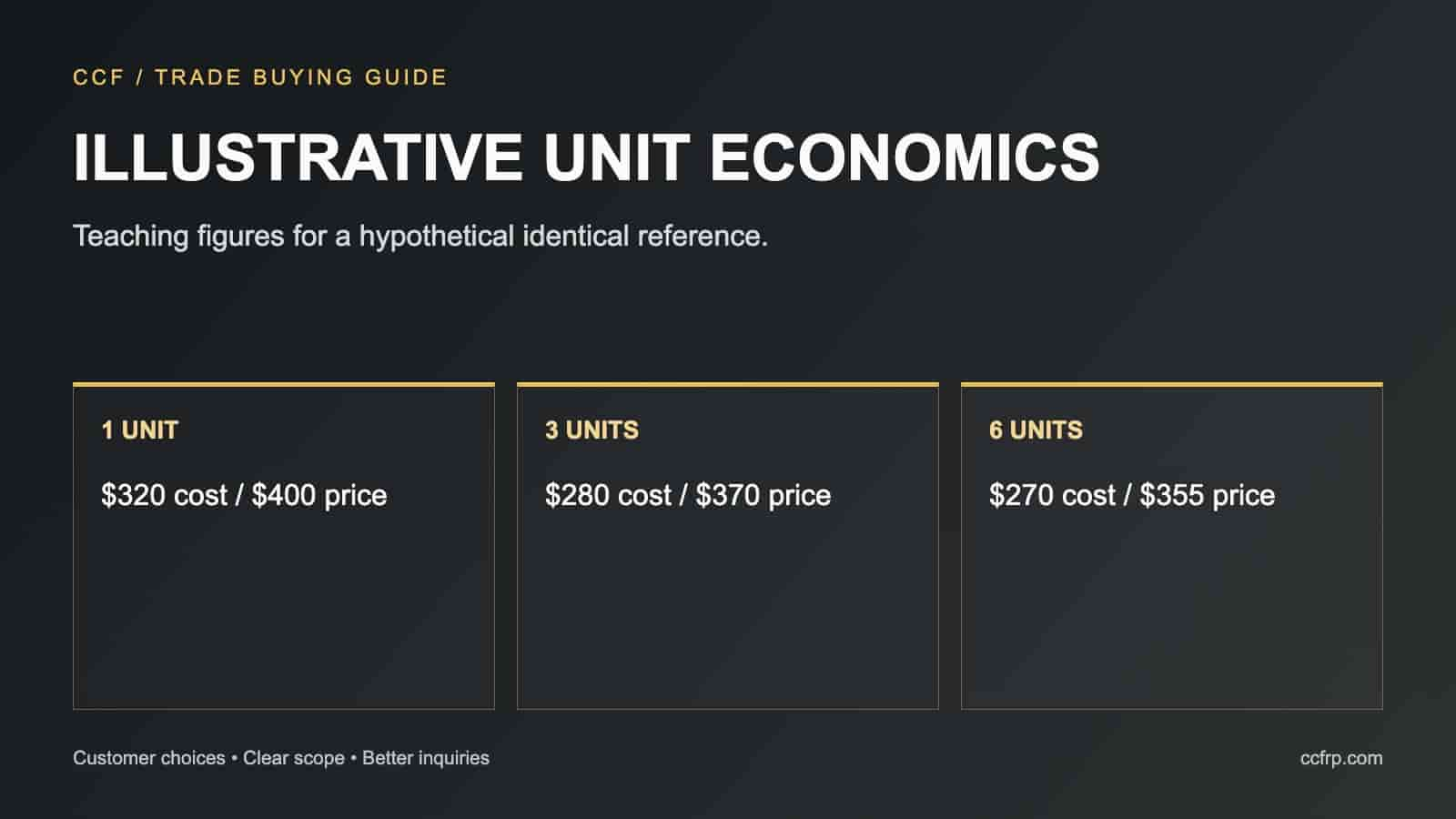
Compare an illustrative quantity scenario
Suppose a selected reference has a $250 landed unit cost, $10 variable unit handling cost and $60 handling cost per order. These are invented figures for identical units delivered under the same assumed scope, not actual supplier terms.
| Order size | Cost per unit | Illustrative trade price | Contribution per unit | Order contribution |
|---|---|---|---|---|
| 1 | $320 | $400 | $80 | $80 |
| 3 | $280 | $370 | $90 | $270 |
| 6 | $270 | $355 | $85 | $510 |
Cost per unit is $250 + $10 + ($60 ÷ quantity). The table shows how spreading a genuine order cost can support a lower unit price while retaining contribution. It is not a reason to promise these reductions when parts need separate cartons or destinations.
Distinguish markup from contribution margin
At a $400 price and $320 variable cost, the $80 contribution is 20% of sales. The markup on the $320 cost is 25%. Calling both figures “margin” can cause your team to quote below its intended floor.
For a target contribution margin m on sales, price equals variable cost divided by (1 − m), when that variable-cost figure is independent of price. If some costs are percentage fees, incorporate those explicitly. Use the contribution guide to distinguish this operating measure from final profit.
Write the conditions next to the price
- The SKU, version, finish and sales unit covered.
- Whether the quantity applies per reference or across an agreed mix.
- The number of shipment destinations and deliveries included.
- Payment terms and price-validity conditions actually agreed.
- Whether branding, packaging or other work is included.
- How changes trigger a revised quote.
A six-unit order to six addresses may not have the same economics as six units to one address. A mix of long skirts and small trim pieces may not share a single packing cost. Use the shipping scope checklist before assuming consolidation creates savings.
Offer a trade structure, not a permanent discount promise
Review quotes when supplier costs, freight or the buyer’s scope change. Document a reason for an exception rather than training every customer to request another discount. Define who may approve a lower contribution and why—for example, a separately justified strategic account decision.
Your trade price is your own offer to your customer. Do not imply that you can dictate independent resellers’ retail prices or promise a protected territory. Use the cooperation questions for relationship scope.
Send the supplier a comparison it can quote
Ask for the same references and delivery terms at your proposed quantities. Request separate identification of any per-order, per-unit or one-off costs. Review supplier offers like for like before building your own tiers.
If your network is still developing, use the local reseller pilot to test real ordering behavior. A spreadsheet tier becomes useful when it reflects actual orders, manageable service commitments and costs your business can support.
For the general distinction between margin, markup and break-even, see Business Victoria’s calculation guide. The scenarios above are illustrative business models, not CCF quotations or earnings forecasts.
Frequently Asked Questions
Does a mixed order automatically earn a lower price?
No. Confirm the actual cost and commercial scope for the selected mix, packing and delivery arrangement.
Can I copy a competitor’s trade tiers?
You can observe market positioning, but your price needs your own cost and service basis. Their unit economics may differ.
Request a Quantity-Based Supply Quote
Send CCF the same SKU list at the quantities you want to compare, with destination and packing scope. Build your resale tiers on a defined factory offer rather than an assumed discount.
Tell Us About Your Business
Include your market, customer vehicles, selected parts and trial quantities.