CCF | Dropshipping & Reseller Operations
A carbon fiber dropshipping order is not simply a request to “ship this item to my customer.” Vehicle fitment, product availability, packaging, customs information, tracking, and post-delivery support all need to be coordinated. This guide explains the order-to-delivery workflow for online automotive parts resellers—and where problems can be prevented before money or merchandise changes hands.
1. How Does an Automotive Carbon Fiber Dropshipping Order Work?
In a conventional wholesale order, the reseller buys inventory and fulfills customer orders from its own warehouse. In a dropshipping arrangement, the reseller markets the product, accepts the customer’s order, and forwards an approved fulfillment request to the supplier, which ships the item to the end customer.
Automotive carbon fiber parts require extra checks because a front lip, diffuser, spoiler, or mirror cap may fit only a particular chassis, facelift, trim, or bumper configuration. The correct workflow is therefore verify first, dispatch second.
Step 1 — Receive the customer’s order
The online store collects the selected part, vehicle information, customer contact details, and complete delivery address. A generic listing such as “BMW M3 carbon fiber front lip” is not enough to confirm compatibility.
Step 2 — Verify the exact part and vehicle configuration
Match the supplier’s product code to the vehicle’s make, model, production year, chassis, body style, and relevant trim or bumper. Ask for photos of the vehicle’s front or rear bumper when the part design depends on the installed body kit. If the information is ambiguous, hold the order for clarification.
Step 3 — Confirm availability and total fulfillment cost
Before promising a delivery date, obtain confirmation of stock or production lead time, the exact item price, packing requirements, shipping quote, destination coverage, and the applicable delivery terms. Large hoods and delicate aero components may incur dimensional-weight or special-handling charges.
Step 4 — Approve the fulfillment request
Send a clear order summary to the supplier. The supplier should acknowledge the exact part, finish, quantity, recipient details, and agreed shipping method. Avoid dispatching from incomplete chat messages or product photos without a confirmed item code.
Step 5 — Inspect, pack, and dispatch
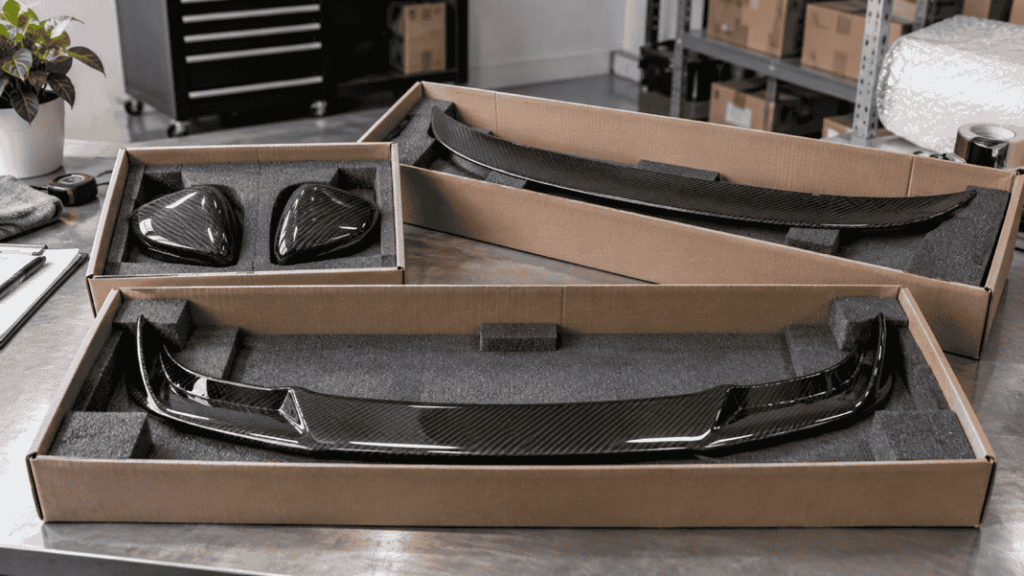
Where agreed, the supplier verifies the item and its visible condition, protects edges and mounting points, and prepares packaging suitable for the component’s size and fragility. Blind shipping requirements must be agreed before label and document preparation, not after the parcel is handed to the carrier.
Step 6 — Send tracking and customer updates
Once a carrier accepts the shipment, record the tracking number and share a realistic status update with the buyer. Tracking activation may lag behind label creation. Customs clearance and local carrier handoffs can also affect the displayed timeline.
Step 7 — Confirm delivery and resolve exceptions
After delivery, invite the buyer to inspect the package and product before installation. If damage, incorrect fitment, or a missing item is reported, collect evidence promptly and follow the agreed claim procedure rather than making an automatic refund or warranty promise.
2. What Information Should a Reseller Collect Before Submitting an Order?
A repeatable order form is one of the simplest ways to reduce wrong-part shipments. It should capture enough information for the supplier to identify the product and for the carrier to deliver it.
| Information | Why it matters | Example / check |
|---|---|---|
| Supplier product code / SKU | Distinguishes similar-looking styles and finishes | Exact code from the supplier’s catalog |
| Make, model, year, chassis | Identifies the vehicle platform | BMW M3, 2023, G80 |
| Trim, facelift, bumper type | Helps identify body-kit or model-year differences | Factory bumper or aftermarket bumper |
| Requested finish and quantity | Prevents material/finish mismatches | Gloss carbon fiber, one piece |
| Reference photos if needed | Clarifies unusual or modified configurations | Front, rear, or mounting area |
| Recipient name, phone, full address | Supports carrier delivery and customs contact | Street, postal code, city, country |
| Shipping and import terms | Clarifies who pays shipping, duties, and taxes | Agreed Incoterm and importer details |
| Order reference | Connects store, supplier, and tracking records | Store order ID and supplier reference |
Practical tip: Use a single order confirmation template even if your supplier communicates through email or WhatsApp. A consistent checklist is more valuable than an automated integration built on incomplete vehicle data.
3. Who Is Responsible for Each Part of the Order?
Many disputes arise because a reseller assumes that “dropshipping” transfers every operational responsibility to the supplier. It does not. Responsibilities should be documented before the first live customer order.
| Activity | Typical reseller responsibility | Typical supplier responsibility |
|---|---|---|
| Store listings and advertising | Accurate claims, pricing, permitted images | Provide agreed product specifications |
| Vehicle information | Collect accurate buyer details | Confirm compatibility against available product data |
| Payment | Collect customer payment; manage chargebacks | Invoice reseller under agreed terms |
| Product preparation | Confirm order details and requested finish | Prepare the agreed item and packaging |
| Shipping and customs | Explain delivery terms and buyer-facing expectations | Arrange agreed carrier service and required shipment documents |
| Customer support | Own the customer relationship and updates | Provide order status and evidence for issues |
| Returns and claims | Apply customer-facing policies and applicable law | Handle supplier-side remedies as contractually agreed |
These are typical roles, not universal rules. The sales contract, shipping terms, consumer law, and agreed warranty policy determine the actual obligations.
4. How Does Blind Shipping Fit into the Process?
Dropshipping describes who fulfills the order. Blind shipping describes how the shipment presents the supplier’s identity to the recipient. They are related but not identical services.
In a blind-shipping arrangement, the supplier may avoid promotional inserts, branded marketing material, or supplier-branded retail packaging when agreed. However, a parcel may still require accurate sender, exporter, manufacturer, origin, or importer information on carrier labels, customs declarations, or regulatory documents. Blind shipping must never involve falsifying shipping or customs information.
5. What Should Happen When an Order Cannot Be Fulfilled as Requested?
Incorrect or uncertain vehicle fitment
Pause dispatch. Request the chassis/trim details or photographs needed to resolve the mismatch. If compatibility remains uncertain, do not describe the product as guaranteed to fit. Offer a compatible alternative only after the buyer approves it.
Out-of-stock or made-to-order item
Obtain an updated production or availability estimate before taking further action. The reseller should offer the customer a transparent choice consistent with its store policies and applicable law: wait, select an alternative, or cancel.
Shipping quote higher than expected
Recalculate the landed cost before approval. A carbon fiber hood may have a manageable product price but a high dimensional-weight shipping charge. Do not silently substitute a slower service or pass unexpected charges to the buyer without authorization.
Address or customs information incomplete
Hold the shipment until the recipient’s contact information and any required import details are confirmed. Incorrect declarations or missing consignee information can cause delays, storage charges, or returns.
6. How Should Resellers Manage Tracking, Delivery, and Claims?
Tracking should be treated as an ongoing customer-service workflow, not a one-time message. A useful order record includes the supplier order reference, carrier, tracking number, dispatch date, delivery status, and any issue history.
- Before dispatch: confirm the expected handover date and the selected shipping service.
- After handover: provide the tracking number and clarify that carrier scans may take time to appear.
- During transit: monitor exceptions such as customs requests, failed delivery attempts, and address corrections.
- After delivery: request timely inspection of the carton and part before installation.
- For claims: ask for photos of the outer carton, shipping label, protective packing, product condition, and the reported issue; retain the original order details.
Damage, wrong-part, and fitment claims should not be treated as the same problem. Transit damage concerns packaging and carrier handling; wrong-item shipments concern fulfillment accuracy; fitment disputes require checking vehicle information, product specifications, and installation conditions. The remedy depends on evidence, contract terms, and applicable law.
7. How Can a New Online Store Test the Workflow Before Scaling?
Start with a limited set of vehicle-specific products rather than uploading hundreds of catalog items immediately. Choose products for which you can verify the exact application, obtain dependable quotes, and explain installation requirements accurately.
A practical pilot checklist
- Select 5–10 product listings with clearly documented vehicle applications.
- Confirm each SKU, finish, packaging method, and order-submission format.
- Request example shipping quotes for your main destination markets.
- Agree on neutral-packaging requirements and the documents that must remain legally accurate.
- Place a sample or controlled trial order where practical.
- Check dispatch communication, tracking updates, transit packaging, and final product condition.
- Record problems and revise your process before adding more listings.
There is no universal “best” starting catalog size. The aim is to validate operational reliability and unit economics before increasing order volume. A reseller who knows the correct fitment and fulfillment steps for ten products is often better positioned than one with a thousand unverified listings.
8. How CCF Can Support Automotive Carbon Fiber Resellers
CCF works with automotive carbon fiber parts buyers and resellers. For standard catalog products, single-item orders and dropshipping requests can be discussed, and blind-shipping arrangements are available subject to confirmation of the specific order and destination. Product selection can begin with CCF’s catalog and vehicle-based product categories.
CCF does not promise an API, automated inventory synchronization, a structured bulk product-data feed, or a standalone photo/video asset library as part of this guide. Product availability, reseller pricing, shipping charges, transit estimates, documentation, and after-sales arrangements should be confirmed for each order or cooperation agreement.
If you are building an online store, send the vehicle models and products you plan to sell, your destination market, and your expected order pattern. That makes it easier to discuss a realistic fulfillment workflow instead of making assumptions about every product in a catalog.
Frequently Asked Questions
Can I dropship carbon fiber parts without holding inventory?
Yes, if your supplier accepts direct-to-customer orders for the selected products. You still need to confirm product availability, exact vehicle fitment, pricing, shipping, and after-sales responsibilities before promising fulfillment.
Is blind shipping the same as dropshipping?
No. Dropshipping is an order-fulfillment model; blind shipping concerns how supplier branding and identity appear in the recipient-facing shipment. Legally required sender, exporter, and customs details must remain accurate.
What vehicle details should I collect for a carbon fiber front lip?
At minimum, collect make, model, year, chassis, and relevant trim or bumper configuration. Ask for photos when the vehicle has been modified or the supplier identifies a potential compatibility ambiguity.
Can a supplier guarantee delivery to Spain or other EU countries by a fixed date?
A supplier can provide an estimated service and dispatch timeline, but customs processing, carrier delays, and local delivery conditions may change the actual arrival date. Confirm the shipping terms and avoid unqualified guarantees.
Who pays import VAT and customs duties?
That depends on the agreed sale and delivery terms, the destination rules, and who acts as importer of record. Establish this before quoting the end customer. For EU sales, verify current VAT, customs, and consumer obligations with a qualified adviser.
What if the customer receives a damaged carbon fiber part?
Ask the customer to retain the packaging and provide photos of the carton, label, packing materials, and damage. Contact the supplier promptly and follow the agreed claims process while respecting applicable consumer rights.
Do I need a supplier API to start?
No. A carefully maintained product catalog, verified SKU list, and standardized order template can support a small pilot. Automation becomes useful as order volume increases, but it cannot replace accurate fitment and fulfillment data.
For automotive parts resellers
Discuss a Carbon Fiber Dropshipping Workflow with CCF
Tell us which vehicle models you sell, which parts you need, and where your customers are located. We can discuss catalog availability, single-item orders, blind-shipping requirements, and shipping quotations for your specific needs.
Explore CCF Dropshipping OptionsRelated Guides and Product Resources
Educational information only. Shipping, tax, customs, consumer rights, and warranty requirements vary by country and transaction. Confirm current obligations and commercial terms before accepting customer orders.