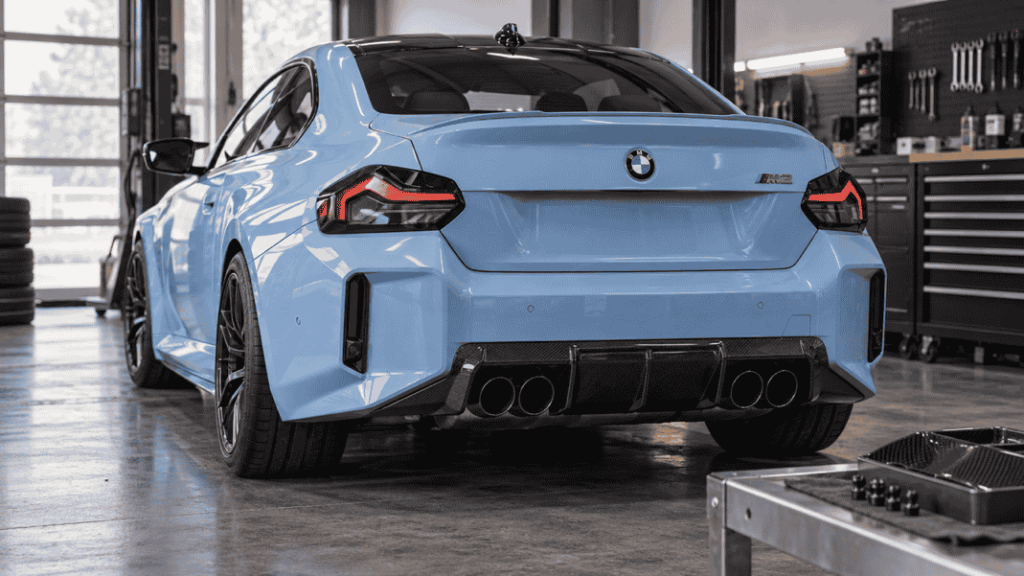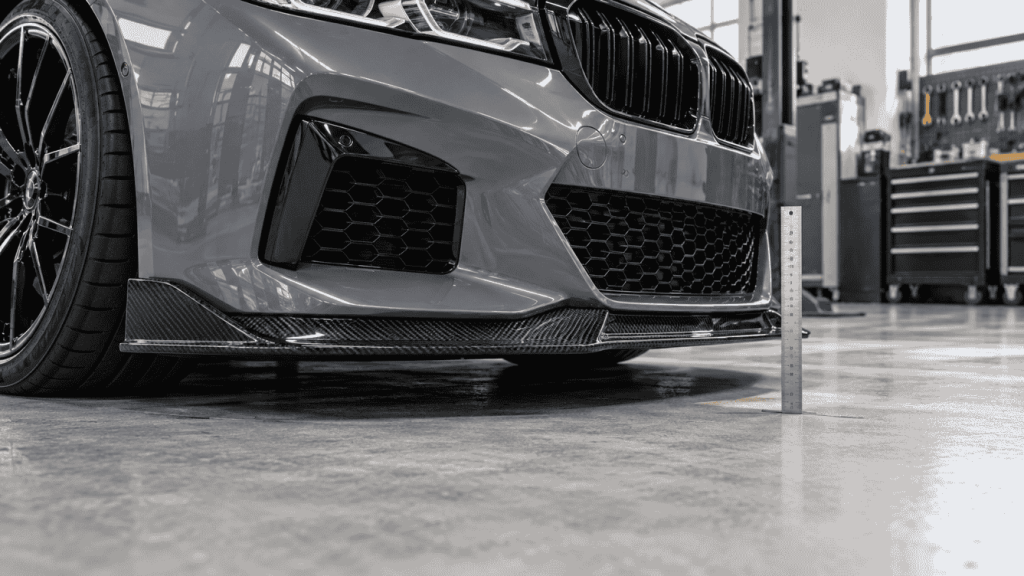
A front lip that looks right on a standard-height car may create a different ownership experience on a customer's lowered vehicle. A static photograph does not show the driveway, parking ramp or load conditions the car encounters every day.
Before quoting carbon fiber parts for a lowered car, record the vehicle's actual setup, the proposed part's position and the customer's normal access conditions. A workshop clearance discussion is not a universal guarantee against contact on the road.

Concept illustration.
Record the setup the customer will actually use
Identify the installed suspension configuration, wheels and tires, current bodywork and any planned changes. If the customer intends to lower the car after fitting the part, note that the present measurement will not represent the final setup.
For adjustable systems, identify the operating setting being discussed. Do not treat a temporary raised setting as the only relevant condition if the customer normally drives at another height. Use appropriate vehicle and suspension guidance for any adjustment or evaluation.
Measure with defined reference points
Have the workshop record measurements on a suitable level surface with the vehicle in a documented condition. Identify where the measurement begins and ends and which part or projection is being assessed. Keep load and setup information with the record.
| Item | Information to record |
|---|---|
| Vehicle condition | Suspension setting, wheel/tire setup and relevant load |
| Existing lowest area | Location and measurement method |
| Proposed part | Exact SKU, mounting position and available dimensions |
| Forward or side projection | Defined reference points, not a photo estimate |
| Normal access | Driveway transition, parking access or other known constraints |
| Remaining uncertainty | Conditions not represented by the static check |
Do not crawl under an unsupported vehicle or improvise a lifting arrangement for photographs. Measurements requiring underside access belong in an appropriately equipped workshop.
Discuss static and real-use conditions separately
A parked measurement describes one condition. Movement, loading and changes in surface angle can create different clearances. Avoid giving a universal “safe minimum” for an unidentified car and part, or promising that a static gap will prevent contact in all driving conditions.
If a known access route is a concern, have a qualified workshop assess it using appropriate methods and without deliberately striking the part. The aim is to inform the product choice, not to prove durability through impact.
Include the practical trade-off in the quote
Explain the proposed design's position and the information still required. If the customer prioritizes daily access, discuss available alternatives based on actual product measurements rather than telling them to accept an unverified clearance risk for appearance.
Use the G87 front-lip buying guide for version selection and the G80/G82 installation workflow for the role of product-specific instructions. Neither replaces a check on the customer's modified car.
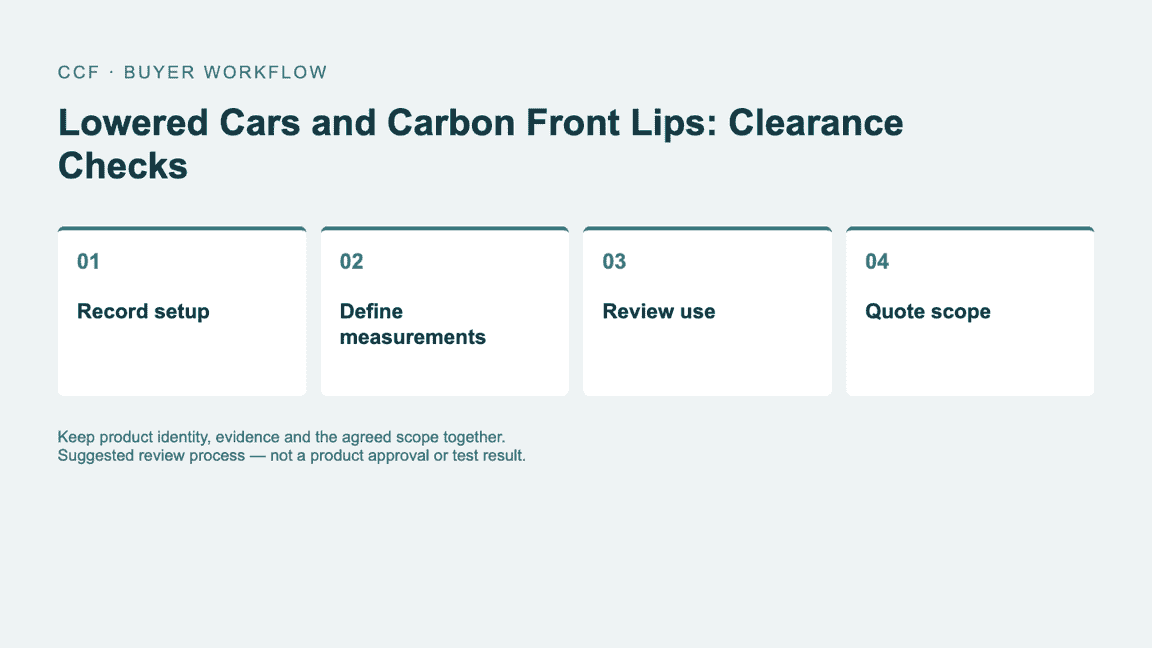
Suggested buyer workflow. Follow the product-specific specification and agreed order terms where applicable.
A clearance discussion record
Use this record as a buyer working tool. Examples and sample labels below are illustrative, not CCF inspection, order or test records.
| Record | Example or required entry |
|---|---|
| Vehicle condition | Record actual suspension, wheels, tires and relevant bodywork changes. |
| Reference points | Use annotated photographs to identify where each agreed measurement begins and ends. |
| Customer use | List the actual ramps or access conditions that need discussion; distinguish observed contact from assumed risk. |
One static measurement cannot represent every loaded or moving condition. The useful deliverable is a documented customer decision and an appropriate workshop assessment, not a universal safe-height number.
Questions buyers ask
Can the factory confirm clearance from a side photograph? It may help identify the setup, but perspective is not a reliable substitute for defined measurements and actual configuration information.
Does carbon fiber make scraping harmless? Do not assume that. If contact or damage occurs, stop and assess the condition appropriately before continued use or modification.
For the related buying decisions, see BMW G87 M2 Carbon Fiber Side Skirts: What Shops Should Check Before Ordering and Using Customer Photos to Identify Carbon Fiber Parts: What Dealers Can and Cannot Confirm.
Resolve the use case before choosing the most aggressive design
Send CCF the vehicle setup, selected product reference and workshop measurements. Ask for the available product dimensions and alternative versions. Quote a part around how the customer uses the car, not only how it looks in a parked photograph.
Send an Inquiry
Include the article title, selected parts, quantity and delivery country.