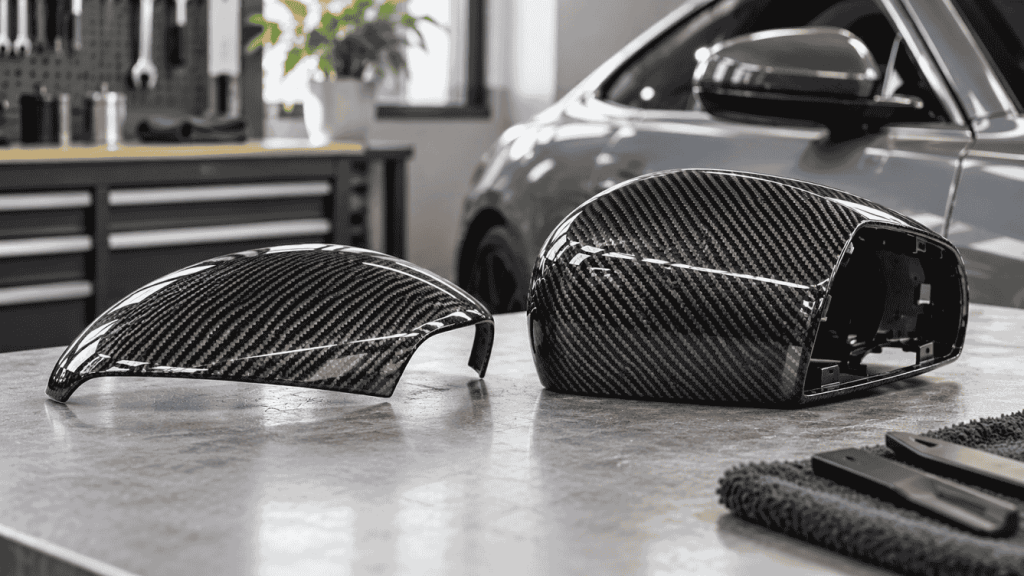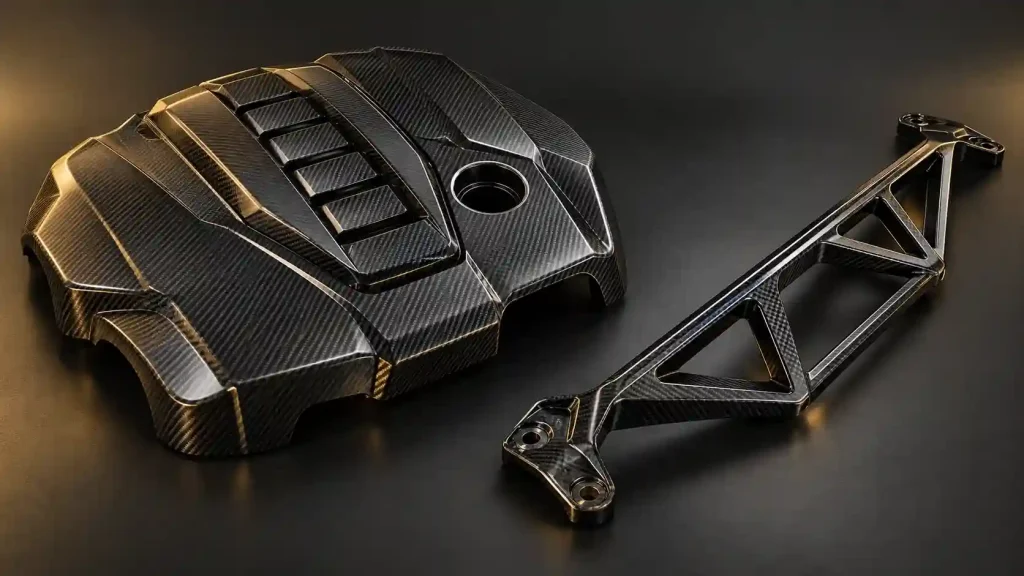
Dry carbon commonly means prepreg, where the reinforcement already contains resin before lay-up. Wet carbon commonly means wet lay-up, where liquid resin is applied during manufacture. These are manufacturing descriptions; a finished-part comparison still needs the exact construction, mass and application.
For tuning shops, a premium is justified by a confirmed requirement or documented product difference, not by the dry label alone. This guide separates the process explanation from the purchasing decision.
When is the more expensive version worth considering?
If the brief specifies a manufacturing route, obtain confirmation for that exact reference. If the customer wants a measurable weight reduction, compare complete finished configurations and the available measurements. If appearance and installed budget are the main goals, compare fitment, finish, supplied contents and total workshop scope first.
Where the two offers cannot be compared on the same basis, describe the known difference and keep the numerical benefit open. Do not pay for or advertise an unverified percentage saving.
Dry vs wet carbon: the purchasing comparison
| Question | What the terminology tells you | What the offer still needs |
|---|---|---|
| How is resin introduced? | Prepreg contains resin before lay-up; wet lay-up adds liquid resin during manufacture. | The actual process for the quoted SKU; identify infusion separately if used. |
| Is it autoclave-cured? | A prepreg description does not by itself specify the cure route. | Written confirmation if an autoclave cure is a purchasing requirement. |
| Which is lighter? | A process label does not quantify a finished assembly. | Comparable finished weights and a stated measurement scope. |
| Which fits the vehicle? | Neither label defines the vehicle interfaces. | Product version, vehicle configuration, mounting details and relevant fitment evidence. |
| Which looks better? | Gloss, matte and weave are separate appearance fields. | Current photos or samples of the actual finish. |
| Which costs less to supply? | Unit prices can cover different products and inclusions. | The same quantity, hardware, packaging and delivery basis. |
What do dry carbon, wet carbon and prepreg mean?
In aftermarket descriptions, “dry carbon” commonly means a part made with prepreg: reinforcement containing resin before it is placed in the mold. “Dry” does not mean that the finished composite contains no resin. “Wet carbon” commonly means wet lay-up, where liquid resin is applied to reinforcement during manufacture.
Ask the supplier to name the process rather than relying on retail shorthand. Resin infusion should also be identified explicitly. A process statement should describe the offered part, not merely a method used somewhere in the supplier’s wider range.
Does prepreg always require an autoclave?
No. Some prepreg systems are designed for an oven and vacuum process. Easy Composites’ out-of-autoclave introduction provides an example. If your customer specifically requires autoclave-cured construction, confirm that requirement for the exact quoted reference.
Compare the construction of the finished part
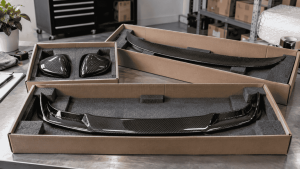
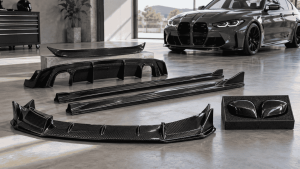
Start by identifying whether each offer is a replacement component, an add-on cover or another construction. Record the visible reinforcement, backing material or core where relevant, included brackets and supplied sections.
Two front lips can share a similar visible weave while having different geometry, backing and mounting arrangements. Do not turn a process comparison into an assumption that those complete products are equivalent. The full-carbon versus fiberglass-backed guide helps separate those construction questions.
Request weights on the same basis
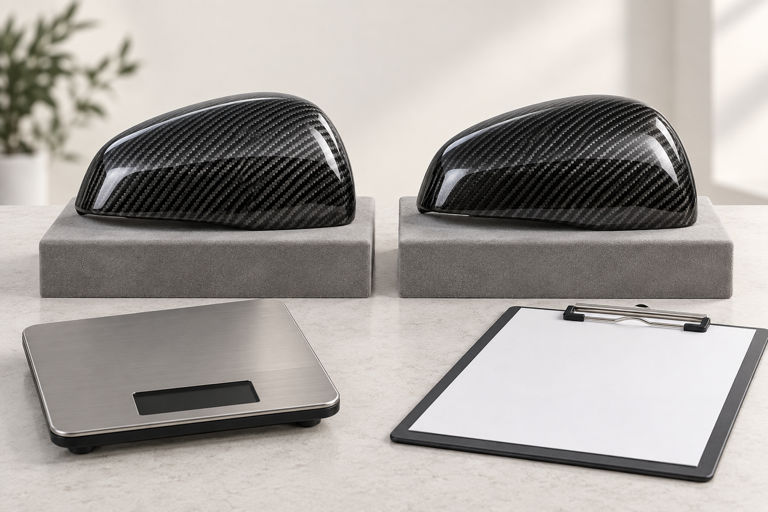
If weight reduction influences the purchase, request a measured value for each identified version. Record whether the measurement covers a bare component or a finished assembly with coating, brackets and hardware. Use comparable geometry and intended application, and identify any scope difference before calculating a saving.
A useful comparison record contains: product reference, sample or revision, included components, measured mass and units, measurement date and source. If no comparable measurement is available, leave the numerical benefit unclaimed. Do not apply a fixed percentage saving to every dry-carbon product.
For advertising or customer-facing weight claims, use the weight-comparison evidence guide to organize the supporting information.
Keep strength, fitment and finish as separate checks
“Stronger” needs a defined requirement. Stiffness, resistance to a stated load and impact behavior are different properties. Relevant product design, construction and testing matter; a process label is not a finished-part performance test.
For fitment, confirm the actual vehicle, bumper or housing configuration and product version. Ask for the corresponding installation information and identify supplied versus reused hardware. A manufacturing description cannot establish a matching mounting point.
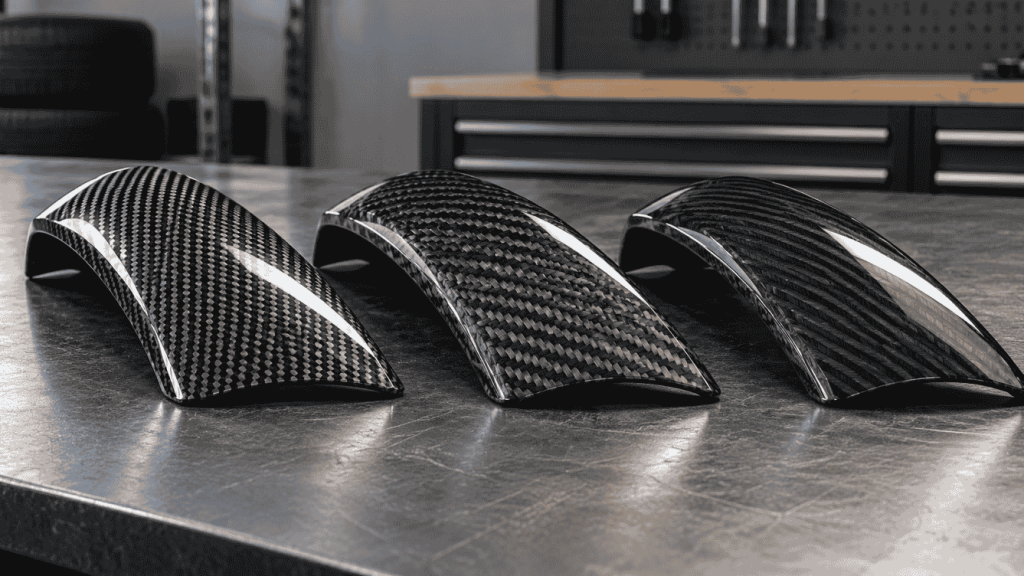
Dry carbon does not mean matte, and wet carbon does not mean glossy. Compare appearance using the actual weave specification and surface finish. A close-up photo can support appearance review but cannot establish the cure method.
Explain a price difference using the offered scope
Ask what differs between the two quotations: design, construction, process, finish, hardware, quantity and packaging. Prepreg handling and controlled curing can involve different manufacturing requirements, but that general explanation does not prove what a particular price includes.
Compare the complete supply cost, then consider the installation work needed for the customer job. A cheaper bare part and a more expensive assembly with accessories are different commercial scopes. Use the like-for-like quotation guide to align them.
Which comparison matters for your customer?
| Customer objective | First purchasing check |
|---|---|
| Carbon appearance within a budget | Fitment, visible finish, construction disclosure and complete installed scope. |
| A measurable reduction in mass | Equivalent finished-part measurements with the same included components. |
| A specified manufacturing process | Written product-specific process and cure-route confirmation. |
| Matching existing carbon trim | Actual weave layout, sheen and sample comparison. |
| A performance requirement | Relevant engineering or test evidence for the part and mounting arrangement. |
Compare Two Identified Carbon-Part Offers
Send both product references, vehicle configuration, your priority, finish, quantity and destination. Request the confirmed process, construction, comparable weight information and complete supplied scope.
Send Your Product Requirements
Include your company, selected product or project reference and the question to resolve.