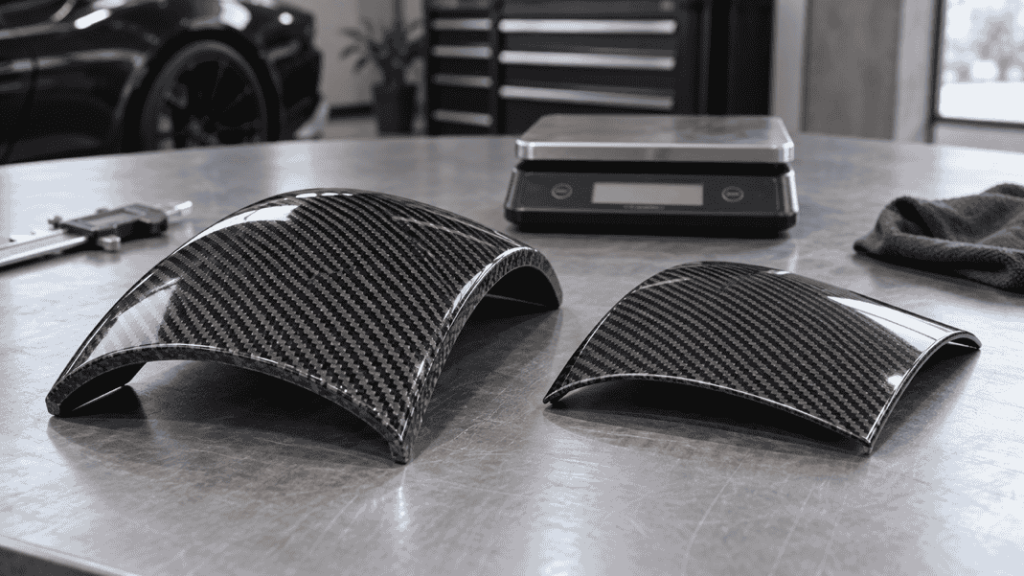
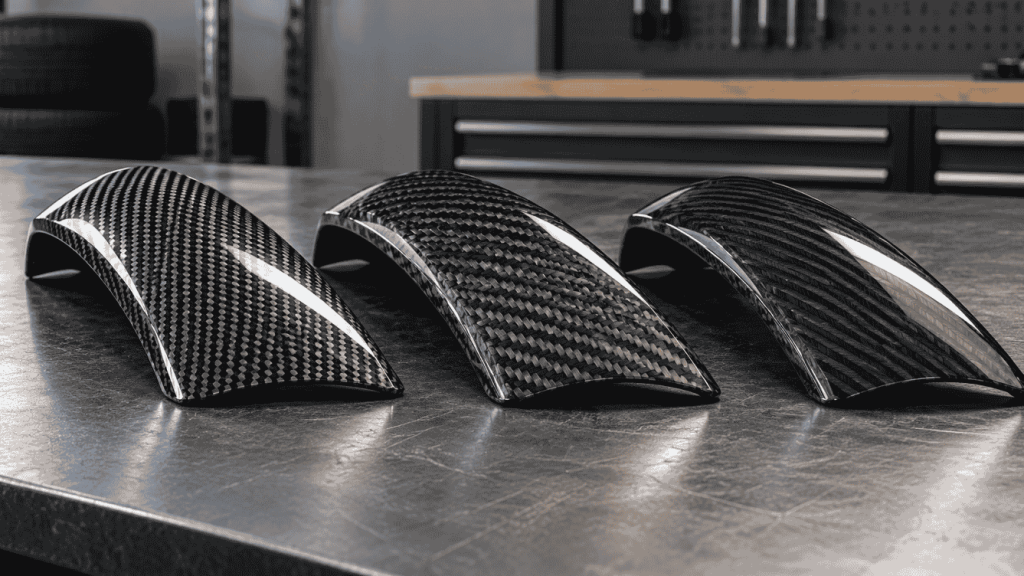
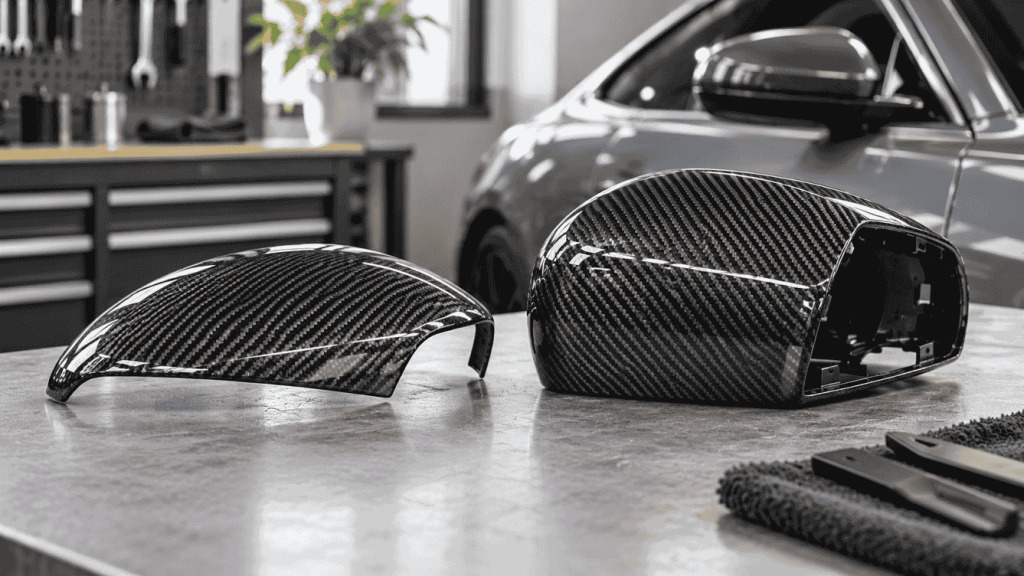
A credible carbon fiber hood weight comparison uses equivalent configurations, a suitable scale and a traceable record. Comparing a bare carbon shell with a complete original hood can exaggerate the difference. Before advertising weight savings, define what is being weighed and whether the comparison represents the customer’s installed assembly.
For distributors, a repeatable weighing record is more useful than an attractive number copied from another listing. For tuning shops, it helps prevent a promised saving from changing once required hardware and transferred equipment are included.
1. Define the comparison before weighing
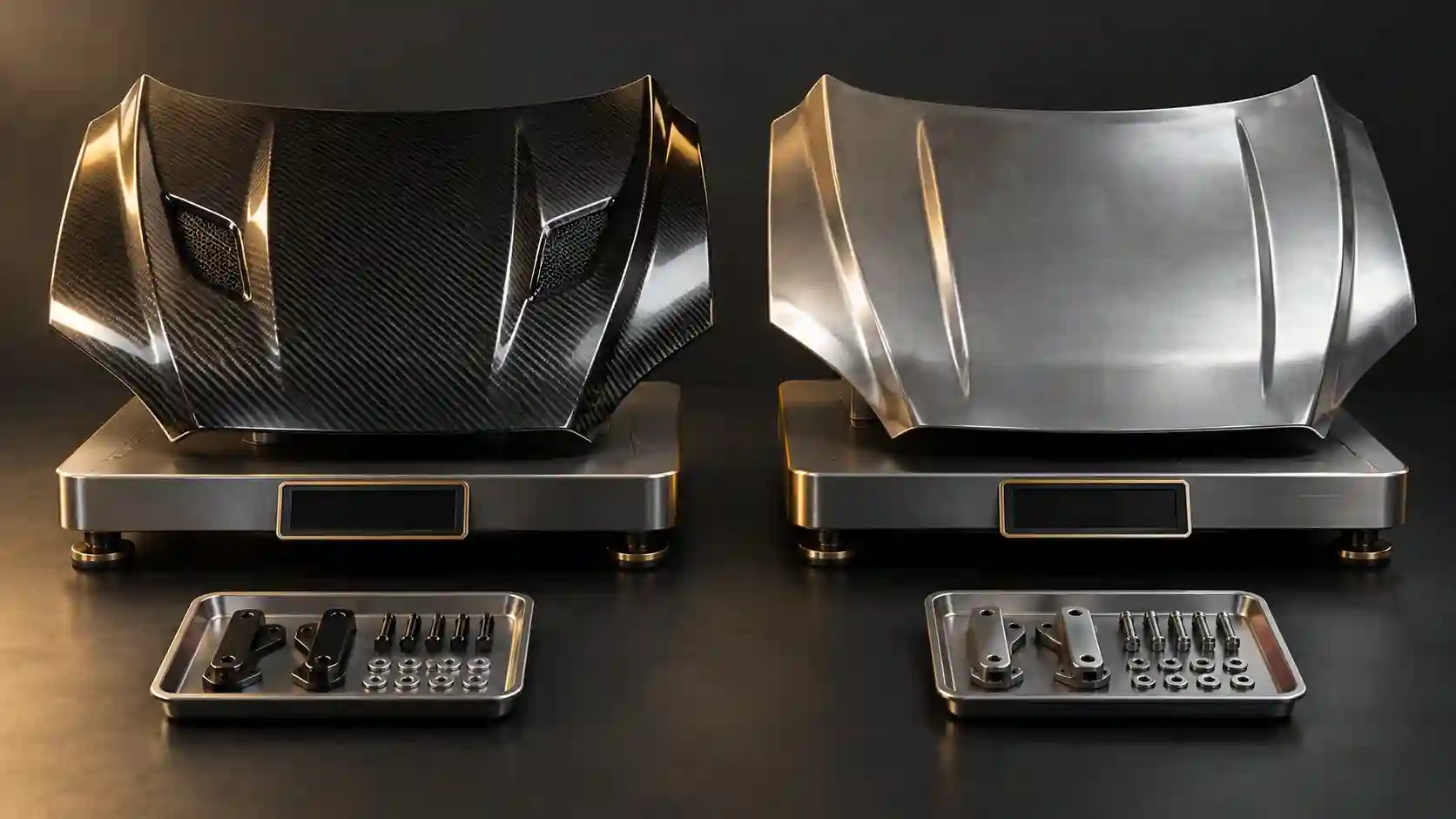
Identify the exact original component and the replacement SKU. Record the vehicle application, finish and product revision. Decide whether the claim concerns the supplied part, the bare panel or the complete installed assembly. These can all be useful measurements, but they answer different questions.
Use separate records when the replacement requires additional components. Do not silently compare one configuration with accessories and another without them. If some items transfer unchanged, state that explicitly and use the same inclusion rule on both sides.
2. Create a configuration checklist
| Item | Original assembly | Replacement assembly |
|---|---|---|
| Main panel and finish | Identify reference and condition | Identify SKU and finish |
| Latch-related hardware | Record included items | Record retained or additional items |
| Vents, mesh and ducts | Record actual configuration | Record specified configuration |
| Insulation, seals and trim | List inclusions and exclusions | List transferred or omitted items |
| Additional required hardware | Record if applicable | Include in installed-assembly comparison |
3. Use a repeatable measurement procedure
Choose a scale suitable for the load and intended reporting precision. Check its status and follow its operating instructions. Use a stable support that does not damage the panel, tare it correctly and ensure the part is not touching another surface. A partially supported hood does not give a valid whole-part reading.
Record the date, operator, scale identity and units. Photograph the part configuration and the readable result. Repeat the measurement after repositioning according to the procedure; investigate inconsistent readings rather than selecting the lowest result. Keep raw readings rather than only the final marketing number.
Do not publish more decimal places than the measurement supports. Packaging weight, freight weight and dimensional shipping weight are different quantities and must not be substituted for the mass of the component.
4. Calculate the saving transparently
Saving = original assembly mass − replacement assembly mass.
Percentage reduction = saving ÷ original assembly mass × 100.
Illustrative arithmetic only: if equivalent assemblies measured 12.0 kg and 8.0 kg, the difference would be 4.0 kg, or about 33.3%. These are hypothetical figures, not CCF product measurements. A real claim must use the recorded results for the actual product.
A mass reduction alone does not prove improved acceleration, handling or durability. Those are separate claims requiring their own evidence. Avoid turning a weighing exercise into a performance guarantee.
5. Publish the scope beside the number
A useful claim format is: “Measured comparison for [vehicle/reference], [defined assembly contents], using [procedure/date]. Original: [result]; replacement: [result].” Add relevant exclusions where readers will see them, rather than burying them at the bottom of the page.
If only one sample was measured, say so. Do not present its result as a guaranteed value for every production unit without an agreed specification and appropriate production evidence. Review the claim when the construction, finish or included hardware changes.
For a wholesale order, ask whether the supplier can provide an actual weighing record. If none exists, keep the listing descriptive until you obtain one. “Carbon fiber hood” is a product description; a specific percentage saving is an additional factual promise.
A weighing record to complete before publishing
Use this record as a buyer working tool. Examples and sample labels below are illustrative, not CCF inspection, order or test records.
| Record | Example or required entry |
|---|---|
| Identity | Original reference: ____ / replacement SKU and revision: ____. |
| Included items | List finish, transferred equipment and required additional hardware for both configurations. |
| Measurement | Scale identity/status: ____ / units: ____ / readings: ____ / support tare: ____. |
| Published claim | Difference: ____ / percentage: ____ / configuration and limitations: ____. |
If the fields cannot be completed from real measurements, publish no numeric saving for the product. The hypothetical calculation above teaches arithmetic and must not be copied into a product specification.
For the connected decisions, use How to Compare Full-Carbon and Fiberglass-Backed Automotive Parts and How to Evaluate Downforce Claims for Carbon Fiber Aero Parts.
Buyer FAQ
Can I use another supplier’s weight?
No. A similar shape does not establish identical construction or assembly contents. Use evidence tied to your own supplied reference.
Should the crate be included?
Not in a component weight claim. Record packed shipping weight separately for logistics and quotation purposes.
What should a shop request before advertising?
Ask for the exact configuration, recorded measurement, scale information and scope of any stated tolerance. Keep that evidence with the approved listing.
Request a Product-Specific Weight Record
Send the hood reference and intended assembly configuration. Ask which actual measurements are available before publishing a weight-saving claim.
Send an Inquiry
Include this article title, your product reference, vehicle details and the question you need resolved.