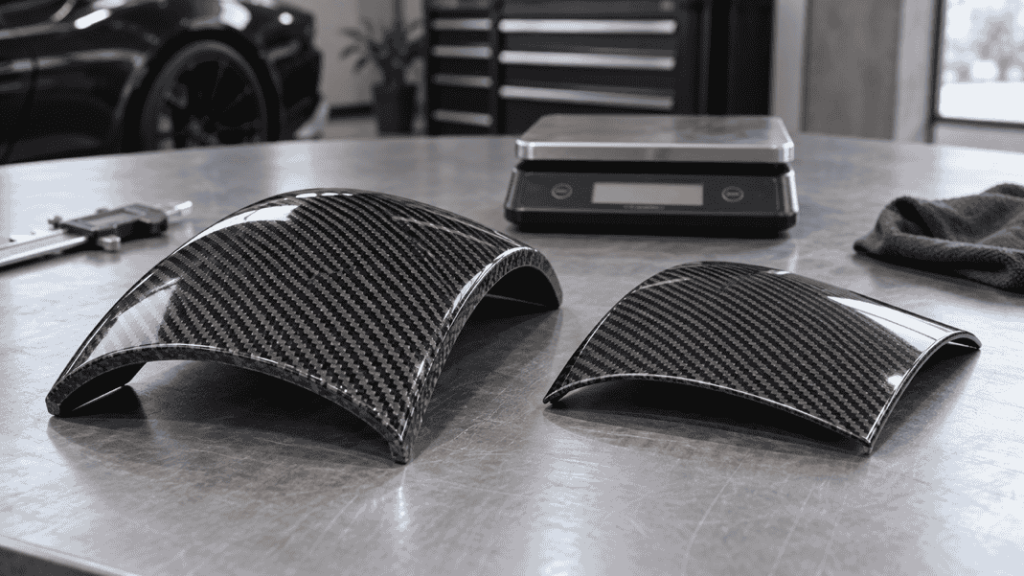
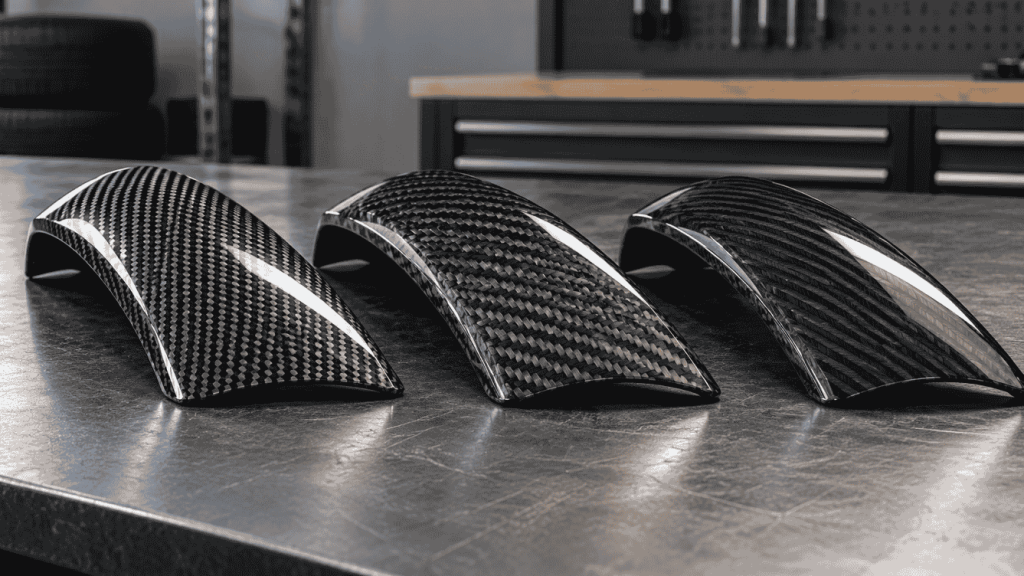
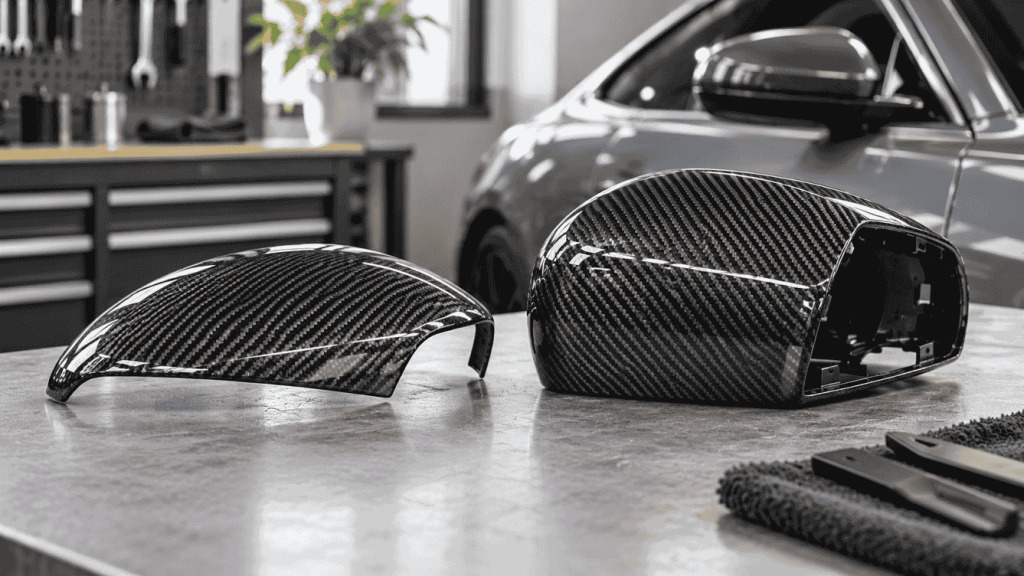
Compare full-carbon and fiberglass-backed parts by their documented reinforcement, complete construction and intended use—not the color of the underside. A visible carbon surface can be combined with different backing materials. Buyers need a clear construction statement before deciding whether two quotations describe equivalent products.
This is a specification problem first and a price problem second. A lower-cost hybrid may suit a customer’s appearance goal, while another buyer requires carbon reinforcement throughout specified skins. Neither requirement is served by a vague “100% carbon” label.
Define what “full carbon” means in the quotation
Carbon composite parts also contain resin and may include cores, inserts, adhesives or hardware. “Full carbon” should not be interpreted as 100% carbon by total weight. Ask whether the term refers to all fiber reinforcement, the visible face, particular skins or something else.
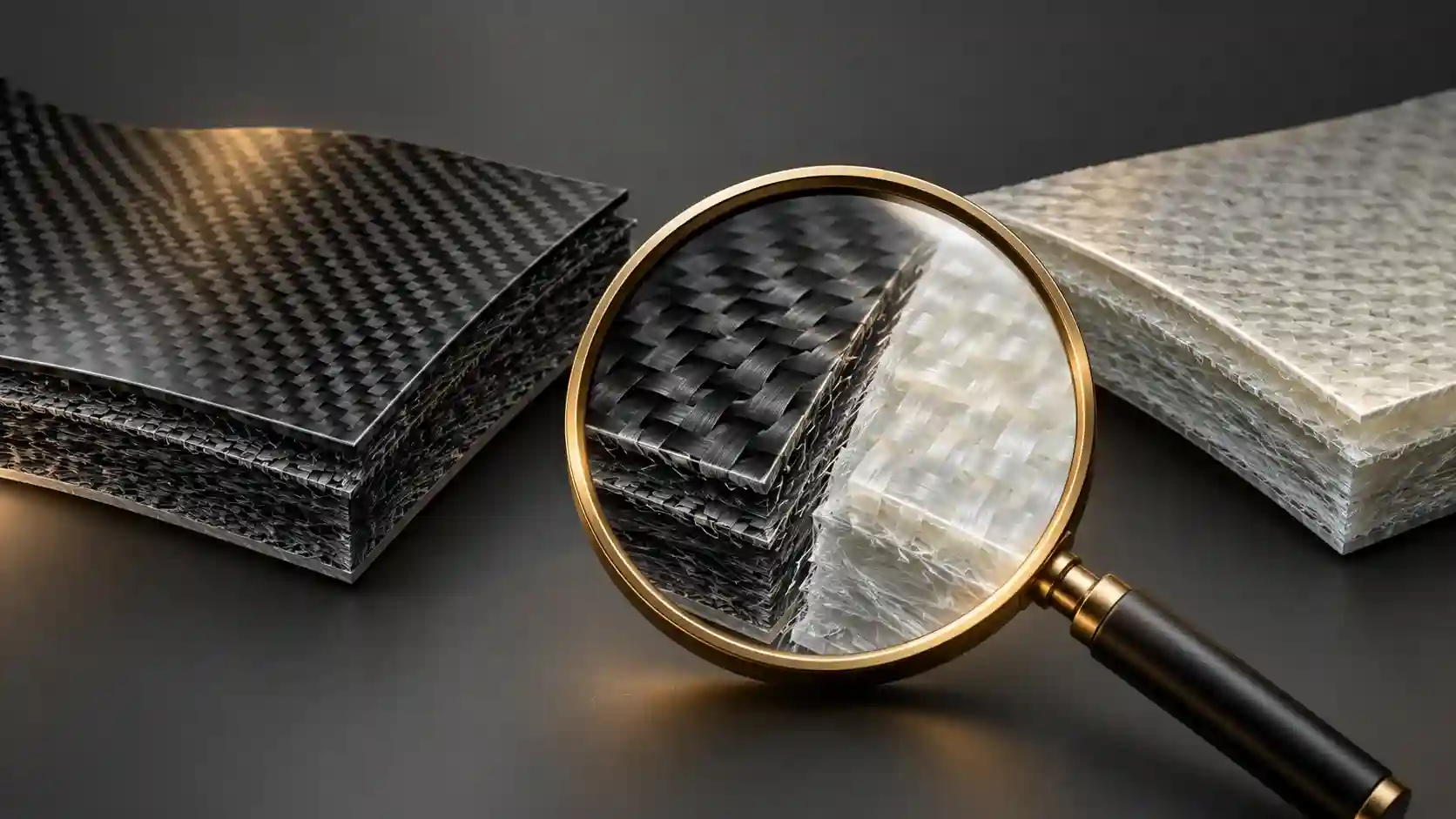
For example, Easy Composites describes its sheet construction as carbon fiber reinforcement with an epoxy matrix. This illustrates the distinction between reinforcement and resin; it is not a specification for an automotive part supplied by CCF.
A fiberglass-backed carbon part may use visible carbon over glass reinforcement. Ask for the actual arrangement rather than assuming every hybrid has the same layup. A decorative carbon skin over another substrate is also different from a complete replacement panel.
Use a comparison sheet that exposes differences
| Field | What to record | Do not substitute |
|---|---|---|
| Product identity | Exact SKU, revision and assembly type | A similar catalog image |
| Visible face | Material and finish | “Carbon style” without explanation |
| Backing and inner structure | Reinforcement, substrate and any stated core | Underside color |
| Measured mass | Defined supplied or installed configuration | Shipping weight |
| Performance requirements | Evidence for the intended function | Material name alone |
| Commercial scope | Contents, finish, packing and support | Unit price alone |
Separate construction from manufacturing labels
Dry carbon, wet carbon, prepreg and other process terms do not automatically answer which reinforcement is used on the back of a finished part. Ask construction and process questions separately. This makes it harder for two different products to appear equivalent in a price comparison.
Similarly, a dark underside can result from several materials or finishes. Photographs are useful for documenting interfaces and appearance, but they cannot reliably establish every hidden layer. Avoid destructive checks on a saleable sample unless an appropriate assessment has been agreed.
Match the specification to the customer’s objective
For an appearance-led build, evaluate the visible finish, fit, complete supplied contents and support route. For a weight target, request a comparable measured assembly mass. For a load-bearing application, obtain the relevant engineering evidence and installation requirements. Do not use a cosmetic sample review to approve a structural claim.
The purchase decision can then be explained plainly: “This option meets the agreed appearance and application requirements at this quoted scope,” or “This project requires a different documented construction.” Avoid presenting every hybrid as inferior or every all-carbon reinforcement system as automatically suitable.
Protect the specification through reorders
- Approve a named product reference and construction description.
- Keep sample photographs and any relevant measurement records.
- List the supplied contents and finish in the purchase specification.
- Ask for notification if the agreed construction changes.
- Review changed references before reusing old advertising claims.
If detailed layup information is proprietary, the supplier may still be able to provide a clear commercial construction statement and evidence relevant to your requirement. Decide whether that information is sufficient for your claim. Do not fill missing details with assumptions.
For mixed wholesale orders, record construction by line item. One confirmed carbon-reinforced hood does not establish the construction of every mirror cap or spoiler in the shipment.
A construction statement request
Use this record as a buyer working tool. Examples and sample labels below are illustrative, not CCF inspection, order or test records.
| Record | Example or required entry |
|---|---|
| Reinforcement | Please identify the stated fiber reinforcement in the relevant skins or layers. |
| Other constituents | Please identify any stated backing, core, resin system or inserts relevant to the requirement. |
| Meaning of label | Please explain what “full carbon” refers to for this exact supplied reference. |
Do not require proprietary details that are unnecessary for the buying decision, but do not replace a missing commercial construction statement with a guess from underside color.
For the connected decisions, use How to Verify Carbon Fiber Weight-Saving Claims Before Advertising Them and Forged or Woven Carbon: How to Choose a Finish for a Private-Label Range.
Buyer FAQ
Is fiberglass backing always unacceptable?
No. Suitability depends on the documented design and the customer’s requirements. Accurate disclosure is essential so the buyer knows what is being selected.
Can I advertise “100% carbon” from a face photograph?
No. Confirm what the supplier means and use precise wording about reinforcement or construction instead of an ambiguous percentage.
What should I send for a comparison?
Send the product references and your required application, finish and evidence. Request equivalent quotation scopes before comparing prices.
Compare Equivalent Construction and Quote Scopes
Send the references you are comparing and the customer requirement. Request clear construction, supplied contents and pricing for equivalent scopes.
Send an Inquiry
Include this article title, your product reference, vehicle details and the question you need resolved.