A discounted body kit can be a good purchase for a confirmed customer build. It can also leave a distributor holding three slow-moving components to obtain the one part customers actually requested.
For carbon fiber body kits wholesale ordering, choose a complete kit when its confirmed contents match the job and commercial terms. Choose individual parts when demand, replacement needs or customer configuration calls for a narrower purchase. Compare the complete usable order, not just the advertised percentage discount.
Send your proposed combination for a kit-versus-parts quotation. Before your next purchase becomes shelf stock, find out exactly what you are paying for and what can be reordered separately.

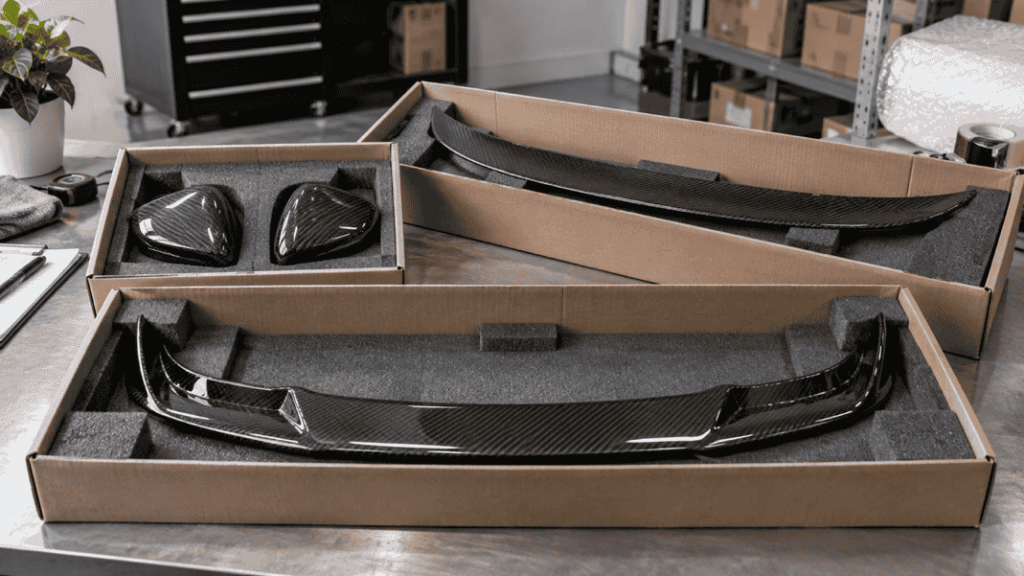
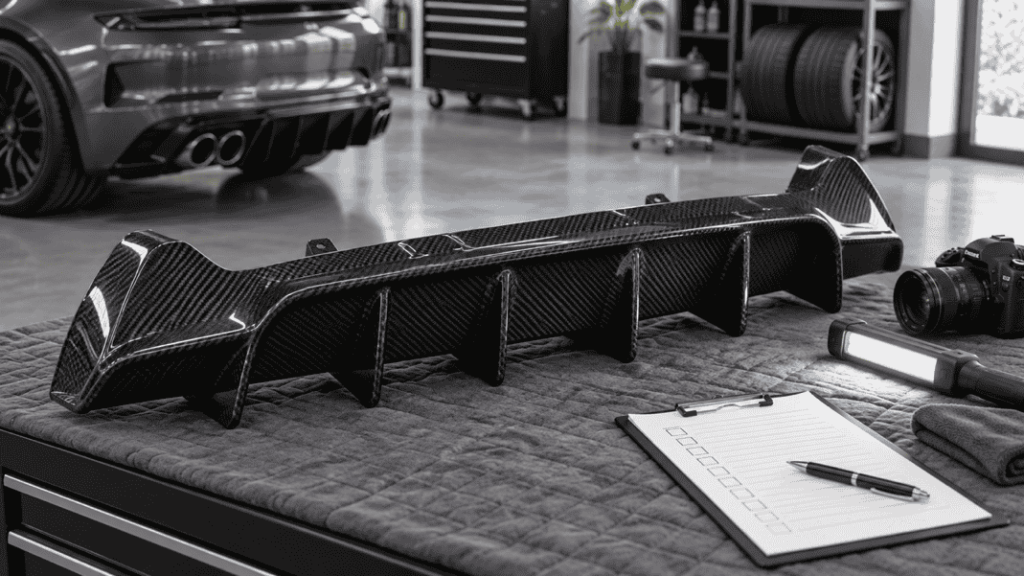
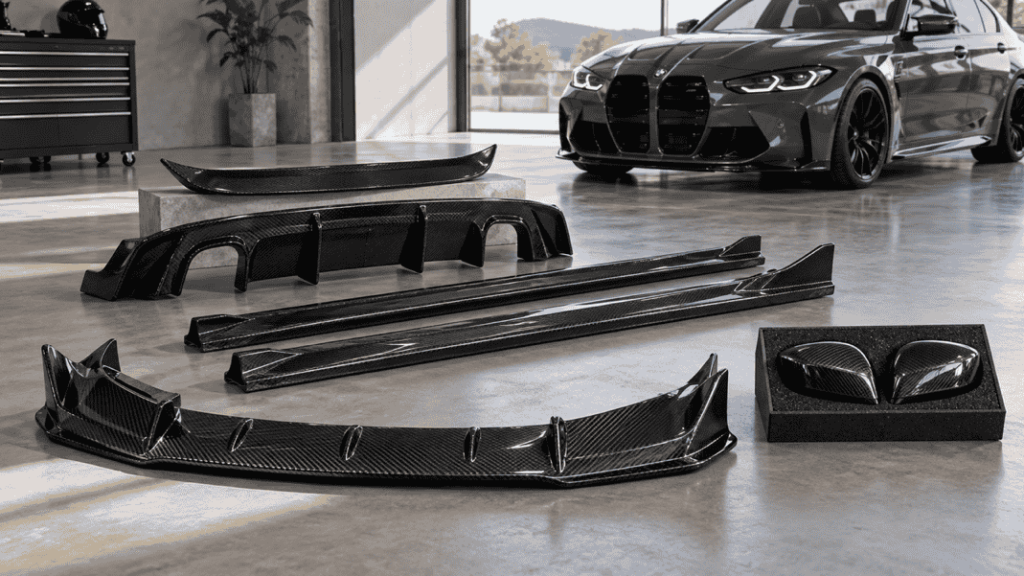
AI-generated assortment concept; not a verified complete kit, included-parts list or fitment reference.
“Complete kit” needs an itemized definition
A body-kit title does not define the contents. One offer may include a front lip, side skirts and diffuser. Another may include corner pieces, a spoiler or only selected exterior components.
Ask for a component list with actual references, quantities and versions. Distinguish a skirt pair from one side and a multi-piece front lip from a single component. Record which fittings are included and which must be transferred or purchased separately.
Confirm whether every item applies to the same vehicle configuration. A shared design name does not independently prove consistent fitment, construction or finish across the bundle.
Choose the buying format around the job
| Situation | Format worth comparing | Main question |
|---|---|---|
| Customer wants a coordinated full build | Defined complete kit | Does every included part fit and serve the agreed design? |
| Customer wants only one visual change | Individual part | Is the exact reference separately available on suitable terms? |
| Distributor is testing demand | Small focused assortment, if offered | What is the minimum commitment for each actual item? |
| Workshop needs to replace one component | Individual replacement, if offered | Can the correct side, version and finish be supplied? |
| Orders span several vehicle configurations | Mixed order, if offered | Are individual applications, quantities and packing clear? |
| A required component has a different readiness date | Full or split shipment | Can each shipment support a useful stage of the job? |
None of these formats is automatically available from a catalog. Confirm the supplier’s actual policy and quotation for the selected references.
A kit discount can hide an expensive extra purchase
Consider an illustrative customer job that requires only a front lip and side-skirt pair. Suppose the separately quoted items total $700, while a larger kit costs $900 and includes an additional rear component. The kit may offer a lower combined list price, but it still requires $200 more cash for that customer’s stated scope before any other cost differences.
If the rear component has a credible buyer or completes a planned package, the larger purchase may make sense. If it simply stays on the shelf, the advertised saving does not turn it into demand. These numbers are hypothetical and do not represent our prices or expected returns.
For a full-build customer, compare the same complete contents in both quotations. Do not compare a complete kit against a partial individual-parts basket and call the difference a discount.
Check the replacement path before selling the kit
Ask what happens if the customer later needs one corner piece, one skirt or a replacement diffuser. Obtain answers about separate availability, minimum quantity, identification requirements and how a revised version will be handled.
Record the original product references and finish information in the customer job file. A photograph of the finished car may not identify a small component accurately enough for a replacement order months later.
Do not promise an exact future cosmetic match without confirmation. If matching appearance matters, ask how the supplier assesses a replacement against the existing part and what images or samples are needed. Keep any uncertainty visible in the replacement quotation.
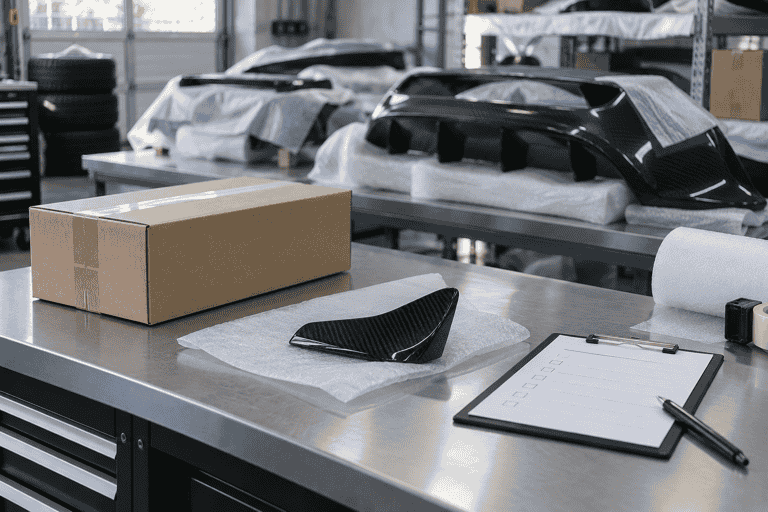
AI-generated replacement-order concept; not evidence of individual-part stock or a replenishment policy.
Use the carbon-parts reorder checklist to record which components can actually be replenished and what must match the original order. A multi-part kit does not itself establish separate replacement supply.
Confirm finish and construction item by item
A kit may contain components with different manufacturing requirements. Ask for the construction and finish of each item rather than assuming that a single “carbon” label describes everything identically.
When adjacent pieces must look coordinated, request representative actual photographs and agree on the appearance review scope. Do not use a computer-generated styling image to approve weave direction, color or gloss matching for production.
If the supplier proposes a substitute for one component, review its fitment, appearance and mounting requirements before accepting the change. An otherwise complete kit can still be unsuitable if its replacement item conflicts with the customer’s build.
For a high-value build, the Audi R8 part-by-part fitment guide shows how to review a mixed exterior-parts list without treating one accepted component as approval of the whole vehicle package.
Compare packing and timing, not just the parts total
A kit does not necessarily travel in one carton, and individual items do not necessarily require separate shipments. Request the proposed package count, external dimensions, gross weights and protection arrangement for each option.
Compare consolidated and split delivery where timing matters. Ask which pieces will be ready together and whether the first shipment will support a useful installation stage. Avoid booking the entire build around one ready item while the remaining components are still unconfirmed.
The International Trade Administration’s pro forma invoice guidance includes item details, pricing, delivery terms and estimated shipping information among the fields that help define an offer. Put the agreed bundle and exclusions in the quotation rather than relying on a verbal description.
Use our landed-cost guide to compare equivalent delivery scopes and the large-part shipping checklist to review protection and receiving requirements.
Keep mixed-order inventory understandable
For a distributor, assign every component to a confirmed customer order, a justified stock position or a controlled trial. Record why you are buying it and when you will review the result.
Allocate shipment costs on a documented basis suited to the package mix. Do not make a large component appear more profitable by spreading its transport cost blindly across unrelated small parts.
If you sell a kit as one storefront item, keep its component references available internally. Your sales team needs the simple package name; your purchasing and support teams need the underlying detail. The dealer product-data guide explains how to preserve that connection.
Frequently asked questions
Are complete kits always cheaper?
Not for every required scope. Compare equivalent contents and delivery costs, then consider whether every additional component has a purpose in the order.
Can I buy a single component from any kit?
Only if the supplier offers it. Confirm availability and ordering terms before promising a customer a future single-part replacement.
Can a mixed order include different chassis?
It may, depending on the supplier’s terms. List each application and quantity separately and request confirmation rather than assuming one kit policy covers all combinations.
Should I split delivery to start the job sooner?
Compare the additional cost and whether the first shipment enables a useful, approved work stage. One early component does not necessarily bring the complete handover date forward.
Buy the combination your business can use
Do not spend more just to qualify for a discount on parts you have not sold. Send your required components, vehicle configurations, quantities and destination now. Request both a defined kit offer and an individual-parts alternative.
Ask for the contents list, separately available replacements, readiness information and packing scope. Choose the option that supports the customer job and your cash flow—not the one with the loudest discount label.