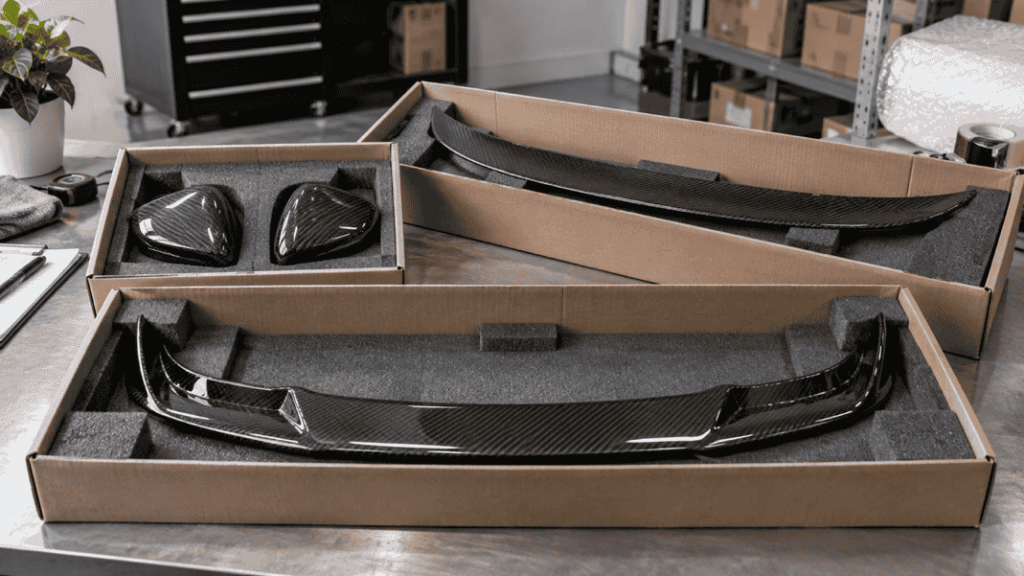
An order for “two side skirts” can mean one left/right pair or two complete pairs. A “three-piece front lip” can be one kit, while a photograph may also show optional corner pieces that are not included. Quantity ambiguity can survive every price discussion and only appear when the carton is opened.
Specify carbon fiber quantities in both sales units and physical contents: the SKU, number of units ordered and components included in each unit. Keep the same interpretation in the quote, order confirmation, packing list and receiving check.

Concept illustration.
Separate three counts
The order quantity is how many sales units you are buying. The component count is what each unit contains. The carton count is how the goods are packed. These numbers may be different and should not substitute for each other.
| Illustrative description | Sales-unit quantity | Physical scope to state |
|---|---|---|
| Left/right mirror-cap pair | 1 pair | One left cap and one right cap |
| Three-section front lip kit | 1 kit | Three identified sections; hardware stated separately |
| Two side-skirt pairs | 2 pairs | Two left pieces and two right pieces, if that is the defined set |
| Individual replacement section | 1 piece | The identified section only, if offered separately |
These are examples of clear wording, not a statement of how every CCF SKU is packaged or sold. Confirm the actual sales unit for each selected item.
Make MOQ and price use the same unit
CCF's wholesale page states that standard catalog products can start from one piece. For your chosen SKU, ask whether the orderable unit is an individual item, pair or complete kit. That clarification should appear alongside the price.
A low minimum does not mean every component of a multi-piece product can be purchased separately. Nor does it mean custom finishes or private-label work follow the same commercial conditions. Review the samples and mixed-order guide for the broader ordering discussion.
List hardware outside vague kit language
“Complete” may mean the complete carbon assembly, not every fastener, adhesive or original component needed for installation. State what is supplied, what is reused from the car and what must be sourced separately.
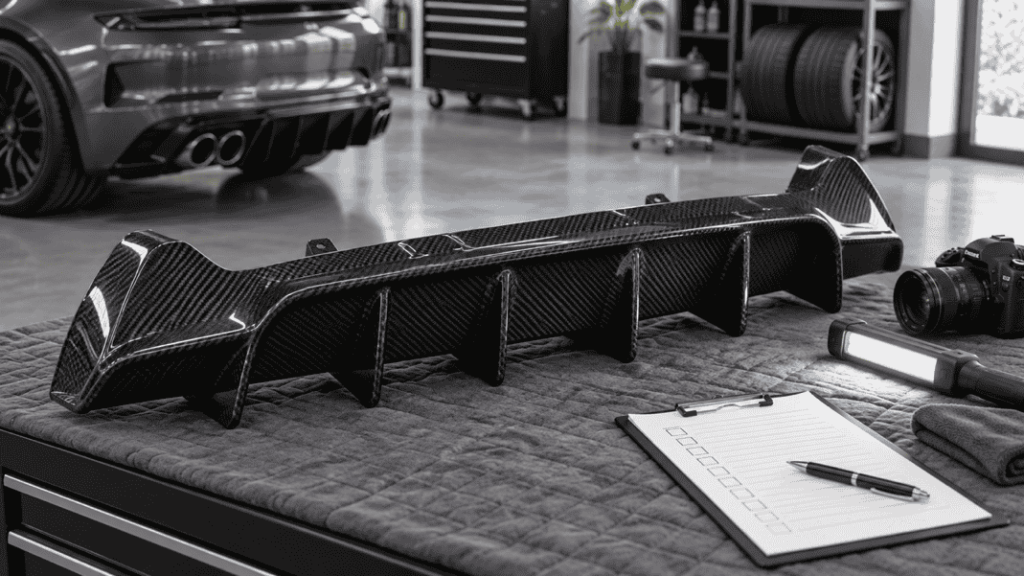
If a photograph contains a lip, diffuser and side skirts, ask whether it shows a sold package or a display of independent options. The kit-versus-individual-parts guide helps establish that distinction.
Confirm the receiving calculation
Before dispatch, compare the ordered sales units with the packing list's component descriptions. A pair can occupy one carton or more, while several small products may share a carton. Do not report a shortage from carton count alone.
At receiving, record the contents against the order and retain product references. If something appears missing, describe the exact discrepancy: “one right-side piece absent from the pair shown on order line three” is more useful than “quantity wrong.”
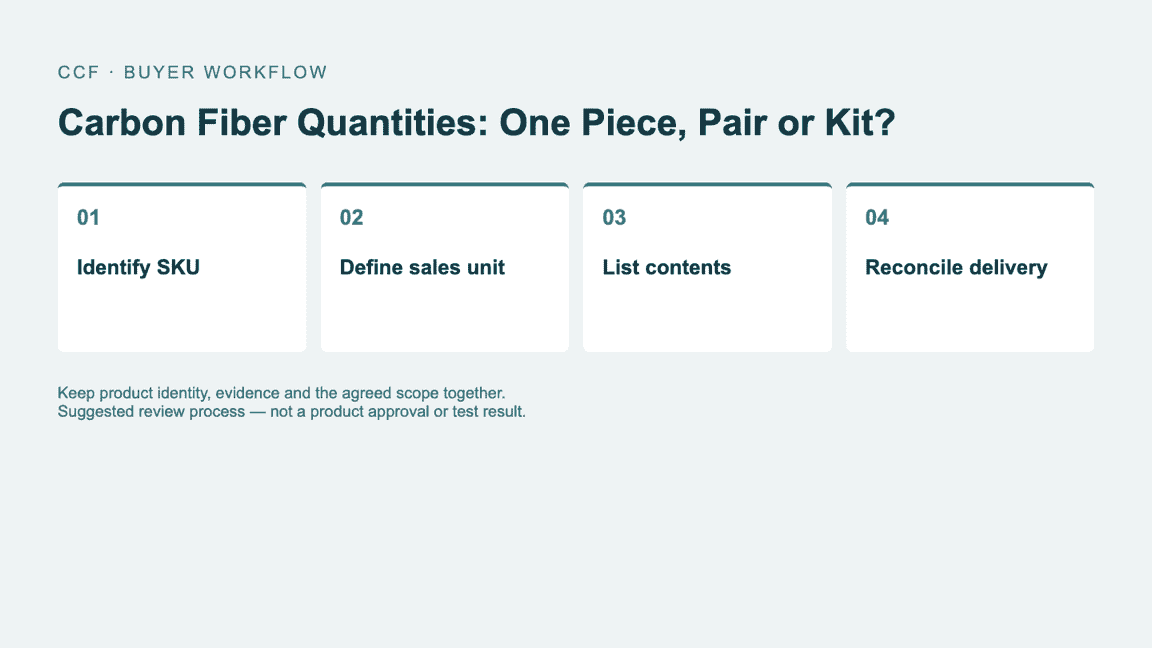
Suggested buyer workflow. Follow the product-specific specification and agreed order terms where applicable.
A receiving arithmetic check
Use this record as a buyer working tool. Examples and sample labels below are illustrative, not CCF inspection, order or test records.
| Record | Example or required entry |
|---|---|
| Order wording | Two pairs of side skirts; each pair defined as one left and one right piece. |
| Expected contents | Two left pieces plus two right pieces: four main pieces total. |
| Separate items | List hardware and optional sections independently; do not infer them from the four-piece count. |
This is an illustrative unit calculation. Ask the supplier to confirm the actual SKU definition, then use that same unit on the order and receiving record.
Questions buyers ask
Can I order only the damaged section of a multi-piece lip? Ask whether that section is separately available for the exact version. Do not assume modular appearance means independent spare-part supply.
Does quantity one always mean one physical object? No. It can mean one defined pair or kit if that is the SKU's sales unit. The quotation should make this explicit.
For the related buying decisions, see Carbon Fiber Packing Lists: How Dealers Match Cartons to Customer Jobs and Before You List Carbon Fiber Parts Online: A Dealer Listing Checklist.
Get the quantity right before payment
Send CCF the selected product references and the number of complete customer jobs you need to supply. Request the sales unit and contents for each line. Clear counting now prevents missing-part disputes later.
Send an Inquiry
Include the article title, selected parts, quantity and delivery country.
Customer reference: BMW Carbon Fiber Exterior: A Customer Build Reference for Tuning Shops. Read the actual feedback alongside the product-specific checks above.