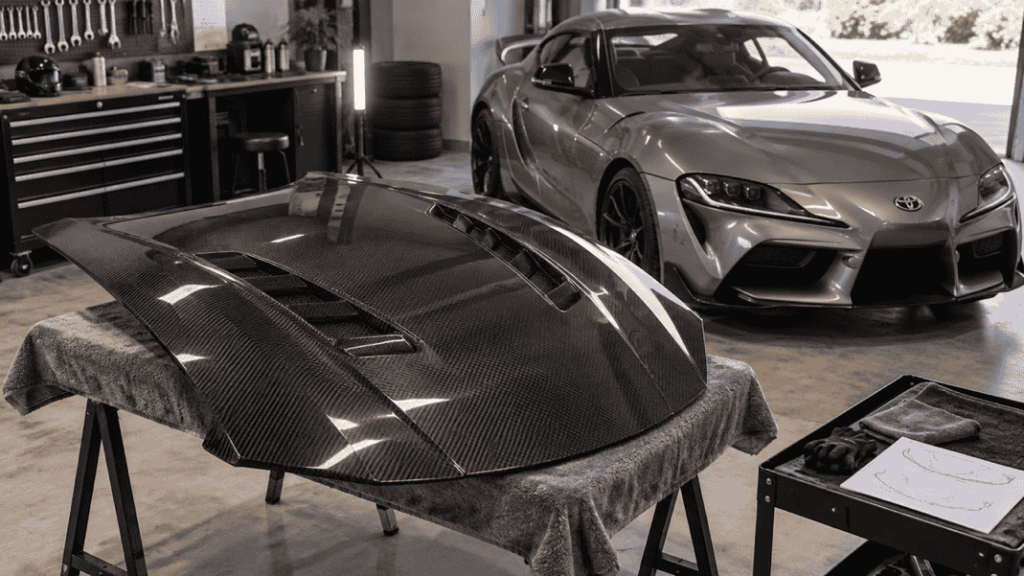
Store carbon fiber body parts so their weight is supported, finished surfaces cannot rub against other objects and each product stays identifiable. The best warehouse method is specific to the panel and packaging. It is not a universal instruction to stand every hood upright or stack every box flat.
For a distributor, stock condition is part of the product you sell. A panel that arrived intact can still develop a cosmetic complaint after repeated handling. A practical storage plan limits contact, movement and confusion from receiving through dispatch.

Give each product a storage decision
Start with the supplier’s packing and handling information. Identify where the item can be supported and whether the shipping package is intended for extended storage. If those details are missing, ask before removing supports or changing orientation. A protruding tab or thin edge should not become a convenient load-bearing point merely because it fits the rack.
| Part group | Storage question | Handling control |
|---|---|---|
| Hoods and trunk lids | Which orientation and supported areas are approved? | Use a dedicated bay or approved package; protect edges and avoid leaning loose panels together |
| Front lips and side skirts | How is the length supported without loading small extensions? | Keep the full assembly stable and prevent overhang into an aisle |
| Mirror caps and small trim | Can pieces move or rub inside the container? | Separate finished faces and keep left/right identity visible |
| Multi-piece kits | Which components and hardware belong together? | Link containers to one kit reference rather than relying on memory |
Separate receiving, approved stock and exceptions
Use three visibly distinct statuses: awaiting inspection, available stock and hold for review. These are suggested warehouse states, not product quality grades. A box in the receiving area should not appear available to sales until its identity and condition have been checked.
Keep a dated inspection record with the SKU, quantity, package condition and any unresolved question. If you move a part out of its original carton, retain the connection between the item, hardware and order reference. Do not remove labels simply to make a shelf look tidy.
Prevent contact damage during ordinary handling
Provide a clean staging surface for inspection and picking. Remove loose fasteners and debris before setting a finished part down. Keep hardware in a separate identified pouch or compartment so it cannot travel against the visible surface. Reuse protective materials only when their condition is suitable and their compatibility is known.
Avoid unnecessary unpacking for repeated sales demonstrations. If the business needs a handling sample, identify it separately from saleable inventory. A display piece with a known history should not quietly return to new-stock status after a customer visit.
Control the environment without inventing a universal limit
Choose a sheltered area away from direct sun, local heat sources, leaking pipes and chemical work. Keep products in the environmental conditions specified for their materials and packaging. This article does not assign one temperature or humidity range to every carbon component, adhesive accessory or finish.
If a package is damp or conditions have changed unexpectedly, isolate it for review instead of sealing it back up and assuming the contents are unaffected. Ask for instructions relevant to the actual product. Condensation, packaging deterioration and surface contamination are different observations and should be recorded separately.
Use a five-field shelf record
- Identity: product reference, version and piece/pair/kit count.
- Location: one clearly named bay or linked set of bays.
- Condition: inspection date, status and photograph reference.
- Protection: retained supports, covers and any handling notes.
- Next check: review before dispatch or after a reported storage incident.
For example, a long side-skirt pair stored in two cartons should still show that both boxes are required for the same sales unit. Picking one carton because its label says “side skirt” can create an avoidable short shipment. Keep the physical arrangement and the inventory record consistent.
Check again at dispatch
Before release, confirm the selected version, visible condition and complete contents. Recheck any item that was opened, moved or used for demonstration. A receiving photo documents the start of storage; it does not establish the condition at the end of several handling cycles.
For your next stock order, send the product list and ask for package dimensions, handling information and any storage restrictions. That allows you to allocate space before the goods arrive rather than improvising around vulnerable panels.
Warehouse questions
Can hoods always be stored vertically?
No universal orientation is established here. Follow the approved support and packaging arrangement for the selected hood.
Is a sealed carton enough protection?
Only if the package and contents remain suitable for the storage conditions. Check the package condition and avoid unsupported stacking assumptions.
Should I use the oldest stock first?
Order age can help organize stock, but release still depends on identity, condition and the relevant product or accessory restrictions.
A storage-status card
Use this record as a buyer working tool. Examples and sample labels below are illustrative, not CCF inspection, order or test records.
| Record | Example or required entry |
|---|---|
| Identity | SKU, revision, sales unit and storage location. |
| Condition | Saleable / display / return hold / unidentified; never combine these statuses in one usable count. |
| Handling | Reference the applicable packaging and support instructions; record any changed packing. |
Review the status before dispatch. An attractive warehouse illustration is not evidence that a particular storage arrangement has been validated for your hood or long trim.
For the connected decisions, use How to Process Returned Carbon Fiber Parts Before Restocking and How to Compare Carbon Fiber Parts Warranties Before Buying for Resale.
Plan Your Stock Before It Arrives
Send the selected parts and intended stock quantities. Ask for packing dimensions and available handling information before allocating warehouse space.
Send an Inquiry
Include this article title, your product reference, vehicle details and the question you need resolved.