CARBON PARTS WORKSHOP SERIES · 06
A dealer supplying an Audi C8 A6/S6 carbon spoiler should send the installer an application record, the exact product identification, supplied contents and the instructions for that SKU. Sending only a product-page link leaves important details vulnerable to later listing changes or misunderstandings.
This Carbon Parts Workshop Series article explains how to prepare that handover. It serves distributors, e-commerce sellers and tuning shops that sell a part for installation elsewhere. It is not a substitute for the selected spoiler’s fitting procedure.
Confirm the body and product, not just “C8”
The C8 label alone is not a complete application description. Capture the model, model year, market and body configuration, together with photographs of the actual rear panel and any existing spoiler. Have the supplier confirm the application of the quoted product. Do not extend an A6/S6 description to an RS6 Avant or another body merely because the generation label is familiar.
Then identify the spoiler by supplier SKU and revision where available. A style label such as “V3” helps distinguish products within a supplier’s range; it is not a standardized specification across suppliers. Keep your dealer stock code linked to the supplier’s reference so the installer can identify the delivered part.
What a product-specific source adds
Canadian Auto Performance publishes an installation guide for its C8 Audi A6/S6 V3 spoiler. The document identifies the product and separates included items from required tools. That distinction is useful for dealer handover: what is in the carton is not necessarily everything the installer needs.
The CAP guide applies to CAP’s identified product. Its tape, tools and procedure should not be represented as the instructions for a CCF spoiler. Request the available information for the actual CCF reference and identify any question still requiring confirmation.
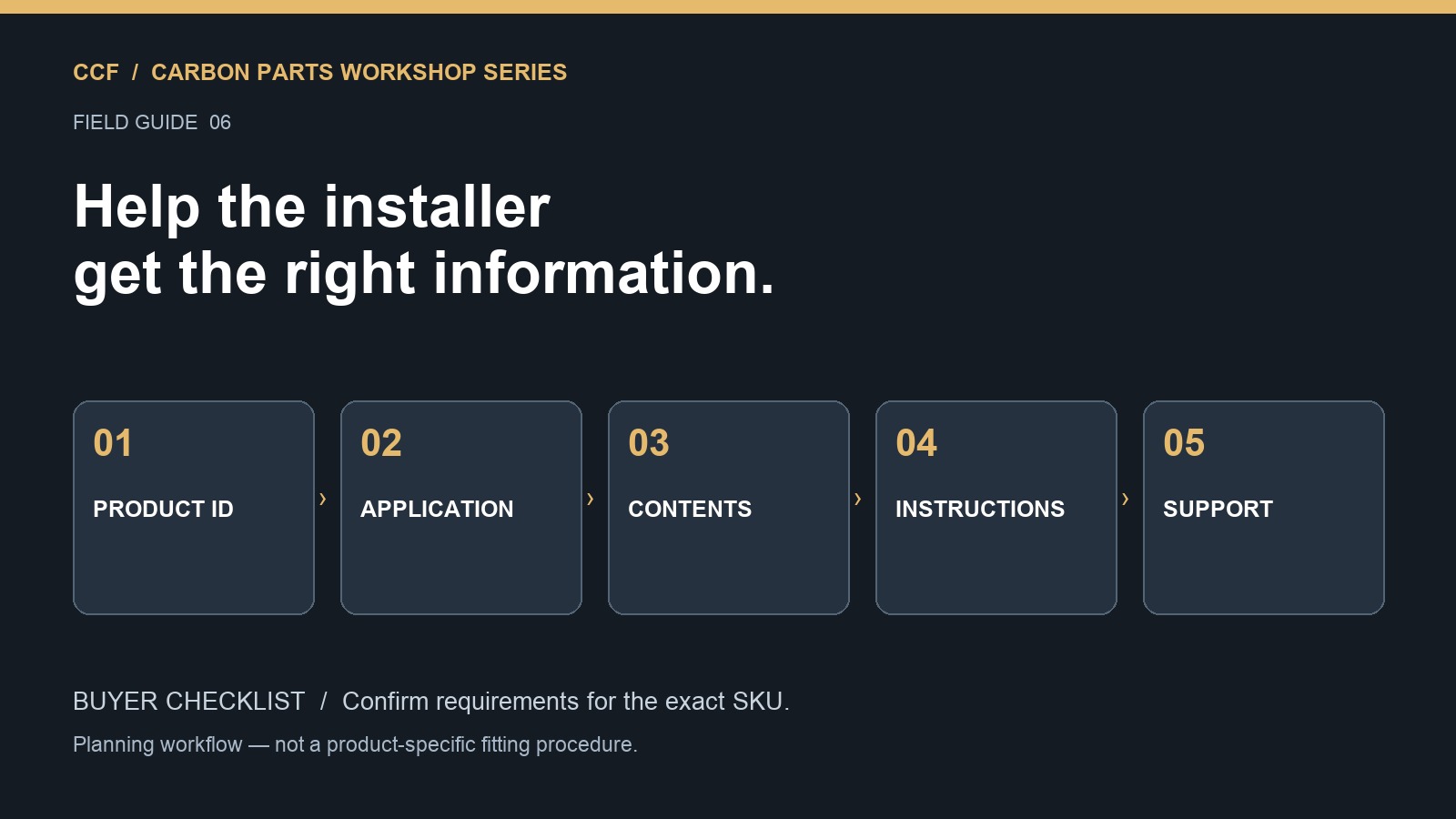
Send a five-part handover pack
| Pack section | Information the installer should receive |
|---|---|
| Product identity | Supplier SKU, dealer code, selected finish and revision if provided |
| Application record | Vehicle details and the photographs used for supplier confirmation |
| Delivered contents | Agreed packing list with separately required items clearly identified |
| Installation information | Applicable document or supplier information, version/date and outstanding questions |
| Support route | Order reference, dealer contact and the information needed to investigate a discrepancy |
Send the pack before the appointment, then include a reference with the shipment. If the installer spots an inconsistency, there is time to resolve it before the customer leaves the car. A PDF download alone is not a complete pack when its connection to the delivered SKU is unclear.
Keep the listing and the handover consistent
Audit the claims the customer has already seen. If the listing says “hardware included,” specify what that means in the supplied contents. If it claims easy installation, do not allow that phrase to replace a review of the actual procedure. If an installation requirement is unknown, avoid adding a confident promise to make the listing more attractive.
Our dealer listing checklist helps identify ambiguous sales claims. Use the dealer product data framework to retain stable SKU and revision records even when the public page is edited.
Clarify removal and preparation scope
Tell the installer about the existing spoiler, previous modifications and any known rear-panel repairs. The installer should assess the actual starting condition and the relevant product instructions. Do not promise that removal leaves every vehicle surface unchanged or that preparation will take a fixed amount of time.
If the selected product uses a bonding system, obtain the specified material and application requirements. A generic “3M tape” description may not identify an exact product or its required conditions. The adhesive selection guide gives questions to ask; it does not approve a substitute for the spoiler supplier’s requirements.
Make unresolved questions visible
Use an open-items list with a short question, named owner and next action. For example: “Supplier to confirm whether the installation document supplied for revision A applies to the delivered revision B.” Do not treat the existence of a newer document as proof that every previous part has changed.
Ask the installer to confirm when the information is sufficient to schedule the job. That acknowledgement concerns the reviewed scope; it is not a performance certificate. If the installer needs additional details, pass the exact question to the supplier rather than paraphrasing it into “customer says it will not fit.”
Handle a mismatch without losing the evidence
Imagine the delivered label differs from the SKU in the installation pack. Keep the packaging and photograph the label, part and included items. Pause the identity-dependent work and ask the dealer to establish which product arrived and which instructions apply. This is a hypothetical example, not a reported CAP or CCF defect.
Our fitment issue evidence checklist helps structure the report. Separating a labeling mismatch from a confirmed fitment problem avoids assigning a cause before the product has been identified.
Close the loop after installation
Retain the installed SKU and the instruction reference used by the workshop. Provide the customer with the applicable care information and a clear contact for any follow-up question. If a dealer receives repeated questions about the same missing detail, improve the handover pack instead of sending each installer through the same email chain.
A short record is enough when it identifies the vehicle, product and relevant documentation. Do not collect unnecessary customer information or publish identifying vehicle details in public troubleshooting posts.
Dealer questions
Can I send a competitor’s installation guide?
It may provide background, but label it as a reference for that competitor’s product. It cannot stand in for instructions covering the delivered SKU.
Should I include a printed guide in every carton?
Choose a method that reliably connects the installer to the correct document. A printed reference, accessible file or stable link can work, provided the revision and product association are clear.
Who answers an installer’s technical question?
Give the installer a named commercial contact who can obtain the supplier’s product-specific answer. The dealer should not invent a technical specification to close the enquiry quickly.
Request dealer-ready product information
Send CCF the vehicle application, spoiler reference, quantity and destination. Explain that the part will be installed by another workshop, and ask which product and installation information can accompany the order. Resolve the open items before presenting the pack as complete.
Editorial reference check: 18 October 2026. Referenced manufacturer documents apply to their identified products. Confirm CCF SKU requirements separately.