CCF Reseller Knowledge Center · Fulfillment & Brand Protection
When an online automotive parts store uses a supplier to ship directly to its customer, the parcel becomes part of the store’s brand experience. Blind shipping can help keep the customer-facing delivery neutral—but it does not eliminate customs paperwork, carrier records, or the need for clear supplier instructions.
Quick Answer: What Is Blind Shipping?
Blind shipping is an arrangement in which the supplier avoids placing its own promotional branding, sales materials, or supplier-identifying marketing content in a shipment sent to the reseller’s customer, subject to carrier and legal requirements. Dropshipping describes who holds and dispatches the inventory. They are related, but not the same: an order can be dropshipped without being blind-shipped.
For automotive carbon fiber parts, successful blind shipping requires advance agreement on packaging, labels, documents, shipping notifications, and the procedure for handling delivery exceptions.
1. Blind Shipping vs. Dropshipping: Know the Difference
Many new automotive parts resellers use the two terms interchangeably. That creates avoidable confusion when discussing order fulfillment with a factory or trading partner.
| Topic | Dropshipping | Blind shipping |
|---|---|---|
| Main purpose | Supplier ships an order directly to the end customer | Supplier limits customer-facing supplier branding or promotional identification |
| Inventory | Often held by the supplier | Can be supplier-held or reseller-owned |
| Branding | May be supplier-branded unless agreed otherwise | Neutral or agreed reseller-facing presentation |
| Documents | Standard shipping and compliance documents | Customer-facing inserts can be controlled; mandatory documents still apply |
| Key question | Who packs and ships the order? | What will the customer see when the parcel arrives? |
Example: A customer in Spain orders a carbon fiber rear spoiler from a Spanish online store. The supplier in China packs and ships the spoiler directly to that customer. This is dropshipping. If the supplier also omits its own advertising inserts and uses an agreed neutral presentation, the order may additionally qualify as blind shipping.
2. Packaging: Neutral Does Not Mean Unprotected
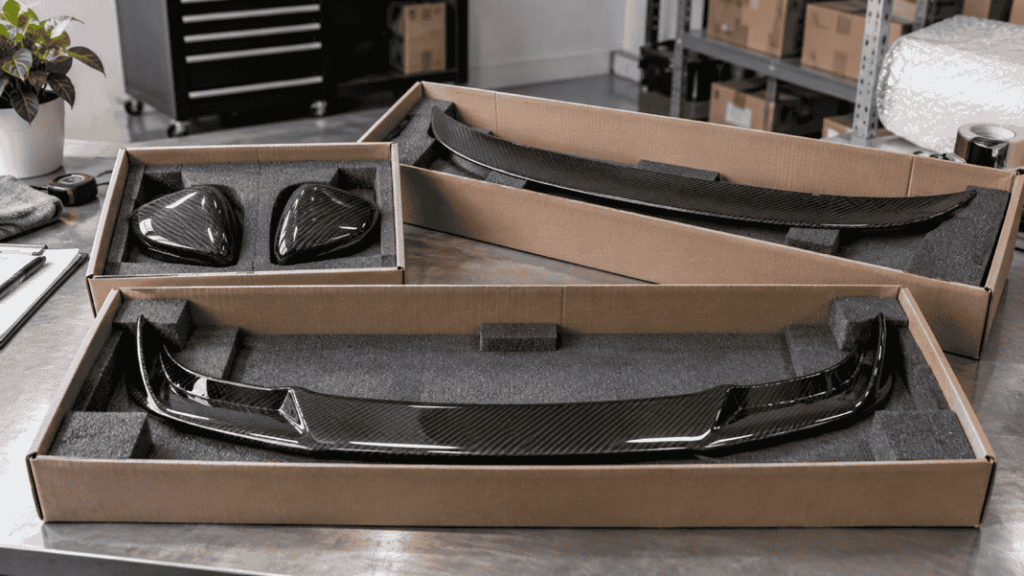
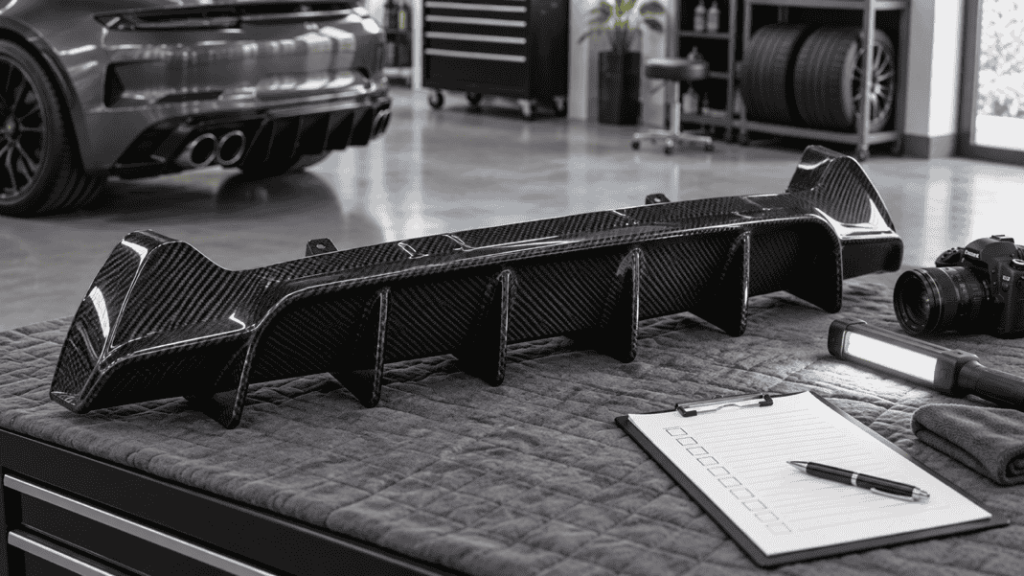
Automotive carbon fiber parts have very different shipping risks from small consumer accessories. A mirror cap, front lip, diffuser, rear wing, and hood cannot be treated as identical parcels. The first priority is safe, product-appropriate protection; branding decisions come second.
Outer cartons and protective materials
- Use packaging appropriate to the part’s dimensions, weight, protruding edges, and finish.
- Protect mounting points, corners, sharp edges, and clear-coated surfaces against abrasion and impact.
- For oversized parts, discuss reinforced cartons, internal supports, or other protective methods as appropriate.
- Confirm whether special packaging increases chargeable weight or shipping cost.
What should be inside the box?
Agree on whether the parcel should contain installation instructions, a packing list, care guidance, warranty information, or other necessary product documentation. Do not remove legally required safety, origin, compliance, or consumer information merely to make a shipment appear anonymous.
3. Shipping Labels, Sender Details, and Customs Documents
The most common blind-shipping misunderstanding concerns the shipping label. A neutral box does not guarantee a completely anonymous shipment. Depending on the carrier, destination, and shipment method, the label or accompanying paperwork may need to show a shipper, return address, exporter, manufacturer, or other responsible party.
| Item | What the reseller can request | Important limitation |
|---|---|---|
| Promotional inserts | No factory flyers, business cards, or unrelated promotions | Usually straightforward if agreed before dispatch |
| Outer carton | Neutral packaging without supplier marketing logos | Protective and regulatory markings may remain |
| Shipping label | Review available sender-display options | Carrier and legal requirements determine required details |
| Commercial invoice | Clarify who receives it and which values/details are required | Never falsify values, descriptions, origin, or parties |
| Return address | Agree on a practical return/claim route | A valid operational address may be required |
| Tracking updates | Provide tracking to the reseller for customer communication | Tracking pages may display carrier, origin, and transit events |
For shipments into the EU, import VAT, customs duties where applicable, import declarations, and the allocation of importer responsibilities depend on the transaction and shipping terms. Resellers should confirm these details with a qualified customs or tax adviser rather than assuming that blind shipping changes import obligations.
4. What Supplier Privacy Can—and Cannot—Protect
Resellers often want to prevent the end customer from bypassing their store and contacting the factory. Neutral customer-facing packaging can reduce unnecessary exposure, but it is not a guarantee that a supplier’s identity will remain undiscoverable.
- Public product listings, reverse image searches, and manufacturer markings may reveal sourcing clues.
- Carrier tracking and legally required import documents may reveal shipment origin or responsible entities.
- Customers may need legitimate product, safety, or warranty information.
- Supplier privacy should never rely on inaccurate declarations or concealment of legally required facts.
Long-term customer retention depends more on accurate fitment advice, reliable service, useful installation guidance, responsive support, and transparent delivery expectations than on anonymity alone.
5. A Practical Blind-Shipping Workflow for Carbon Fiber Parts
Step 1 — Define the reseller’s customer-facing requirements
Before accepting orders, decide what neutral packaging means for your store. Specify acceptable inserts, product labels, the desired presentation, and whether the supplier may contact the end customer for delivery purposes.
Step 2 — Verify vehicle fitment and product specification
Collect the vehicle make, model, year, chassis/generation, trim, and relevant factory options. Confirm the exact product version, finish, and any installation constraints. Blind shipping does not reduce the need for accurate fitment checks.
Step 3 — Confirm price, availability, shipping method, and responsibilities
Request an order-specific quotation, stock or production confirmation, estimated dispatch timing, and shipping cost. Agree who handles customs questions, address corrections, damage claims, and customer communications.
Step 4 — Submit complete shipping instructions
Provide the correct recipient details and a clear note such as “Neutral packaging; no supplier promotional inserts, subject to mandatory shipping and customs documentation.” Confirm that the supplier has accepted the instruction before dispatch.
Step 5 — Pack and document the shipment correctly
The supplier should use appropriate protective packaging and complete the carrier and customs documentation accurately. If the reseller requires specific compliant inserts, those should be agreed and supplied through an approved process.
Step 6 — Receive tracking and update the buyer
Send the customer a realistic delivery update without promising an exact arrival date that has not been confirmed. Explain possible customs processing and delivery-contact requirements.
Step 7 — Confirm delivery and manage exceptions
Ask customers to inspect the package promptly and retain the carton, labels, and photographs if damage is suspected. Route issues through the agreed reseller–supplier support process.
6. Five Common Blind-Shipping Problems—and How to Prevent Them
Problem 1: The supplier includes its own business card
Prevention: Use a written packaging instruction for every new supplier relationship and confirm it during the first test shipment. Do not assume “dropshipping” automatically means “no marketing materials.”
Problem 2: The customer sees a Chinese shipper on the label
Prevention: Explain the limitations of sender information before selling. Confirm which display options the carrier actually permits; do not request false shipper information.
Problem 3: The parcel arrives with unexpected import charges
Prevention: Clarify Incoterms, who is importer of record, and who pays duties and taxes before checkout. Communicate the applicable arrangement to the customer.
Problem 4: A carbon fiber part is damaged in transit
Prevention: Confirm protective packaging standards, insurance or claims terms where available, and evidence requirements. Large aerodynamic components deserve particular attention.
Problem 5: A return goes to the wrong address
Prevention: Establish an authorized return procedure. Never tell a customer to ship a large or fragile part back internationally before receiving return instructions.
7. Blind-Shipping Instruction Checklist for Resellers
Use this checklist when preparing a supplier onboarding document or first test order:
- Product: exact SKU, finish, quantity, vehicle fitment details, and any installation notes.
- Recipient: complete name, address, phone number, and delivery instructions.
- Packaging: neutral outer packaging requested; protection suitable for the part.
- Inserts: no supplier marketing materials; required product/compliance information retained.
- Labels: sender-display requirements reviewed for the chosen carrier.
- Customs: accurate description, value, origin, and required parties; tax responsibility agreed.
- Tracking: tracking number and communication responsibilities confirmed.
- Exceptions: process for damage, wrong item, address correction, and returns agreed.
Example message to a supplier
“We operate an online automotive parts store and would like this order shipped directly to our customer. Please use neutral packaging without your promotional flyers or business cards, while retaining all legally required shipping, customs, and product information. Before dispatch, please confirm the exact part, fitment, protective packaging, total shipping cost, and tracking process.”
This is a request template, not a statement that every supplier or carrier can accommodate every instruction.
8. Blind Shipping and Dropshipping with CCF
CCF works with automotive carbon fiber parts resellers and supports dropshipping and blind-shipping arrangements for eligible orders. Resellers can request available product catalogs and discuss individual product requirements without committing to a large opening inventory order.
To avoid surprises, each order should still be confirmed for product availability, vehicle fitment, shipping destination, packaging requirements, costs, and estimated dispatch or delivery timing. CCF does not promise a public API, automatic catalog synchronization, a complete standalone media library, or universal fixed shipping rates.
If you are preparing a new online store, begin with a manageable set of vehicle-specific products and test the full ordering, packaging, shipping, and customer-support workflow before expanding.
Discuss Neutral Shipping for Your Carbon Fiber Parts Store
Tell CCF which vehicle models and products you plan to sell, where your customers are located, and what neutral-packaging requirements you need. The team can review available catalog options and discuss order-specific fulfillment arrangements.
Explore CCF DropshippingFor wholesale pricing and a specific product quotation, use the CCF wholesale inquiry page.
Frequently Asked Questions
Is blind shipping the same as dropshipping?
No. Dropshipping describes direct supplier-to-customer fulfillment. Blind shipping concerns what supplier information and promotional branding the customer sees. An order can use both arrangements.
Can blind shipping completely hide the manufacturer?
No supplier should guarantee complete anonymity. Carriers, customs documents, product markings, and legally required information may identify parties involved in the shipment.
Can I put my store’s logo on the package?
Custom-branded packaging is different from neutral blind shipping and may involve separate production, minimum quantities, artwork, costs, or operational requirements. Confirm availability with the supplier before advertising it.
Can the supplier remove the commercial invoice?
Mandatory shipping and customs documentation must be provided accurately wherever required. Discuss how documents are handled, but never request falsified or omitted legally required information.
Who pays import VAT and customs duties?
That depends on the agreed shipping terms, importer arrangement, and destination rules. Confirm the responsibilities in advance and communicate them clearly to the customer.
Does blind shipping affect delivery time?
Neutral packaging alone does not determine transit time. Stock availability, packaging preparation, carrier selection, customs processing, and the destination all affect delivery.
Can I blind-ship large carbon fiber parts such as hoods or diffusers?
It may be possible depending on the product and shipping service, but oversized parts require individual confirmation of packaging, handling, carrier acceptance, cost, and risk.
Does CCF support blind shipping for online resellers?
CCF supports dropshipping and blind-shipping arrangements. Confirm the specific product, destination, neutral-packaging instructions, and commercial terms before placing an order.
Related Guides and Resources
Continue with these resources to plan a practical automotive carbon fiber resale operation:
Editorial note for readers: Shipping, customs, labeling, and consumer obligations vary by country and shipment. Confirm current requirements with your carrier and qualified advisers. This guide is general operational information, not legal or tax advice.