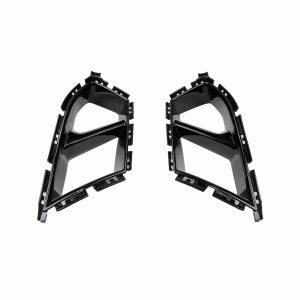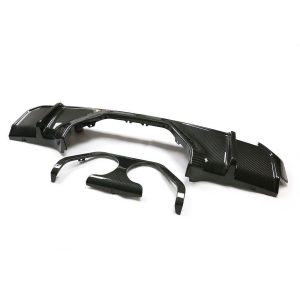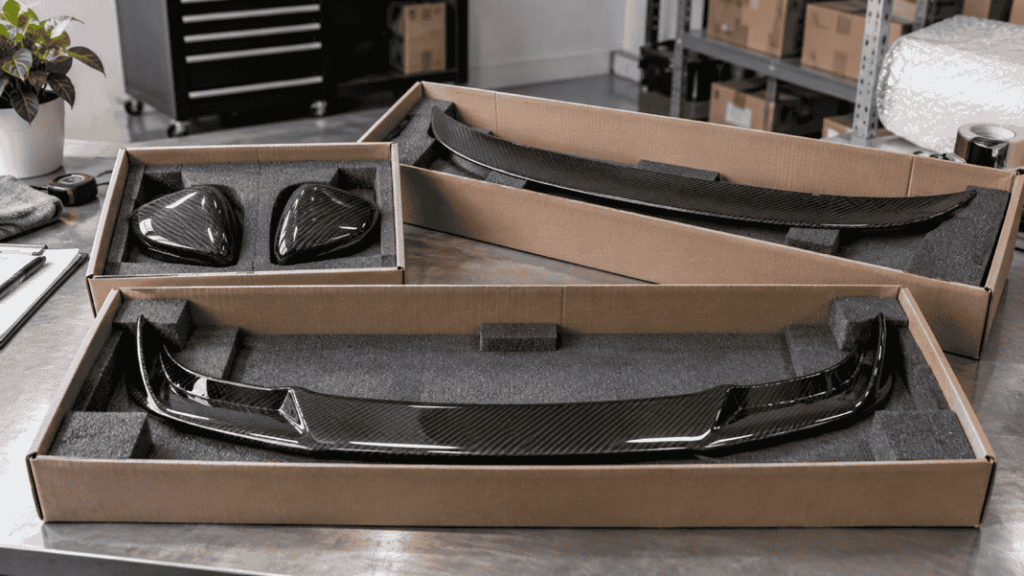
A BMW carbon fiber dealer catalog should match a specific supplier reference to a specific vehicle configuration. “Fits M3/M4” is a search label, not a complete ordering rule. To reduce wrong orders, separate chassis, body version, production range and equipment conditions from styling names, and keep the evidence behind each fitment statement accessible.
This guide is for distributors and online sellers building a reusable BMW product database. Its output is a fitment matrix your purchasing and sales teams can maintain together. It complements a product specification sheet by explaining how to connect that information to listings, customer questions and order approval.
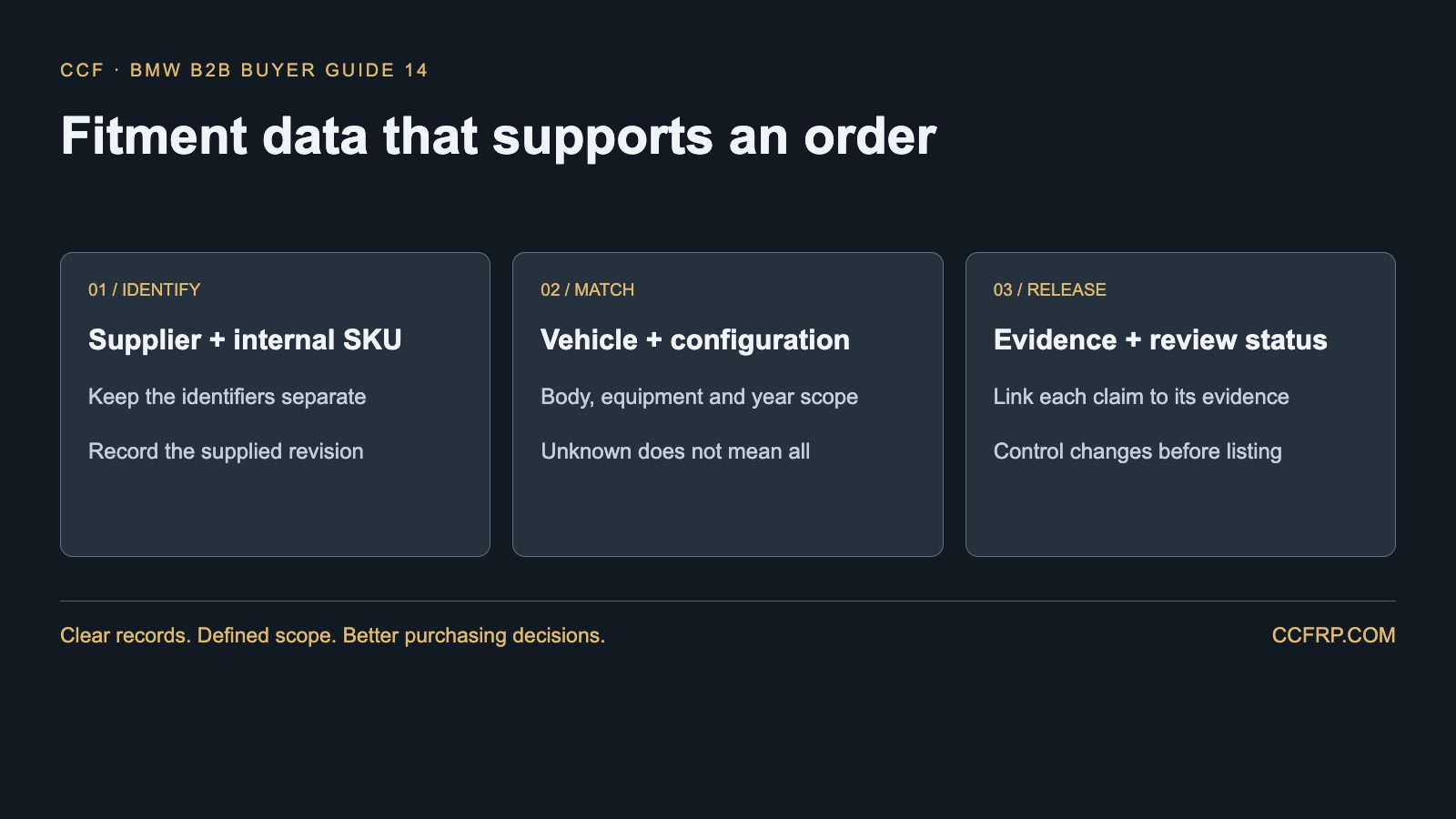
Use one row for each defined application
Start with the supplier’s product reference, not the headline on your website. One reference may have more than one supported application, but each needs an explicit record. Conversely, visually similar products may have different references because their interfaces or supplied contents differ.
Keep three identifiers separate: the supplier SKU, your internal SKU and the vehicle application record. A supplier SKU identifies the item you buy; your internal SKU identifies the item your warehouse sells; the application record describes the configuration for which that item has been reviewed. A website title should be generated from those records, not become their only source.
For example, a category called G80/G82 exterior parts can contain references with different application restrictions. Do not copy the category-level heading into every SKU’s compatibility field. Use the BMW product range to find candidate products, then build the record from the selected item’s information.
Build the minimum useful fitment matrix
The following fields are a working template, not confirmed fitment data for any CCF product. Leave an unknown value marked as pending rather than substituting “all.”
| Field | How to record it | Why it changes a buying decision |
|---|---|---|
| Product identity | Supplier reference, internal SKU and revision if available | Connects the catalog entry to the purchased item |
| Vehicle identity | BMW model, chassis and body version as separate fields | Prevents a broad family name becoming a universal application |
| Production or model-year scope | Supplier-stated range plus source and date | Stops an assumed carryover into an unreviewed update |
| Equipment conditions | Only relevant requirements: bumper, ACC, steering side, exhaust or trunk configuration | Exposes exceptions before checkout or quotation |
| Sales unit and contents | Piece, pair or kit; included and excluded components | Prevents the right application being ordered in the wrong quantity |
| Evidence | Document reference, photo set or review record linked to that application | Shows the basis and limits of the compatibility statement |
| Approval and revision | Owner, review date, status and change history | Allows old stock and new supply to be distinguished |
Use three statuses that your team can act on
Pending review means the application is incomplete or unanswered. It should not appear as confirmed compatibility in a filter or an automatic customer recommendation. The record should name the missing information and the person following it up.
Supplier-stated application means the supplier has identified the scope, with the supporting document retained. That is useful information, but it should not be silently upgraded to “tested by our shop.”
Reviewed for a stated configuration means your team has examined the available evidence or completed the recorded review. Describe what was actually reviewed: photographs, dimensions, physical fit, or relevant functional checks. The status is not a certification and should not extend beyond the evidence.
Keep physical installation and functional compatibility separate. The G80/G82 ACC grille checklist illustrates why a part’s physical position does not establish that the vehicle’s driver-assistance functions have been verified.
Resolve blanks before they become misleading filters
A blank steering-side field could mean “not relevant,” “both reviewed” or “unknown.” Those are different answers. Use explicit values and a short explanation where needed. Do not let a spreadsheet import convert blank values into unrestricted compatibility.
Similarly, a year range should not continue indefinitely because your system requires an end date. Store the confirmed range and arrange a review when the supplier or vehicle configuration changes. The BMW M3/M4 carryover fitment guide is relevant when a listing is extended to a facelift or production update.
Use conditional questions only where they matter to the part. Requiring every customer to answer irrelevant fields adds friction. For a mirror-cap reference, steering side and housing details may need attention; for a diffuser, the rear-bumper and exhaust interface may be the more useful questions.
Keep the customer-facing version shorter
Your internal matrix may be detailed, but the product page needs a readable summary. Show the intended application, the important exclusions, the sales unit and the information needed if the customer’s configuration is uncertain. Put the detailed record behind your purchasing and support process.
For an unresolved item, a useful message is: “Send your chassis, model year and current component photos for a product-specific review.” A vague “fits most models” statement provides neither a reliable match nor a useful next step.
The dealer product-data guide covers the wider specification record. Use the listing checklist when deciding which verified fields to publish.
Test the catalog before importing a full range
Run a small set of deliberate checks before uploading hundreds of rows. Search by chassis, by the consumer-facing model name and by a known incompatible configuration. Confirm that the results do not imply broader coverage than the underlying records.
- A customer enters the correct model family but the wrong body version: does the listing ask for clarification?
- A supplier reference is replaced by a new revision: can old inventory still be identified?
- A pair is imported as one piece: does the sales-unit field prevent an incorrect quote?
- An equipment condition is pending: can the product still be incorrectly selected as an approved match?
These are catalog-quality checks, not vehicle installation tests. They can reveal data problems without implying that a product itself is defective.
Make changes traceable across sales and purchasing
When a supplier revises an application statement, record the previous value, new value, reason and affected stock. Review open customer orders before changing the public listing. Keep the original evidence with the batch or revision to which it applies.
Assign one person to approve fitment-data changes and another to check the public listing when practical. A simple change log is more useful than several untracked spreadsheets with different compatibility claims.
Buyer questions
Can one SKU cover both G80 and G82?
Only if the specific product’s supported applications establish that coverage. The shared model-family label is not enough to create the rule.
Should we publish the supplier’s full application table?
Publish a clear, current summary suitable for customers. Retain source details and review notes internally, and make important restrictions visible before ordering.
What if the supplier provides only a product name and photos?
Record the item as a candidate and request the missing application information. Do not fill the gaps by copying another seller’s listing.
Request data for a defined BMW range
Send CCF your selected product links, target chassis and intended sales units. For a reference such as the G80/G82 carbon grille, identify the configuration questions you need answered. Discuss your wholesale product list with the data fields attached so your team can turn the response into a controlled catalog rather than another unstructured message thread.