CARBON PARTS WORKSHOP SERIES · 12
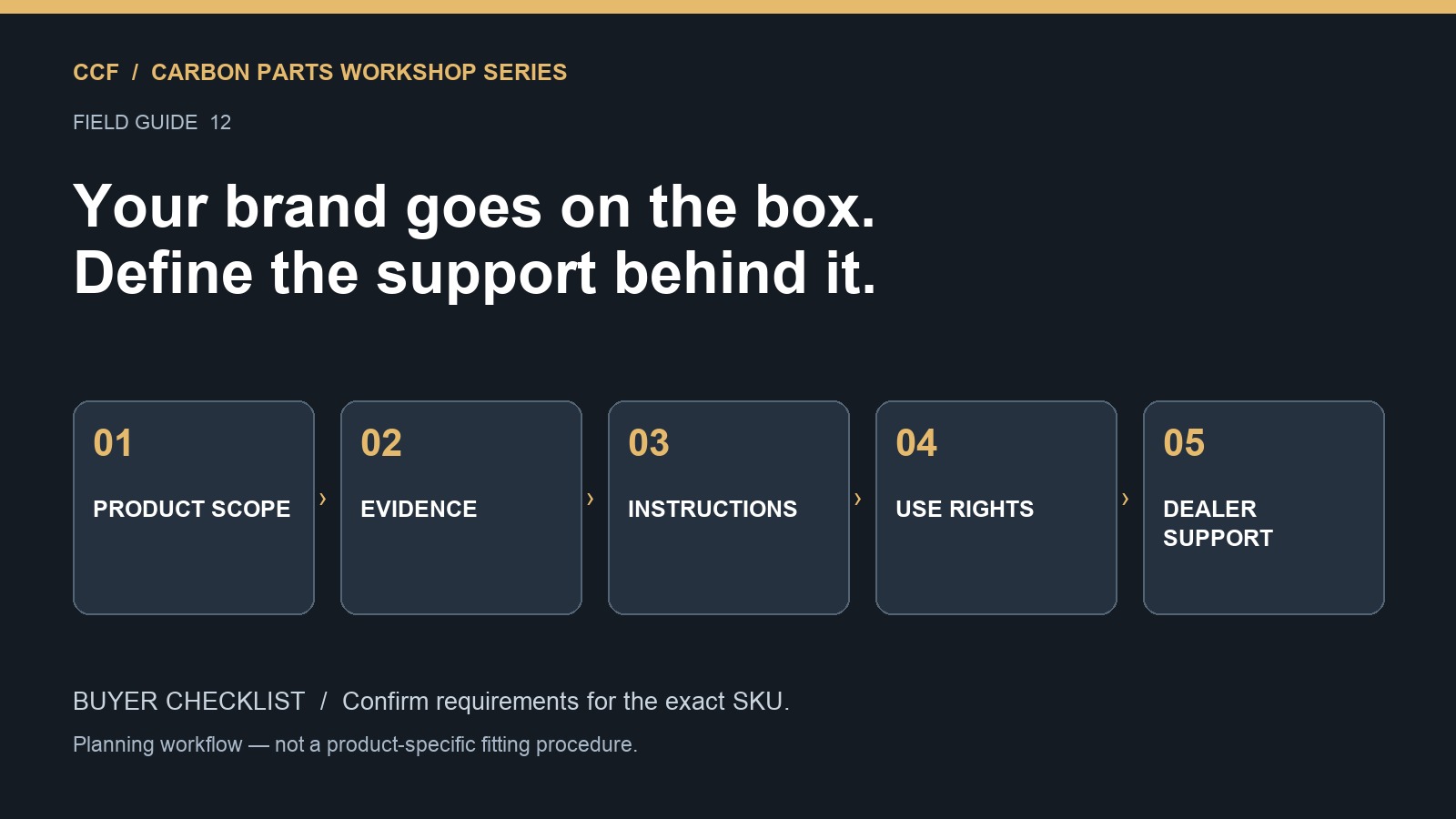
A private-label carbon parts buyer should agree the product’s application evidence, available installation information and support responsibilities before approving the launch package. A branded carton and a polished listing do not give a downstream workshop the information it needs to assess a job.
This final Carbon Parts Workshop Series article offers a suggested documentation brief for brand owners and distributors. Treat it as a negotiation checklist. It does not imply that every factory supplies the same evidence or that a particular CCF product has already passed the checks described.
Start with the product and intended claim
Define the component, target vehicle applications, sales unit and intended positioning. Separate cosmetic appearance, confirmed application and any proposed performance statement. A claim about one approved sample should not silently become a claim about every body version in a broad catalogue category.
Use the OEM/ODM project guide for the wider development process. This article focuses on the installation and support information that needs its own deliverables, owners and acceptance criteria.
Request evidence that answers a named question
Ask what each item demonstrates. A front-facing photograph may document appearance. A supplied-parts list documents the agreed package. A written application statement identifies the supplier’s scope. An installation record may show what was done on a specific vehicle, but its value depends on the vehicle, product revision and conditions being identified.
Do not call a marketing video a complete validation report. Equally, do not request a large bundle of files without saying what decision they support. The useful question is whether the evidence resolves the claim or requirement you intend to publish.
Define a practical evidence pack
| Deliverable | What to agree |
|---|---|
| Product identity | Supplier reference, buyer reference, revision identification and sales unit |
| Application record | Vehicle scope, exclusions, supporting information and unconfirmed variants |
| Package record | Included components and separately required items |
| Installation information | Available instructions, document scope and questions requiring further work |
| Evidence record | What was assessed, on which product and vehicle, and what the record does not establish |
| Support process | Contact route, change notification and information needed for dealer enquiries |
Specify whether a deliverable is available now, to be created under the project, or outside the agreed scope. That distinction keeps a request list from becoming an accidental promise that all documents already exist.
Give sample approval a defined boundary
Identify what approval covers: appearance, package completeness, a documented application or another agreed criterion. Record open items instead of treating one general signature as approval of every possible requirement. If a technical assessment is needed, agree who will perform it and what evidence they will provide.
The remote sample review guide can help structure an initial review. Remote photographs do not replace every assessment that may be needed for the product. Do not label unperformed testing as complete because the sample looks acceptable.
Keep technical claims connected to their source
Manufacturer documents illustrate the importance of a precise scope. For instance, the TRD Supra parts table identifies separate accessories and their application conditions. It is a reference for that range, not permission to transfer its application statements to a private-label part.
When using external research, retain attribution and distinguish it from your product’s evidence. Do not remove another manufacturer’s name from a guide and present the result as your own installation validation. Your buyer-facing instructions need an appropriate basis for the actual product being supplied.
Agree what you may publish and distribute
Discuss permission to use supplier photographs, installation documents and any third-party materials before putting them in a branded pack. Record whether you may edit, translate or distribute the material, and how the technical content will be reviewed after changes. Obtain any necessary permissions rather than assuming payment for parts transfers every right in the supporting material.
This is a document-management question, not a substitute for legal advice on a specific contract. Keep original records available so your team can distinguish the supplied information from later marketing edits.
Define who answers the installer
The dealer should have a clear contact route for product identity, missing items and installation-information questions. Agree what information the supplier needs to investigate a report and how unresolved questions will be handled. Avoid promising response times or technical services that have not been agreed.
Keep the record connected to your dealer product information. If instructions change after launch, the support team needs to know which shipped products they apply to. A generic latest-version link is not enough when earlier stock needs different information.
Separate packaging approval from launch approval
A brand may approve the carton layout while the application record still has an open question. Record those as separate decisions. The private-label packaging approval guide concerns packaging; it does not establish the product’s installation readiness.
Before launch, review whether each public claim has its stated basis and whether the dealer pack identifies unresolved limits accurately. If a particular vehicle variant remains unconfirmed, do not add it to the listing simply to broaden the apparent market.
An example of a useful project milestone
In a hypothetical project, a buyer approves the visible finish but requests clearer identification of the supplied mounting components before finalizing the dealer pack. The milestone should record “appearance approved; package documentation pending,” not an unqualified “product approved.” This preserves progress while keeping the remaining decision visible.
The milestone does not itself specify a manufacturing change or test result. It defines the next deliverable. Once that deliverable is reviewed, record the outcome and any effect on the quotation or launch schedule.
Private-label buyer questions
Can I ask for an evidence pack on a catalogue product?
Yes, but establish what already exists and what would require additional work. A request does not mean the supplier has all the material available.
Does a branded installation sheet prove fitment?
No. Branding is presentation. The application and procedure need support appropriate to the actual product.
Should I publish all supplier research files?
No. Publish relevant, authorized information suitable for the reader, and retain internal evidence and confidential material in the appropriate project records.
Include documentation in your private-label brief
Send CCF your target applications, product references, quantity plan and intended sales channels. Explain the information your dealers and installers will need, and ask what is available, what can be developed and what remains outside the project scope before approving launch claims.
Editorial reference check: 18 October 2026. Referenced manufacturer documents apply to their identified products. Confirm CCF SKU requirements separately.