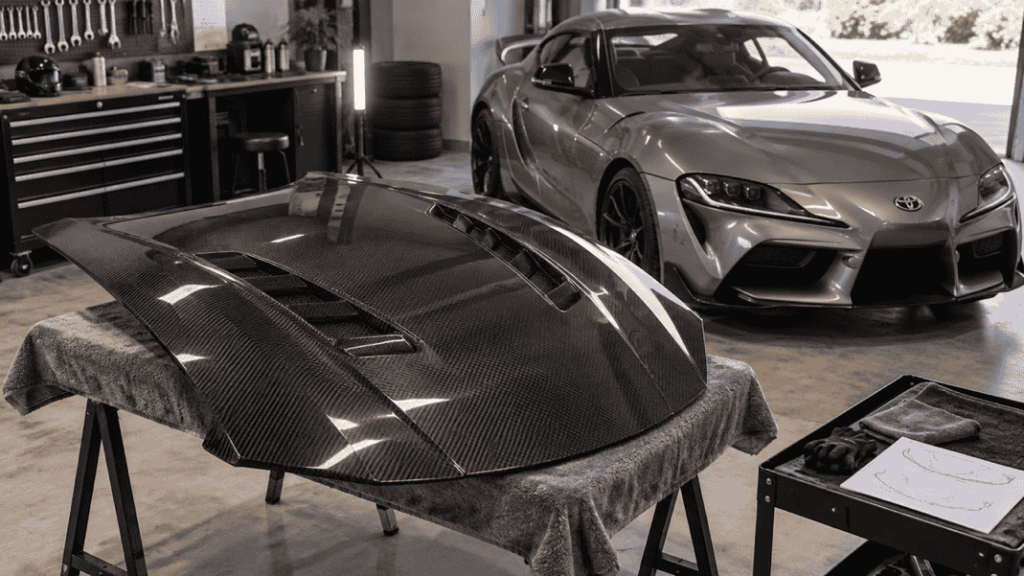
A damaged carbon fiber part needs an assessment of its role, damage and attachment condition before a repair-or-replacement decision. A surface photograph alone cannot establish that a component is safe to keep using. For a shop, the first job is to control the situation and preserve useful evidence, not immediately promise a cosmetic repair.
This guide concerns damage discovered during use. It is a triage and quotation workflow, not a structural repair procedure or an authorization to return a part to service.
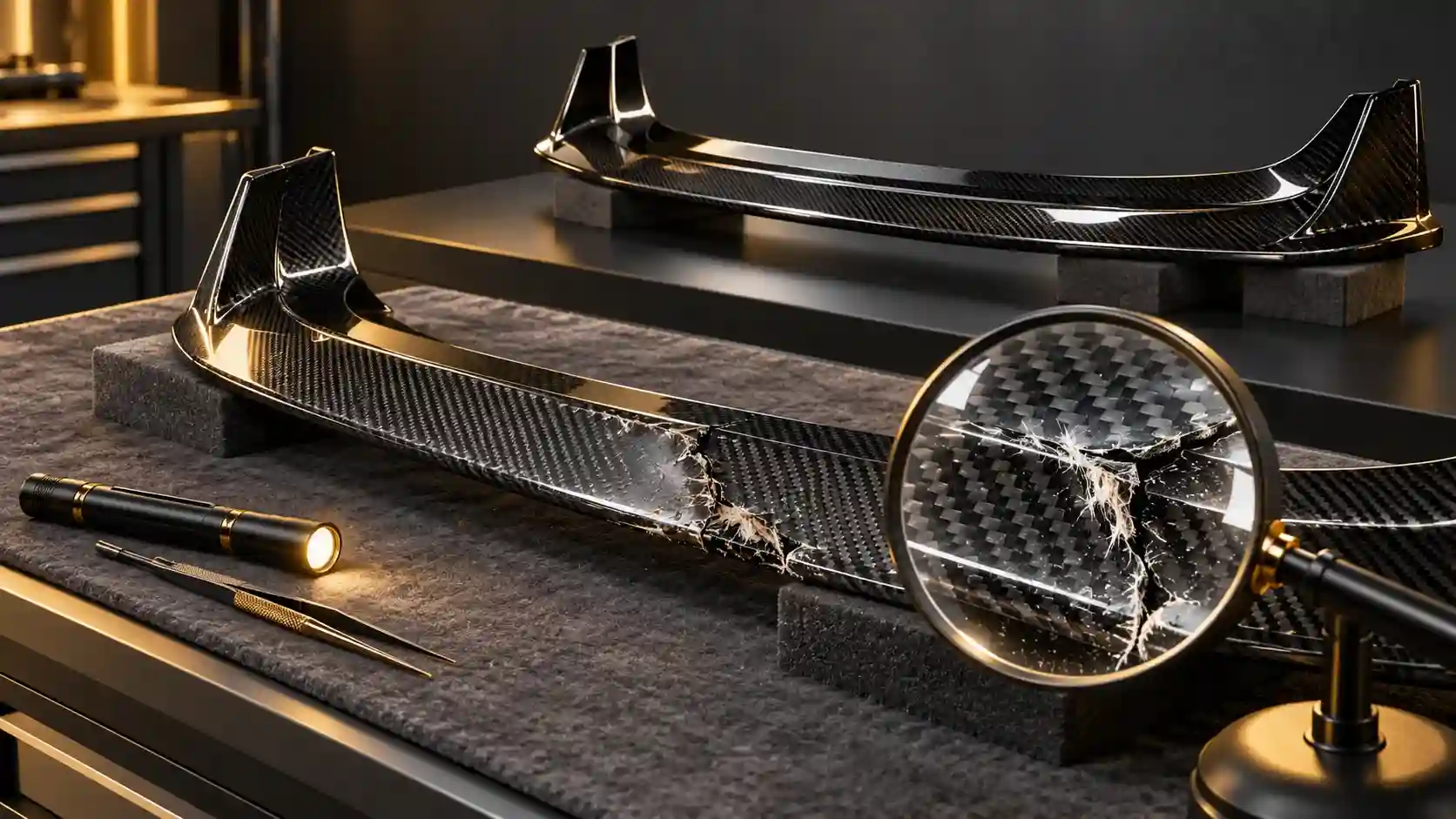
First identify the component and the incident
Record the exact product, vehicle, installation history and what happened. A stone mark on a finish, an impact on a front lip and damage near a load-bearing mount raise different questions. Do not classify them by the size of the visible mark alone.
If attachment integrity or safe operation is in doubt, stop using the affected component and have the vehicle assessed appropriately. Do not conduct an improvised road test to find out whether it stays attached.
I-CAR’s vehicle-material repair guidance notes that carbon fiber damage may not be visible from the front. That supports a careful assessment rather than a decision based only on an exterior photograph.
Collect a useful assessment pack
| Record | What to include |
|---|---|
| Identity | Order reference, SKU and vehicle configuration |
| Incident | Known impact or event, date and subsequent use |
| Overall condition | Whole-part and installed-context photographs |
| Local condition | Clear close-ups with a scale where safe to obtain |
| Other surfaces | Accessible underside and mounting-area views |
| History | Earlier repairs, coatings, modifications or attachment changes |
Preserve the original images and keep the part identified. Avoid sanding, filling or recoating before the assessment because those changes can hide evidence and complicate the support discussion.
Use three decision routes
Possible finish-only concern: request an appropriate inspection before treating it as cosmetic. The visible surface is a starting point, not confirmation that the underlying laminate is unaffected.
Suspected laminate or attachment damage: refer the component to a qualified composite or vehicle repair specialist with relevant product information. The specialist should determine the suitable inspection and whether an approved repair route exists.
Replacement route: obtain the correct replacement reference when the assessment or applicable instructions call for replacement, or when an acceptable repair cannot be established. Confirm that any associated vehicle mounts or adjacent parts are also addressed.
A tap, a photograph or a seller’s reassuring message is not a universal substitute for the required assessment. Do not publish a generic “cracks under this size are repairable” rule for a mixed range of automotive parts.
Compare complete job scopes
A repair quotation should identify the approved work, refinishing scope, inspection and return-to-service decision. A replacement quotation should identify the part, hardware, removal, installation and any related checks. Compare these complete scopes rather than a filler-kit price against a new component.
For appearance-sensitive customers, explain whether the proposed work can meet the agreed finish expectation. Structural acceptability and an invisible visual result are separate questions. Neither should be guaranteed before the relevant specialist has assessed the job.
Record who authorized the work and what documentation will be handed over. Keep the incident and repair history attached to the vehicle job record rather than treating the repaired part as an undocumented new item.
Keep warranty and technical decisions separate
A decision that a part needs replacement does not automatically establish who pays. Check the applicable order terms and evidence separately. Report the issue before unauthorized modification and follow the supplier’s current support process.
Similarly, a warranty exclusion does not prove a component is suitable for continued use. Commercial coverage and technical condition answer different questions. Explain both clearly so the customer can make an informed decision without confusing a declined claim with a safety assessment.
A repair-assessment handover
Use this record as a buyer working tool. Examples and sample labels below are illustrative, not CCF inspection, order or test records.
| Record | Example or required entry |
|---|---|
| Immediate status | Record whether the vehicle or component has been removed from use pending appropriate assessment. |
| Evidence | Product identity, incident, whole-part, local and accessible mounting-area views. |
| Decision owner | Qualified reviewer identifies assessment scope and any authorized repair or replacement route. |
The seller can review commercial support while the qualified specialist addresses condition. Neither a warranty decision nor a photograph alone authorizes a damaged component to return to service.
For the connected decisions, use Gloss or Matte Carbon Fiber: How to Choose for Customer Builds and How to Calculate Margin on Carbon Fiber Parts After Returns and Rework.
Buyer FAQ
Can a shop repair every damaged carbon part?
No. The component’s role, damage, available procedures and qualified assessment determine whether a repair route is appropriate.
Can clear coat hide a crack?
Changing the finish does not establish that underlying damage has been resolved. Obtain an assessment before cosmetic work.
What should I send to CCF first?
Send the product and order reference, incident details and clear overall, local and mounting-area photographs. Ask for the applicable support route while arranging any necessary qualified assessment.
Start With a Clear Damage Report
Send the order reference, incident history and overall, local and mounting-area photographs. Ask for the support route before modifying the part.
Send an Inquiry
Include this article title, your product reference, vehicle details and the question you need resolved.