CCF / Reseller Operations Guide
When an online customer reports a cracked front lip, scratched diffuser, missing mounting hardware, or a spoiler that does not fit, the reseller becomes the first point of contact—even when the order shipped directly from a factory overseas. The right response is not to promise an instant refund or blame the carrier. It is to protect the customer, preserve evidence, identify the cause, and agree on a documented resolution.
1. Classify the Problem Before Choosing a Remedy
Automotive carbon fiber parts are vehicle-specific, often oversized, and vulnerable to edge impacts. The same customer statement—“the part is unusable”—can have several different causes. Each requires different evidence and may involve a different party.
| Reported problem | Possible cause | First evidence to request | Initial action |
|---|---|---|---|
| Cracked corner or broken mounting tab | Transit impact, handling damage, or pre-existing defect | Outer carton, inner padding, part close-ups, delivery date | Preserve packaging; notify supplier and carrier promptly |
| Surface scratch or clear-coat blemish | Packaging friction, production finish, or installation handling | Images before installation, protective-film status, full part photo | Determine when the damage became visible |
| Part does not match bumper or mounting points | Wrong model, trim, bumper variant, product version, or part defect | VIN or verified vehicle configuration, bumper photos, part code | Pause installation and review fitment data |
| Wrong item delivered | Order entry, picking, or labeling error | Order confirmation, shipping label, item and carton labels | Compare customer order with supplier dispatch record |
| Missing accessories | Kit specification difference or packing error | Unboxing photos, packing list, product listing | Check what the order actually included |
| Customer no longer wants the product | Change of mind | Order date, delivery date, product condition | Apply the seller’s lawful consumer return terms |
Important: A photograph alone may not establish liability. The goal is to assemble a consistent record of what was ordered, shipped, delivered, and attempted during installation.
2. What to Do When the Customer Reports a Problem
- Acknowledge the report promptly. Give the buyer a case reference and explain what information is needed.
- Ask the customer to stop installation if the part is damaged or appears incompatible. Avoid drilling, cutting, sanding, or bonding until the issue is reviewed.
- Request clear evidence. Collect overall photos, close-ups, part labels, packaging and relevant vehicle details.
- Record the timeline. Note delivery, unboxing, discovery, and installation-attempt dates.
- Keep the buyer updated. Explain when you expect to provide the next update without guaranteeing an unapproved remedy.
Customer-facing message template
Thanks for letting us know. We’re sorry the part has not arrived or fitted as expected. Please send clear photos of the part, packaging, shipping label, and—if this is a fitment issue—your vehicle’s model, year, trim, and bumper configuration. Please keep the packaging and avoid modifying or installing the part while we review the case. We’ll check the details and update you on the next steps.
Adapt this wording to your store’s actual support process and statutory obligations.
3. How to Document Shipping Damage on Carbon Fiber Parts
A front lip or diffuser can have an intact outer carton while the mounting points inside are damaged. A hood can suffer corner compression or pressure marks even when most of the panel looks undamaged. For this reason, the inspection record should cover both the package and the component.
Minimum shipping-damage evidence checklist
- Tracking number, delivery date, and any visible delivery exception.
- Photos of every side of the unopened carton, if available.
- Close-ups of dents, punctures, crushed corners, broken straps, or wet areas.
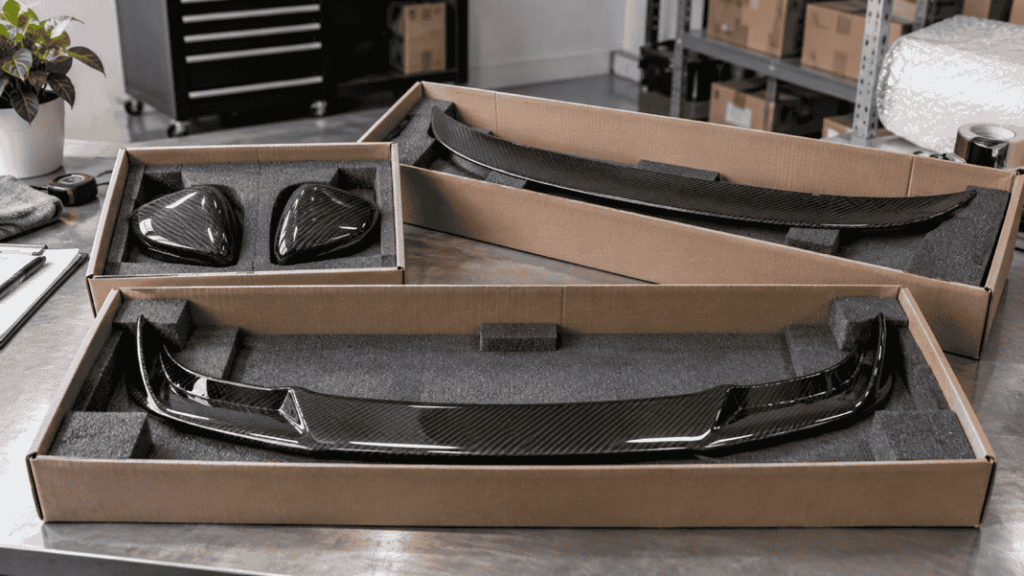
- Photos of protective foam, supports, bags, and inner packaging.
- Full-part photos and close-ups showing the damage and its location.
- Part number, label, and any serial or batch identifier available.
- Brief description of whether the part was installed, altered, or handled after opening.
Do not discard the carton or foam until the relevant claim process permits it. Carriers and insurers may require inspection, and claim submission windows differ by service and contract. A reseller should verify the actual deadlines for each shipment rather than advertise one universal claim period.
Packaging matters before a claim ever happens
For long front lips and side skirts, protect protruding ends and mounting tabs from direct load. For hoods and larger panels, verify corner protection, surface separation, rigid support, and whether the selected carrier accepts the final package dimensions. Neutral packaging for blind shipping must still meet the physical protection needs of the product.
4. How to Investigate a Fitment Complaint
“BMW M3 front lip” is not a complete fitment specification. Body generation, model year, trim, OEM versus aftermarket bumper, and prior modifications can all affect compatibility. A supplier should not be asked to approve a return solely because a customer reports that the part does not fit.
- Verify the exact vehicle. Record make, model, generation or chassis code, model year, trim, and market where relevant.
- Confirm the exterior configuration. Ask whether the front or rear bumper is factory-original, facelifted, or aftermarket.
- Match the order to the listing. Compare the customer’s selected variant, supplier part code, and any stated exclusions.
- Inspect the delivered item. Check product label, mounting points, and visible geometry against the confirmed SKU.
- Request non-destructive test-fit evidence. Photos of alignment gaps or conflicting attachment points can be useful, but avoid instructing the buyer to force the part into position.
- Determine the likely cause. Possible outcomes include an incorrect listing, mistaken customer selection, supplier picking error, vehicle modification, or a genuine production issue.
For a more detailed order-release checklist, see the CCF guide to carbon fiber parts fitment verification once that companion article is published.
5. Who Is Responsible: Store, Supplier, Carrier, or Customer?
Responsibility depends on the sales contract, shipping terms, evidence, and applicable law. The table below is an operational starting point, not a legal determination.
| Situation | Who should investigate? | What the reseller should do |
|---|---|---|
| Carrier appears to have damaged the parcel | Contracting shipper, carrier, insurer as applicable | Support the buyer; preserve evidence and coordinate the claim |
| Supplier packed the wrong SKU | Supplier and reseller | Compare order records and arrange a compliant resolution |
| Product has a suspected manufacturing defect | Supplier quality team and reseller | Collect inspection evidence and agree on remedy |
| Listing omitted a critical fitment restriction | Reseller and product-data owner | Correct the listing and address the buyer’s rights |
| Buyer selected an incompatible version despite clear information | Reseller | Review the order and applicable consumer-return rights |
| Buyer changed their mind | Reseller | Follow applicable cancellation and return rules |
For EU consumer sales: The online store’s obligations to the consumer are not automatically removed because a factory ships the goods directly. EU rules generally provide a 14-day withdrawal right for many distance purchases, subject to exceptions, and legal remedies for non-conforming goods. Country-specific implementation and exceptions matter. Sellers should consult official EU consumer guarantees and returns guidance and qualified local advice before publishing store policies. Do not assume every carbon fiber part is exempt from withdrawal rights merely because it is vehicle-specific.
6. Should the Part Be Returned, Replaced, Repaired, or Refunded?
For bulky automotive parts, an international return may cost more than the item can economically recover. That does not eliminate consumer rights. It means the reseller should understand the practical options and confirm which ones are lawful and available in the specific case.
| Possible resolution | When it may be appropriate | Questions to confirm |
|---|---|---|
| Replacement part | Wrong item, verified defect, or severe damage | Availability, shipping cost, disposal or return instructions |
| Replacement accessory or hardware | Missing kit component | Correct specification and delivery time |
| Repair or local rework | Minor repairable issue, if safe and agreed | Qualified repairer, cost approval, warranty impact |
| Partial refund | Customer voluntarily accepts an agreed reduction where lawful | Documented agreement; no pressure to waive legal rights |
| Full refund and/or return | Required by law or justified by case facts | Who pays return freight, timing, return destination |
Never instruct a buyer to destroy a part, pay expensive return freight, or accept a partial refund without first confirming the seller’s legal obligations and the supplier’s written agreement.
7. A Practical Cross-Border Claims Workflow
- Open the case: order ID, SKU, customer contact, delivery and report dates.
- Collect evidence: product, carton, label, vehicle details, and installation status.
- Classify: transit damage, defect, incorrect SKU, fitment mismatch, missing item, or withdrawal.
- Check obligations: customer-facing legal requirements and store policy.
- Escalate: send a structured case summary to the supplier or carrier.
- Confirm a remedy: record the decision, payer, costs, and expected next milestone.
- Resolve with the buyer: provide clear instructions and confirmation.
- Close and learn: record root cause and update product data or packing rules.
Supplier claim template
Subject: After-Sales Review — Order [ID] / SKU [Part Code]
Issue type: [Transit damage / fitment / incorrect item / defect]
Vehicle: [Make, model, year, chassis, trim, bumper version]
Delivered: [Date and tracking]
Reported: [Date]
Installation status: [Uninstalled / test-fitted / installed]
Evidence: [Photo links, carton photos, labels, measurements]
Requested review: [Confirm cause and available resolution]
Please review the attached evidence and advise the next step. We will not instruct the customer to modify or return the part until the appropriate process is confirmed.
8. Reduce Returns Before the Order Ships
- Use a fitment gate. Confirm chassis, year, trim, and bumper variant before dispatch, especially for body kits.
- Maintain accurate listings. Separate compatible and incompatible vehicle versions; identify exclusions.
- Check product codes. Use the same SKU in the listing, supplier order, packing confirmation, and customer support record.
- Ask about packaging. Confirm protection for protruding edges, tabs, and large panels.
- Document special instructions. Record blind-shipping requirements and any permitted insert materials.
- Confirm the shipping plan. Know who books freight, receives tracking, and initiates claims.
- Publish lawful customer terms. Explain returns, damaged delivery reports, and support contact details without restricting mandatory consumer rights.
- Start with a controlled trial. Review early orders for repeat fitment, packaging, and support issues before expanding the catalog.
9. What to Confirm with a Carbon Fiber Dropshipping Supplier
Before accepting orders, ask the supplier to document the available after-sales workflow. Key questions include whether photos are required, who reviews suspected defects, who contacts the carrier, whether replacement components can be shipped, and what happens when an oversized part cannot economically be returned. Confirm these terms before advertising a particular warranty or return promise.
CCF supports catalog-based carbon fiber parts supply, dropshipping, and blind shipping arrangements. However, the remedy for a specific damaged, defective, or incompatible item must be reviewed case by case under the applicable agreement and law. This article does not establish a universal CCF return period, guaranteed refund policy, or automatic replacement entitlement.
Discuss Your Carbon Fiber Reseller Requirements with CCF
Planning an automotive carbon fiber online store? Share your target vehicle models, expected order flow, destination markets, and fulfillment requirements. CCF can discuss catalog products, dropshipping arrangements, and the practical order details that should be agreed before launch.
Explore CCF Dropshipping Request Wholesale InformationFrequently Asked Questions
Who handles returns when a carbon fiber part is dropshipped?
The seller who sold the item to the end customer generally remains the customer’s contact and must comply with applicable consumer law. The supplier, carrier, and seller may have separate contractual responsibilities for investigation and reimbursement.
What photos should I request for a damaged carbon fiber front lip?
Request the entire front lip, close-ups of the damage, all sides of the carton, inner padding, shipping label, and the part code. Ask the customer to preserve packaging and avoid installation while the case is reviewed.
Can a customer return a carbon fiber part because it does not fit?
Potentially. The appropriate remedy depends on the listing, actual vehicle specification, cause of incompatibility, purchase terms, and applicable consumer rights. Do not treat all fitment complaints as customer error.
Does blind shipping change who handles customer complaints?
No. Neutral packaging does not change the store’s customer-facing legal responsibilities. The reseller still needs a clear support and claims process with its supplier.
Should customers install a part before reporting a defect?
They should inspect and, where appropriate, perform a careful non-destructive test fit first. If the part appears damaged or incompatible, they should stop and seek instructions rather than drill, cut, bond, or force the part into position.
Is international return shipping always required?
No universal rule applies. The lawful remedy, product condition, shipping contract, and agreed supplier process determine whether return, replacement, repair, or refund is appropriate. Never promise that a buyer must pay international return freight in every case.
How quickly must a shipping damage claim be filed?
Carrier, insurer, and contractual claim windows vary. Check the service used and act promptly. A store’s consumer-law obligations may be different from a carrier’s claims deadline.
Does CCF guarantee refunds or replacements for every dropshipping complaint?
No universal policy is stated here. Each case requires review of the evidence, order terms, and applicable legal obligations. Resellers should confirm the after-sales arrangement with CCF before making commitments to their customers.
Related Guides for Automotive Carbon Fiber Resellers
Editorial note: This guide provides general operational information, not legal advice. Consumer rights and carrier claims vary by jurisdiction and contract. Last reviewed October 2026.