CCF / Reseller Logistics Guide
For European automotive parts resellers, the shipping price quoted for a carbon fiber front lip, spoiler, diffuser or hood is only one part of the true delivery cost. Packaging dimensions, customs clearance, import VAT, delivery terms and the way a damage claim is handled can determine whether an order is profitable.
1. Choose a shipping method based on the part—not just the rate
Carbon fiber automotive parts vary dramatically in size and fragility. Mirror caps and small trim pieces can be shipped very differently from front lips, side skirts, rear diffusers and full-size hoods. An economical service for a compact parcel may be unsuitable for an oversized panel.
| Shipping option | Typical use case | What to verify |
|---|---|---|
| International express courier | Smaller, time-sensitive parcel orders | Oversize surcharges, remote-area fees, customs brokerage and delivery restrictions |
| Air freight | Consolidated orders when speed matters | Airport handling, brokerage, last-mile delivery and minimum charges |
| Sea freight / consolidation | Larger replenishment orders where transit time is flexible | Port charges, destination handling, customs clearance and final-mile transport |
| Specialized freight / crating | Oversized or especially vulnerable panels | Crate cost, dimensional weight, handling equipment and insurance terms |
There is no universal fastest or cheapest service. Transit estimates are route- and service-specific, and customs processing can change the final delivery date. Ask for an actual quotation for the packed item and destination postcode rather than relying on a generic country-wide estimate.
2. Understand dimensional weight before pricing a hood or splitter
Large carbon fiber parts are often light relative to their packed volume. Couriers may therefore charge by dimensional (volumetric) weight instead of physical weight. The applicable divisor depends on the carrier, service and route.
Suppose a packed part measures 150 × 45 × 25 cm and physically weighs 8 kg. With an example divisor of 5,000:
Dimensional weight = (150 × 45 × 25) ÷ 5,000 = 33.75 kg.
The carrier may rate the shipment at approximately 34 kg or another rounded chargeable weight, even though the parcel weighs only 8 kg. The carrier’s actual formula, rounding and surcharges must be checked.
This is why a reseller should request packed dimensions, not just the product’s unboxed dimensions. Protective packaging increases volume but can be essential to prevent damage.
3. Calculate landed cost, not just supplier price plus freight
A practical estimate includes the product purchase price, protective packing, international transport, any fuel or oversize surcharges, customs duty if applicable, import VAT, brokerage or clearance fees, and domestic delivery or handling. For some businesses, import VAT may be recoverable subject to local rules; cash-flow timing still matters.
| Illustrative cost component | Amount | Notes |
|---|---|---|
| Product purchase | €180 | Example only |
| Protective packing | €15 | Example only |
| International freight | €75 | Example only |
| Customs duty | To calculate | Depends on correct classification, origin and customs value |
| Import VAT | To calculate | Depends on destination rules and tax base |
| Brokerage / destination fees | To confirm | May be billed separately |
In this illustration, the subtotal before customs duty, VAT and destination charges is €270. It is not the final landed cost. Do not quote a customer an all-inclusive delivered price until the payer of each additional charge is clear.
Profitability must include post-delivery risk
For bulky aftermarket parts, one damaged shipment or incompatible item can erase the margin from several successful orders. Set aside a realistic allowance for customer support, payment processing, returns and claims. For a deeper calculation, see CCF’s guide to carbon fiber parts profit margins after returns and rework.
4. Customs, product classification and import VAT in Europe
European customs treatment depends on the importing country, the goods’ actual classification, customs value, origin and any applicable trade measures. A carbon fiber product is not automatically classified under one tariff code merely because it contains carbon fiber. A front lip, body panel and decorative trim item may require different classification analysis.
- HS/CN classification: Confirm the appropriate product code for the actual item. Do not copy an unverified code from another product.
- Customs value: Determine the legally required valuation basis and which transport or other costs are included.
- Origin: Provide accurate country-of-origin information and supporting documents when required.
- Import VAT: Confirm the destination country’s applicable rules and who is responsible for payment.
- Importer identification: EU businesses may need an EORI number and a customs representative, depending on the arrangement.
- Product compliance: Assess applicable EU or national rules for the particular aftermarket part and its intended road use; customs clearance does not itself establish road legality.
For shipments to Spain, buyers should check requirements with the Spanish Tax Agency (Agencia Tributaria) and, where appropriate, their customs broker. EU-wide guidance is available through the European Commission’s Taxation and Customs Union. These are starting points, not substitutes for transaction-specific customs advice.
5. Clarify Incoterms and who pays each charge
Shipping arrangements can be described with Incoterms such as EXW, FCA, DAP or DDP. These terms allocate certain transport, risk and customs responsibilities between seller and buyer, but they do not replace a full sales contract. Use the agreed rule together with a named place and the relevant Incoterms edition.
| Question to settle | Why it matters |
|---|---|
| Who books and pays international freight? | Determines the transport quotation and operational control |
| Who acts as importer of record? | Affects customs filings and importer obligations |
| Who pays duty, import VAT and brokerage? | Prevents surprise charges to the end customer |
| At what point does transport risk transfer? | Important when a shipment is damaged or delayed |
| Who handles the last-mile delivery and claims? | Determines the customer support process |
Important: A parcel described informally as “door-to-door” is not necessarily duty-paid. Confirm the exact commercial terms in writing. In dropshipping, the seller of record, consignee and importer may be different parties; the arrangement must be lawful and consistent across invoices, labels and declarations.
6. Packaging for front lips, diffusers, spoilers and hoods
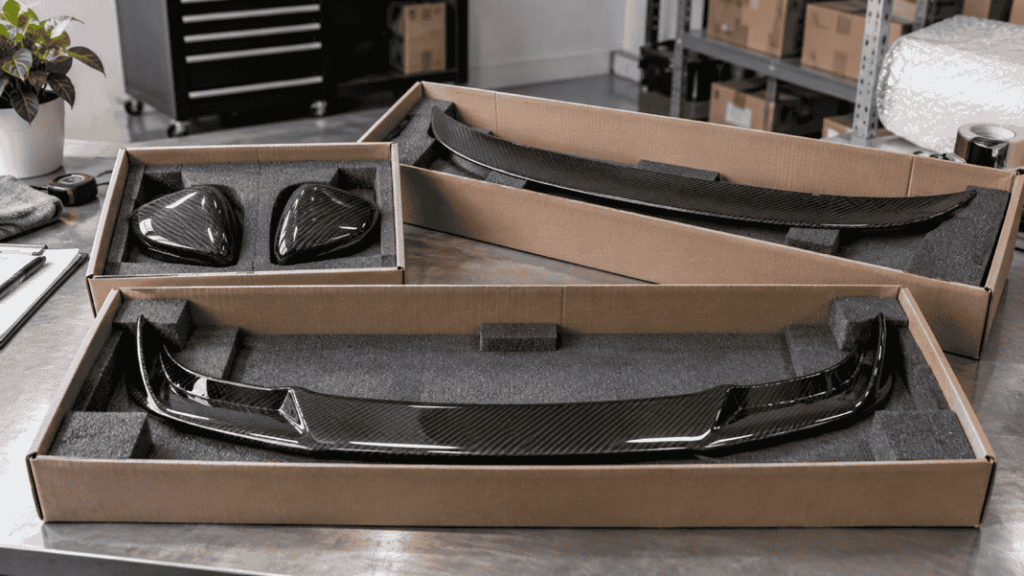
Carbon fiber parts can be damaged by concentrated impact, compression, abrasion or insufficient immobilization inside a box. A shiny clear-coated surface can also be scratched without visible outer-carton damage. Protective packaging should be chosen for the specific geometry and shipping method.
- Front lips and side skirts: Support long edges and corners; prevent bending and movement inside the package.
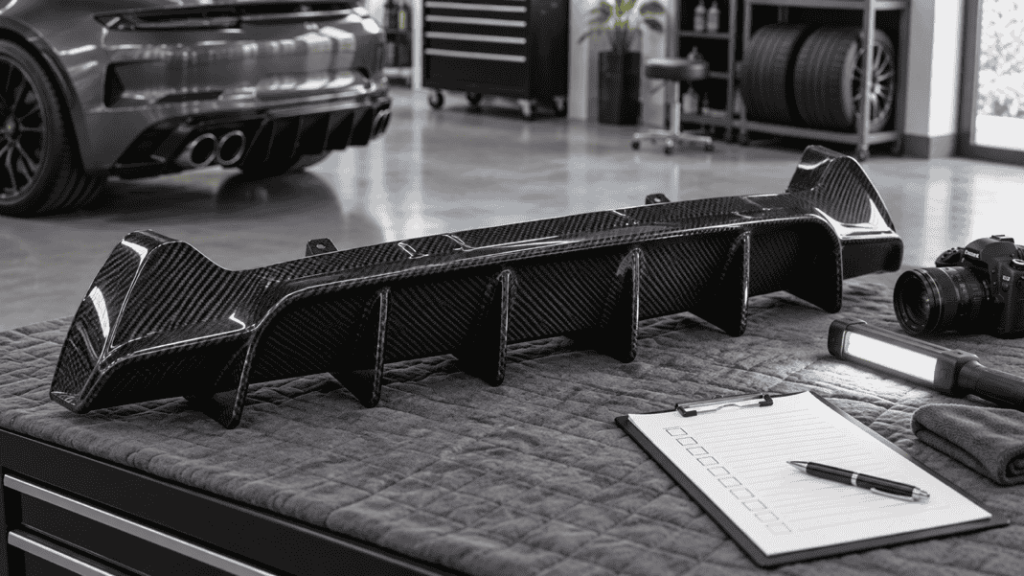
- Diffusers: Protect fins, mounting tabs and projecting sections from direct pressure.
- Spoilers: Separate brackets and hardware from the finished surface; immobilize raised elements.
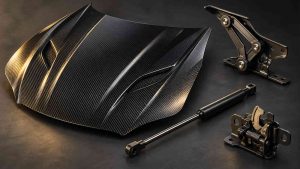
- Hoods and trunk lids: Evaluate rigid edge protection, panel support and suitable oversized freight handling; crating may be appropriate in some cases.
- Small trim: Use surface protection and cushioning so parts cannot collide.
Ask the supplier for packed measurements, a packing description and, where available, pre-dispatch photographs. Do not assume every order includes a wooden crate, insurance or special packaging unless confirmed in the quotation.
7. A practical shipping checklist for European resellers
- Confirm vehicle fitment: Collect make, model, model year, chassis code, trim and relevant bumper configuration before authorizing shipment.
- Confirm the exact SKU: Match the item, finish, quantity and included accessories to the order.
- Request a packed quotation: Obtain destination postcode, packed dimensions, weight, carrier/service and expected surcharges.
- Agree on trade terms: Record the Incoterm, importer, duty/VAT payer and customs documentation responsibilities.
- Agree on packaging: Specify protection requirements and whether the shipment should use neutral packaging.
- Verify recipient information: Check address, contact number and any customs information required by the carrier.
- Release the order: Confirm the final amount and dispatch conditions before the parcel is handed to the carrier.
- Send tracking and delivery guidance: Explain that customs holds and local delivery exceptions may affect timing.
- Document delivery and issues: Ask the customer to inspect the packaging promptly and retain photos if damage is suspected.
8. What changes when shipping directly to a retail customer?
With dropshipping, the factory or fulfillment partner dispatches the goods to the reseller’s customer. The reseller still needs to control the customer-facing promise: product description, compatibility, final price, import-charge disclosure, delivery expectations and after-sales communication.
Blind shipping may allow neutral outer packaging and the omission of unnecessary supplier promotional material, but it does not authorize inaccurate customs invoices, false declarations or suppression of legally required sender information. See CCF’s dropshipping service overview for business inquiries; confirm individual packaging and documentation requirements before ordering.
9. How CCF can support European automotive parts resellers
CCF supplies automotive carbon fiber parts and can discuss direct-to-customer fulfillment and blind shipping for eligible catalog products. Product availability, pricing, packing, freight, delivery estimates and order-specific terms must be confirmed before payment or dispatch. CCF does not promise fixed transit times, automatic customs clearance, API inventory feeds or universally duty-paid delivery.
For a useful quotation, provide the product or catalog reference, full vehicle details, destination country and postcode, expected order quantity, and whether the parcel will go to your business or directly to your customer.
For online stores and wholesale buyers
Request a shipping-ready carbon fiber parts quotation
Share your product requirements and European delivery destination. Ask CCF to confirm product availability, packaging, shipping options and quotation terms for your specific order.
Contact CCF WholesaleFrequently asked questions
How much does it cost to ship a carbon fiber hood from China to Spain?
There is no dependable flat rate. A quotation requires the packed hood dimensions, gross weight, collection point, delivery postcode, chosen service and applicable surcharges. Customs and taxes may be separate.
Why is a carbon fiber front lip expensive to ship if it is lightweight?
Its long protective box may trigger dimensional-weight billing or oversized-parcel surcharges. Carriers often price by the greater of actual and chargeable dimensional weight.
Does the shipping price include European import VAT?
Not necessarily. The answer depends on the agreed trade terms and carrier service. Confirm who is the importer and who pays duty, VAT and clearance fees before the order is placed.
Can a Chinese supplier ship directly to my customer in Europe?
Direct-to-customer fulfillment may be possible. The reseller should confirm fitment, delivery address, customs roles, customer-facing tax disclosure and after-sales procedures with the supplier.
Does blind shipping hide the supplier from customs?
No. Blind shipping concerns customer-facing branding and presentation; customs declarations and legally required commercial information must remain accurate.
Which shipping method is best for large carbon fiber body panels?
It depends on the packed dimensions, fragility, urgency, destination and shipment volume. Compare total delivered costs and damage risk rather than only the headline freight rate.
Who handles a part damaged during international shipping?
Responsibility depends on the sales contract, risk transfer, carrier terms and insurance. Preserve the packaging and take prompt photographs of the outer box, inner protection and damage, then follow the agreed claim process.
Can I use one shipping rate for every European country?
Usually not reliably. Postcode, carrier zone, customs arrangements, parcel size, remote-area charges and local taxes can vary. Quote by destination and product whenever possible.
Related guides for carbon fiber resellers
Educational information only. Customs, VAT, product-compliance and Incoterms obligations should be verified for the specific shipment with qualified local advisers and the relevant authorities.