
A carbon fiber hood’s support and retention requirements must come from the instructions for that exact hood and vehicle application. Original gas struts, hinges and latches are not automatically suitable because the outside shape looks familiar. Resolve the supplied hardware and any additional retention requirements before quoting the installation.
For a tuning shop, these checks belong in the purchasing conversation. They affect the parts list, installation scope and whether the customer can receive a complete quote. This is a procurement checklist, not an installation procedure: it does not prescribe strut force, drilling positions, tightening values or a universal retention arrangement.
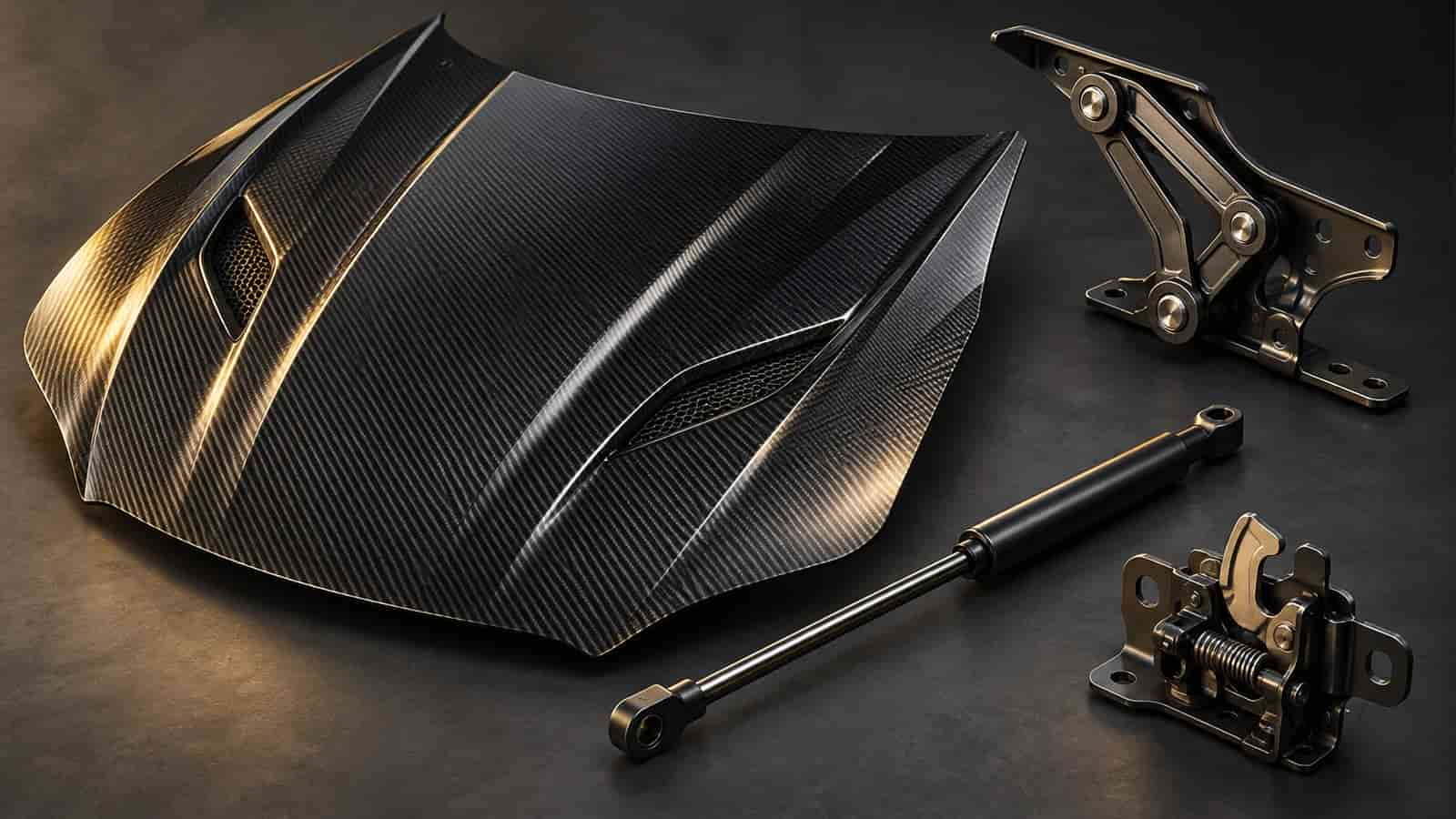
Treat support and retention as different systems
A support system holds the hood open during access. Hinges define how it moves and connect it to the vehicle. Latches and any required additional retention secure it when closed. Approval of one component does not establish compatibility of all the others.
Ask separately about the original primary latch, secondary catch or other retention features applicable to that vehicle, and any additional hardware required by the replacement hood’s instructions. A supplier’s statement that a panel “uses OEM mounting points” is not a complete answer about struts or closed-position retention.
Do not infer a support specification from the words dry carbon, wet carbon or lightweight. The appropriate requirement must come from the product documentation and relevant vehicle or component instructions, not from an assumed material rule.
Identify the actual vehicle and hood version first
Record the chassis, year, body and engine configuration, together with any existing intake, engine-bay, hinge or front-end modifications. Send photographs of the current hood underside, support arrangement and relevant interfaces. If the vehicle has previous repair work, tell the installer so that the current condition can be assessed.
Ask the supplier to identify the quoted hood by SKU and revision. A photograph of another style or a different generation is not sufficient. For a model-specific example of the information to gather, use the BMW G87 M2 hood fitment checklist. Its vehicle scope should not be generalized to other hoods.
Put each interface into the quotation record
| Component or question | Required clarification before commitment |
|---|---|
| Hood supports | Whether original supports are permitted; any specified alternative and its source |
| Hinges | Reused or supplied items; compatibility information and inspection requirements |
| Primary latch interface | Required hardware, installation documentation and compatibility scope |
| Secondary or additional retention | What the product instructions require for this application |
| Hood pins, if specified | Required system and product-specific documentation; included or separately sourced |
| Accessories | Seals, vents, rain management pieces and any other items included or reused |
| Instructions | Current document or video version and contact for unresolved questions |
An answer such as “ask your installer” leaves a commercial gap if the installer has no manufacturer requirement to evaluate. Arrange a three-way clarification between buyer, supplier and installer instead of treating either party’s guess as approval.
Ask a precise question about gas struts
A useful request is: “For this hood SKU on this vehicle, are the existing hood supports permitted by your instructions? If not, what specified support arrangement is required, and is it included in the quotation?” That is more actionable than asking whether carbon hoods generally need weaker struts.
Do not buy a replacement support solely because another owner used it successfully. Their hood, mounting points or vehicle may differ. If the supplier has not documented an arrangement, leave that item unresolved and do not schedule the job as a routine direct replacement.
Likewise, a seller’s claimed weight saving does not determine the support requirement by itself. Construction, attachment details and the relevant instructions still need to be addressed. A weight comparison is a separate purchasing question.
Why supplier-specific instructions matter
Manufacturer instructions can contain requirements that a generic buying guide cannot replace. SEIBON’s product support resources and published terms illustrate this distinction for its products. They are not CCF installation instructions. Obtain the applicable documentation for the hood actually being supplied.
Resolve the hood-pin question without a blanket answer
Some buyers ask whether pins are “optional” because they prefer a clean appearance. The answer cannot be separated from the exact hood, retention design, use and applicable instructions. Obtain the required arrangement in writing before taking a deposit for a promised appearance or installation scope.
Do not tell a customer that pins are unnecessary for every carbon hood, or that adding pins makes any installation acceptable. If the required arrangement conflicts with the customer’s preference, explain that before ordering. The customer may need to select a different documented product or retain the original hood.
The Supra A90 hood installation planning article is another example of why installation information must stay tied to a particular application. It is not an authorization to transfer hardware specifications between models.
Check the underside package as well as the outer panel
A complete planning review includes vents, rain-management pieces and nearby modified components. Ask for underside views and relevant measurements when an aftermarket intake or other change may affect clearance. Do not assume a component can be removed or trimmed without affecting its intended function.
The vented hood rain guide helps frame these questions. If a conflict is identified, obtain a documented resolution rather than converting a customer’s forum workaround into workshop practice.
For distributors, store this information with the SKU. Your dealer should not have to infer installation requirements from a short catalog description. The dealer product data checklist can help separate confirmed application data from items awaiting verification.
Quote the complete scope and set a hold point
Separate the hood, required support or retention hardware, other accessories, installation work and any finishing work. Identify who is supplying each item. If an essential requirement remains unknown, issue a conditional estimate with the unresolved item clearly stated rather than a fixed all-inclusive promise.
Before installation is committed, the shop should have the correct part identity, relevant instructions and a reconciled contents list. Any mismatch in those records is a reason to pause and clarify. The installer remains responsible for assessing the actual vehicle and following the appropriate instructions; this article cannot determine roadworthiness from a photograph.
At handover, retain the product identity, documentation version and completed installation record. Provide the customer with the care and inspection information applicable to the installed assembly. Do not substitute a generic “check it regularly” statement for required product-specific guidance.
Frequently asked questions
Can I reuse the original hood struts?
Only where the documentation for the particular replacement hood permits that arrangement and the installer confirms the application. The original vehicle fitment does not automatically approve use with a replacement panel.
Does every carbon fiber hood need hood pins?
There is no universal answer in this buying checklist. Confirm the required retention arrangement for the actual product and intended use before ordering.
What should I send for a useful hood quotation?
Send the vehicle configuration, current under-hood photographs, product reference, known modifications, quantity and destination. Ask explicitly about support, retention, included hardware and installation documentation.
Resolve the hardware questions before booking the bay
Ask CCF for the available mounting and retention information for the hood you are considering. Confirm what is supplied, what must be sourced separately and what still requires installer review. A clear parts list is a better starting point than discovering a support or latch question after the vehicle has been dismantled.
Send Your Product Enquiry
Include your company, vehicle details, product reference, quantity and destination.