Evaluate a vented carbon fiber hood for daily use by checking the actual opening design, the areas underneath it and any specified water-management components. An attractive vent pattern is not evidence of rain protection. For a tuning shop, the question is whether the particular hood and vehicle arrangement suit the customer’s use.
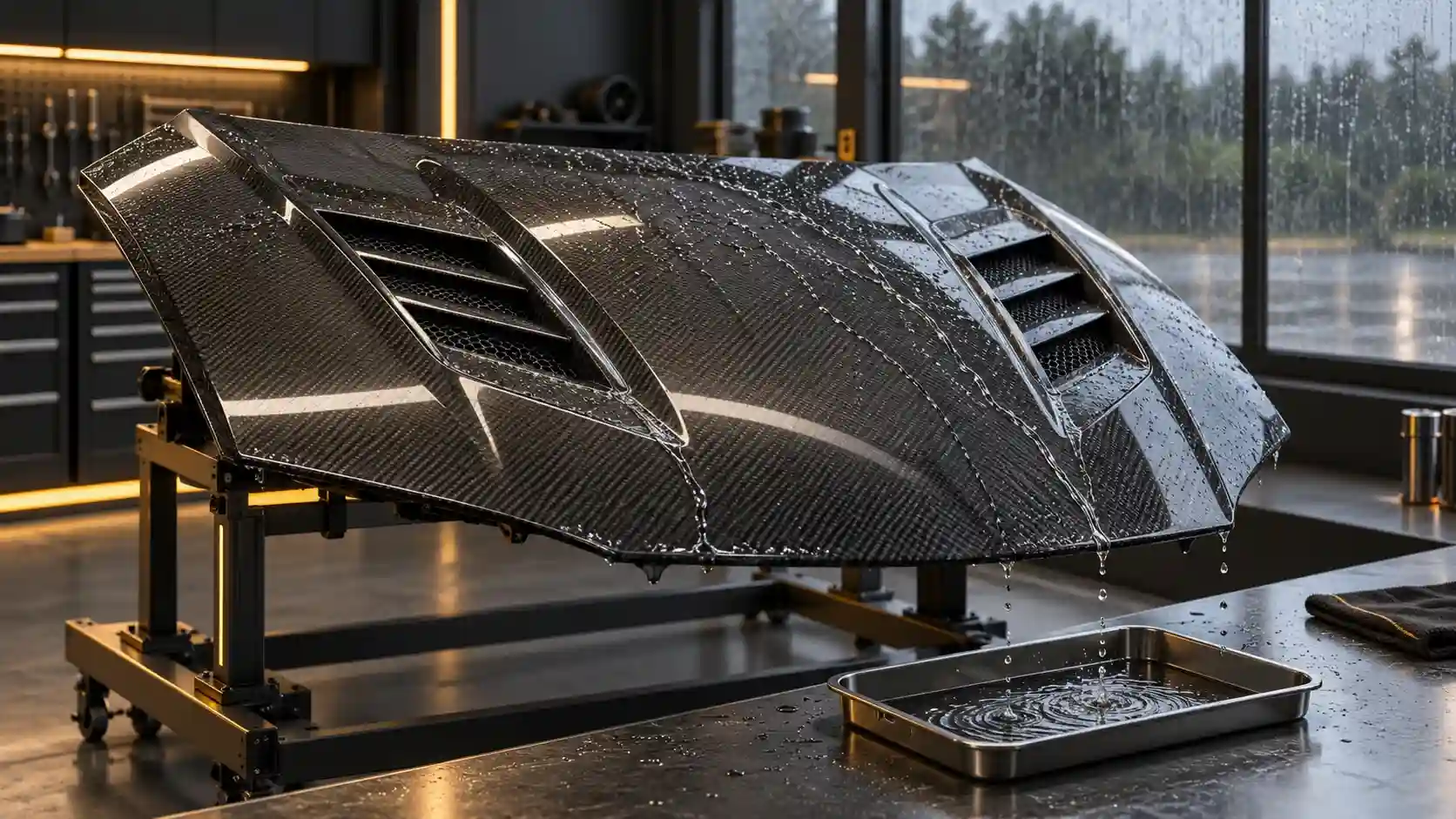
Separate the customer’s goals
Ask whether the customer wants a styling change, a documented thermal function or both. Do not infer a cooling benefit from the presence of openings, and do not assume that a cover can be added without affecting the hood’s intended operation. Each proposed configuration needs its own review.
Record the vehicle’s use: daily driving, outdoor parking, washing arrangements and any relevant modifications under the hood. These details help frame the questions for the supplier. They do not, by themselves, establish whether a design is suitable.
Request the underside, not only the exterior
Ask for photographs or drawings that identify the vents, surrounding structure and any supplied trays, ducts, covers or seals. Confirm what is included in the quote and what is optional. A product image may show a component that is not supplied with the selected version.
| Question | Evidence to request | What remains unproven without it |
|---|---|---|
| Are the visible vents open? | Front and underside views of the exact version | The path through the panel |
| What sits below each opening? | Vehicle-specific layout and relevant modifications | Where water could reach on that car |
| Is a tray or cover specified? | Part reference, attachment and installation information | Whether the proposed accessory belongs to the system |
| Where is water directed? | Design explanation and applicable validation evidence | A supported water-management claim |
| What use restrictions apply? | Written product guidance | Suitability for the customer’s intended conditions |
Check the complete configuration
Review clearances and nearby components using the appropriate product-specific information. If the engine bay has aftermarket equipment, identify it rather than assuming that an earlier vehicle reference remains valid. A route that appears clear in one photograph may be different on the customer’s actual car.
Do not treat a generic tray as a harmless extra. Its mounting, clearance and effect on the intended arrangement need review. Never improvise by blocking openings or attaching loose material under the hood to solve an unverified concern.
Ask what evidence supports the claim
If a product is described as suitable for rain or daily use, ask what that statement covers. Request the tested or reviewed configuration, the conditions considered and any limitations. A brief water demonstration is not proof of suitability for every speed, exposure or vehicle setup.
Where further validation is required, it should be planned by qualified personnel for the actual vehicle and product. This buying guide does not prescribe spraying an engine bay, a universal test volume or a homemade electrical-protection method.
Keep fitment, retention and water management separate
A hood may align with surrounding panels while other questions remain open. Closure, retention, support arrangements and clearances require their own product-specific checks. Passing one visible fitment check does not validate the entire installation.
Use the same separation in your customer quote. Identify the hood version, included accessories and the information needed before final installation approval. If a component or validation step is unresolved, show it as an open item instead of hiding it inside a fixed package promise.
Use a written recommendation for the customer
A practical recommendation has three parts: the customer’s intended use, the configuration being proposed and the evidence or conditions supporting it. If the supplier cannot provide sufficient information, offer a different supported option or postpone the decision. There is no need to promise a rain-proof outcome from an exterior photo.
For example, a daily-driven car parked outside raises different questions from a display vehicle used under controlled conditions. This is a planning distinction, not a rule that either type of hood is automatically acceptable for one use or the other.
Questions from shops
Are all vented carbon hoods unsuitable for rain?
No universal conclusion is made here. Suitability depends on the actual design, vehicle arrangement and supported use conditions.
Does mesh stop water entering?
Do not treat a mesh appearance as evidence of water management. Ask how the specified system handles exposure.
Can I add a rain tray later?
Only after the specific tray and hood arrangement are confirmed. Availability and compatibility should be resolved before the order.
What should I send for a quote?
Provide the model, year, engine-bay photographs, relevant modifications and intended use. Request the exact hood version, underside information and supplied accessory list.
A hood opening-to-underbody map
Use this record as a buyer working tool. Examples and sample labels below are illustrative, not CCF inspection, order or test records.
| Record | Example or required entry |
|---|---|
| Opening A | Mark the opening on the selected hood reference and identify the area directly beneath it. |
| Supplied components | List any quoted mesh, ducts, trays or other parts without assuming they are included. |
| Open question | Identify which water-management or use requirement still needs product-specific review. |
Repeat the row for each relevant opening. A generic engine-bay photo cannot show the underside arrangement of a different hood version.
For the connected decisions, use How to Assess Yellowing or Cloudiness on Carbon Fiber Parts and How to Plan an OEM Equipment Transfer to a Carbon Fiber Trunk Lid.
Review the Hood Before Promising the Build
Send vehicle and engine-bay photos, relevant modifications and intended use. Request the selected hood’s underside information and accessory scope.
Send an Inquiry
Include this article title, your product reference, vehicle details and the question you need resolved.