Specify heat exposure by describing the installed location, heat sources, operating duration and required performance of the complete trim assembly. “Dry carbon” is not a temperature rating. A material label does not establish that a finished engine-bay component is suitable for a particular installation.
For OEM buyers, a useful inquiry starts with the operating environment and the result the part must maintain. That lets the engineering team review materials, coating, attachment and validation together instead of guessing from a photograph.
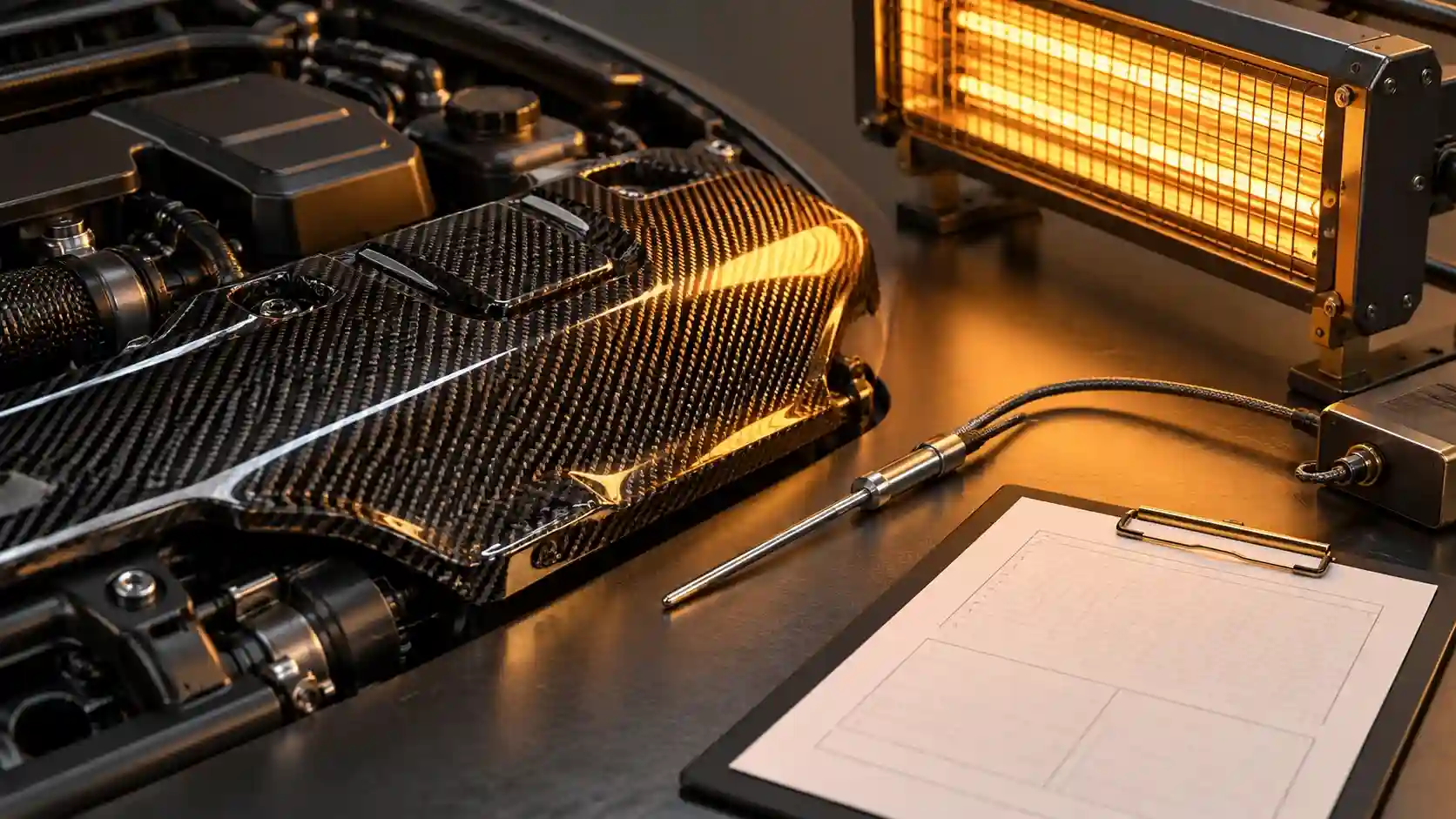
Describe the actual installation environment
Provide the vehicle configuration, installed position and nearby components. Identify relevant modifications, shielding and airflow conditions. A generic engine-bay image may miss the heat source that matters most for the project.
Distinguish normal operation, short peaks and heat soak after shutdown where relevant. State how those conditions are known: measured records, vehicle information or assumptions awaiting confirmation. Do not present a guessed temperature as an established design input.
Use a heat-exposure brief
| Input | Information to supply |
|---|---|
| Location | Installed views and relation to nearby heat sources |
| Operating scenarios | Relevant driving, idle, shutdown or other conditions |
| Temperature information | Measurement location, method, duration and limitations |
| Other exposure | Relevant fluids, vibration and environmental conditions |
| Required outcome | Appearance, geometry, attachment and other functions to maintain |
| Verification scope | Responsible engineer, method and acceptance criteria |
Where measurements are needed, have a qualified person establish a suitable procedure. This article does not prescribe sensor placement or a vehicle test sequence. Poorly located measurements can answer a different question from the one the design needs.
Review the complete material system
Resin systems have different intended applications and properties, as illustrated by Easy Composites’ epoxy material range. That is a reason to request the relevant material documentation, not a basis for assigning a universal heat rating to carbon parts.
Ask the engineering team to review the laminate, coating, adhesive, inserts and any other relevant elements of the actual assembly. A favorable value for one constituent does not automatically establish the finished product’s allowable service conditions.
Keep material test properties separate from an approved application limit. If a datasheet value is proposed as evidence, ask what it measures and how it relates to the component, processing and intended exposure. Avoid converting a technical property into a customer promise without that review.
Define what acceptable performance means
State which outcomes matter: retained shape, acceptable appearance, secure attachment or another project-specific function. Ask the team to define how each will be evaluated and which limits apply. “Heat resistant” without an agreed outcome is difficult to verify.
Separate visual changes from functional concerns. A part that still looks acceptable has not automatically met every mechanical requirement; a visual change also needs interpretation in context. The validation plan should identify the required observations rather than rely on a single photograph.
Use representative conditions and samples as agreed by the responsible engineer. A coupon test can be useful evidence, but its connection to the finished assembly must be explained. Do not treat an unrelated supplier test as approval of a custom installation.
Control assumptions before production
- List confirmed operating information and unresolved assumptions.
- Agree the proposed assembly and material documentation.
- Define validation responsibilities and acceptance criteria.
- Review results and limitations before approving claims.
- Reassess relevant changes to the installation or construction.
If the customer later changes the heat source, shielding or mounting position, review whether the earlier assessment still applies. A previous approval should remain tied to its recorded configuration.
For the RFQ, identify whether the request is for feasibility work, a prototype or a production order. Unresolved operating conditions may affect the engineering scope. Making them visible early is more useful than asking for an unsupported temperature guarantee.
A heat-environment input register
Use this record as a buyer working tool. Examples and sample labels below are illustrative, not CCF inspection, order or test records.
| Record | Example or required entry |
|---|---|
| Known | Installation position and identified nearby components, supported by actual photographs. |
| Measured | Temperature record with location, method and conditions, only where measurements exist. |
| Unknown | Unmeasured operating scenarios or missing material information assigned for review. |
| Required outcome | State what appearance, geometry and attachment behavior must be evaluated. |
A blank measured-temperature field is better than a guessed service rating. The engineering team must connect the inputs to a suitable validation plan before any product temperature claim is published.
For the connected decisions, use How to Specify Mounting Inserts for Custom Carbon Fiber Parts and How to Plan a Test-Fit Vehicle Session for a Custom Carbon Fiber Project.
Buyer FAQ
Does dry carbon automatically tolerate engine-bay heat?
No. Suitability requires review of the specific construction, installation environment and intended function.
Can I quote a resin datasheet temperature as the part rating?
Not without an appropriate engineering assessment linking that value to the complete component and its use conditions.
What should I send with an inquiry?
Send the installation location, vehicle configuration, known operating information and required outcomes. Ask what additional evidence is needed for a feasibility review.
Start With the Actual Installation Environment
Send the vehicle configuration, installed position, known operating information and required outcomes. Request a feasibility review before making temperature claims.
Send an Inquiry
Include this article title, your product reference, vehicle details and the question you need resolved.