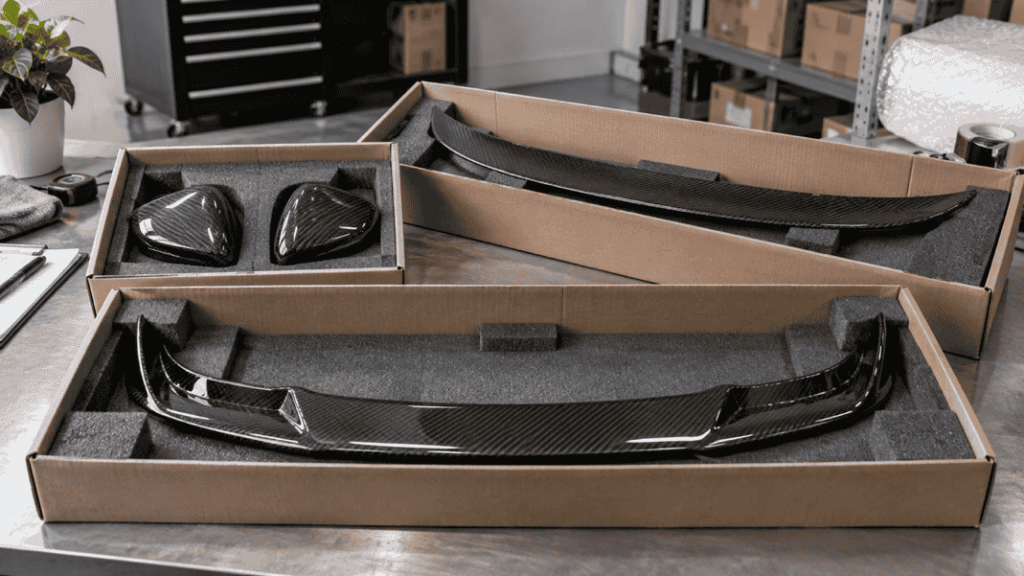
A customer changes their mind about a finish, adds a second pair of mirror caps or asks for delivery to another workshop. The request sounds small, but the original order may already be in production, packed or booked for transport.
Treat a carbon fiber order change as a revision that requires written acceptance, not as an automatic replacement of the original instruction. Confirm the affected line, cost, timing and fulfillment status before telling your customer the change is complete.

Concept illustration.
Identify exactly what is changing
Reference the order number and current revision. State the existing line and proposed replacement: SKU, version, finish, quantity, destination or packaging requirement. Avoid messages such as “change it to the other one” that depend on someone reconstructing a chat history.
For quantity changes, state the sales unit. Adding “two” could mean two pieces or two pairs. For a different design, provide a product reference and image; visual similarity does not make it the same item.
Check the order stage
| Current stage | Questions before accepting the change |
|---|---|
| Quotation only | Does the new scope require a revised quotation? |
| Confirmed but not started | Has the supplier accepted the revision and any changed terms? |
| Production or development underway | What work has begun and what can still change? |
| Packed or shipping arranged | Is repacking, relabeling or rebooking required? |
| Dispatched | What options are available through the applicable transport and sales process? |
These are review questions, not cancellation entitlements. Custom work and catalog orders may have different conditions. Refer to the actual accepted order terms and CCF's current buyer FAQ.
Ask for an impact statement
The supplier's response should identify whether the change is accepted, any revised cost, the effect on timing and what remains unchanged. If approval is still pending, keep the order status as pending change rather than assuming the latest message overrides production instructions.
Where a delivery address changes, verify the recipient and destination details through the agreed private channel. Ask whether the route, service or quoted cost changes. Do not send unnecessary customer information to unrelated recipients.
Maintain one current order version
A simple revision table prevents the sales team, packing team and customer from working from different instructions.
| Field | Entry to record |
|---|---|
| Original order and revision | The instruction currently in force |
| Requested change | Specific old and new values |
| Request date and sender | Who requested the revision |
| Supplier response | Accepted, rejected or awaiting information |
| Commercial impact | Revised price, payment or timing if applicable |
| Final release reference | The version both parties will use |
Keep superseded records for traceability, but mark them clearly. Do not leave two files both named “final order” without dates or revision identifiers.
Tell the customer what is actually confirmed
Explain the accepted change and its consequences before promising a new installation date. If only part of the request can be accommodated, obtain the customer's decision on that exact proposal.
When a change results in separate deliveries, use the delivery-planning guide and the like-for-like quotation guide to review the revised scope.
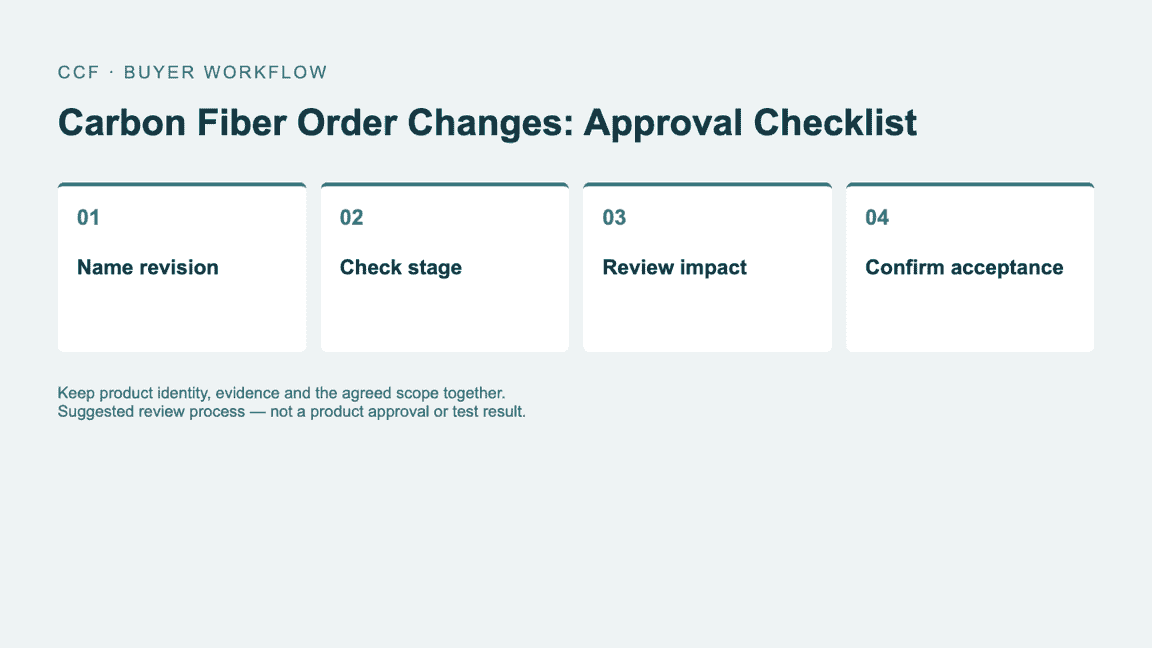
Suggested buyer workflow. Follow the product-specific specification and agreed order terms where applicable.
Worked change-control example
Use this record as a buyer working tool. Examples and sample labels below are illustrative, not CCF inspection, order or test records.
| Record | Example or required entry |
|---|---|
| Original line | One pair in the approved finish, under the current order revision. |
| Requested change | Customer asks for another finish; record request date and affected reference. |
| Impact response | Supplier states whether the change is feasible and identifies price, timing and documentation effects. |
| Release | Buyer accepts the revised scope in writing; the new order revision supersedes the old one. |
Until the revised order is accepted, a request is not a confirmed change. Keep the old record for traceability rather than deleting it.
Questions buyers ask
Does sending a change request stop production? Do not assume it does. Ask for explicit acknowledgement and the current order status.
Can a custom order be changed without cost? That depends on the accepted scope and work already performed. Request a specific review rather than assuming a universal rule.
For the related buying decisions, see Private-Label Carbon Fiber Parts: A Branding and Packaging Approval Checklist and Splitting a Mixed Carbon Fiber Order: Ship Ready Parts or Wait?.
Resolve the revision while options remain
Contact CCF with the order reference, exact proposed change and required decision. Ask for written acceptance and an updated scope before relaying the change as confirmed to your customer.
Send an Inquiry
Include the article title, selected parts, quantity and delivery country.