CARBON PARTS WORKSHOP SERIES · 09
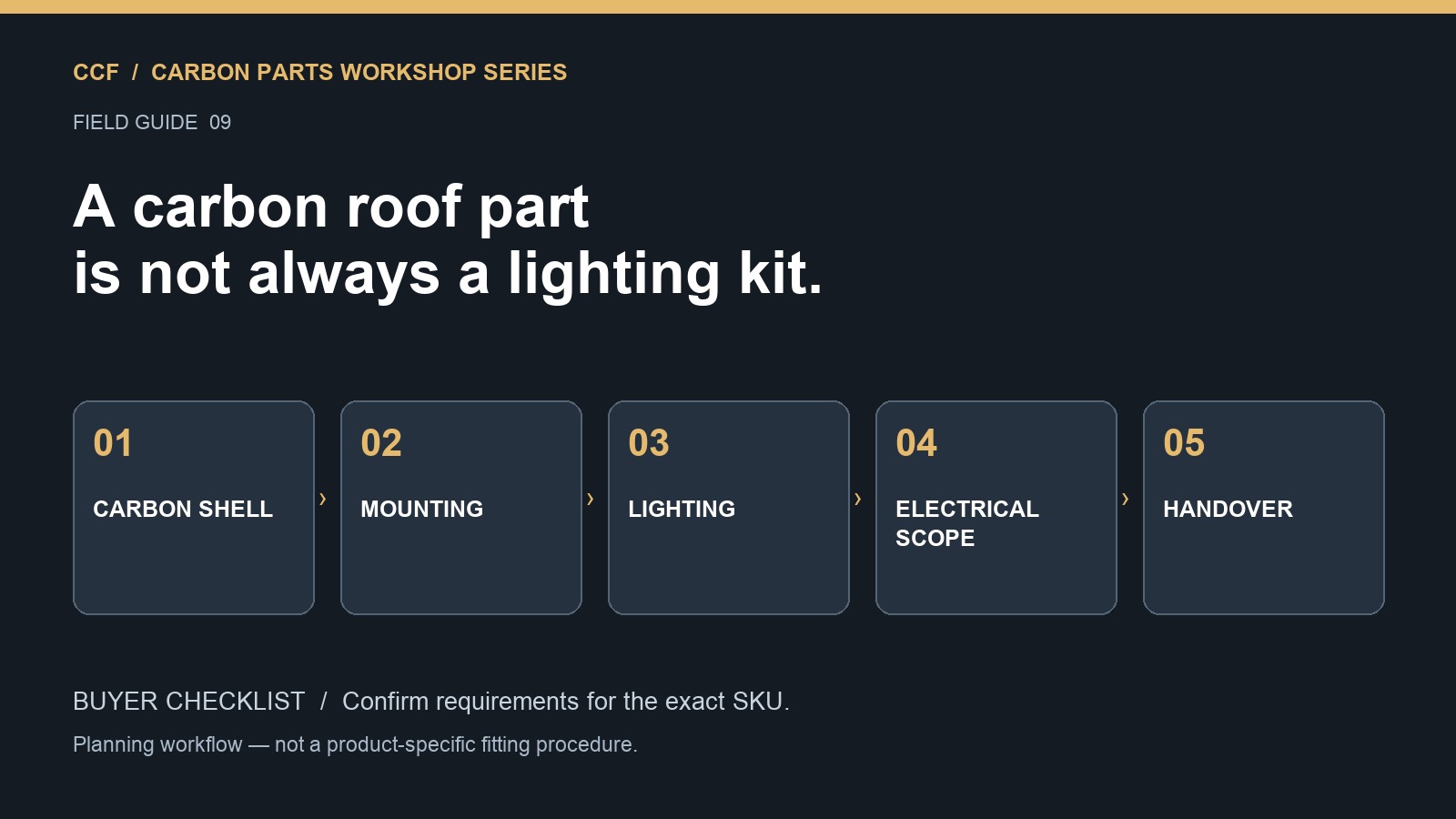
Before quoting a G-Class carbon roof accessory, establish whether the offer is for a cosmetic component, a mounting package or a complete lighting system. A photograph with illuminated lamps does not tell a buyer which of those elements is included.
This Carbon Parts Workshop Series guide helps trade buyers separate the scopes before accepting an order. It does not provide wiring instructions, confirm road-use approval or establish compatibility with any unidentified CCF product.
Identify the accessory position and function
Ask the customer to mark the intended location in the reference photograph. A rear roof spoiler, a front roof attachment and a lamp-equipped roof assembly serve different purposes and should not share one vague “roof spoiler kit” description. Identify the supplier’s exact product name and SKU.
Record the vehicle year, market and body version rather than relying only on “G63.” If an enquiry uses W463 or W465 terminology, have the supplier confirm the actual application from the vehicle information. The G-Class application checklist provides a starting structure; it does not replace confirmation for the roof accessory being ordered.
A source example: the carbon component is only part of the package
A BRABUS-authored guide hosted on a regional site identifies a W463 roof attachment with high-beam LED lights, article 463-360-00_10. Its delivery list includes a carrier, lamps, brackets, a control unit and wiring in addition to the carbon component.
This is a document-specific illustration of package scope, not evidence that a similar-looking part includes the same equipment. The regional-hosted document has not been established here as the latest manufacturer revision. Its contents and method cannot be transferred to a CCF part or a later G-Class application.
Break the quote into five lines
| Scope | Question to resolve |
|---|---|
| Carbon component | Which shell or trim piece, finish and quantity are being supplied? |
| Mechanical mounting | Which bases, carriers or other product-specific attachment items are included? |
| Lighting equipment | Are lamps included, separately specified or only pictured for reference? |
| Electrical integration | What system information is available, and what work or equipment remains outside the supplier’s package? |
| Installation and handover | Who will review and complete each workstream, and what documentation will be provided? |
Each line should have an included, excluded or unresolved status. Do not label an unresolved item as excluded merely to finish the quote. The buyer needs to know whether the requirement is understood at all.
Keep appearance approval separate from system approval
A customer may approve the finish and overall shape without understanding the package boundaries. Confirm that approval as a styling decision, then obtain agreement on the supplied mechanical and lighting scope. Do not let a marketing image substitute for that discussion.
Our G-Class roof component buying guide helps distinguish bases, end pieces and assembly contents. For a lamp-equipped accessory, additional system questions remain even when the visible pieces are clearly identified.
Assign responsibility before the installer receives the vehicle
Decide who will assess the attachment requirements and who will handle any electrical work. This may be one appropriately equipped workshop or coordinated specialists. Give them the actual product information before promising a finished installation date.
Ask the supplier what product-specific documentation is available. Ask the installer what additional vehicle information is needed. Do not improvise wiring, electrical ratings, circuit connections or sealing details from another product’s guide. If those requirements are not established, the electrical portion of the project remains unconfirmed.
Do not treat a functioning lamp as proof of approval
Whether a lamp turns on is different from whether the complete installation meets the applicable requirements for its intended use. Ask for the relevant product identification and available supporting documentation, and have the installer determine which local requirements need checking. Do not advertise road legality or approval on the basis of appearance or a competitor’s certificate.
This is a procurement boundary, not jurisdiction-specific legal advice. A claim about one identified lamp or system should not be broadened to an unrelated combination of carbon shell, lamps and wiring.
Explain the difference between two superficially similar offers
In a hypothetical comparison, quote A supplies a carbon shell only, while quote B supplies an identified assembly with additional equipment. Comparing the total prices without separating those scopes can mislead the customer. Normalize the contents and ask the installer what remains to be supplied for each option.
Use the installation quotation guide to keep mechanical, electrical and conditional work visible. This does not require a complicated quote; a few clear lines are better than an undefined “complete installation” promise.
Inspect the delivered package by workstream
On receipt, compare the carbon component and any separately packed equipment with the agreed list. Preserve identification labels and photographs. Record missing or different items without assuming that the installer can replace them with a generic equivalent.
The sample inspection framework helps create that record. It supports a commercial receiving decision; it does not certify an electrical system or validate an attachment under use.
Give the customer a clear handover
Retain the installed product identification and the documentation used for each part of the work. Provide the relevant operating and care information and a contact for follow-up. If some equipment was supplied by another party, make that scope explicit rather than attributing the entire assembly to one supplier.
Buyer questions
Does a lamp opening mean lamps are supplied?
No. Confirm the packing list and distinguish included components from reference imagery.
Can I use a W463 guide for a later G-Class?
Only if the relevant product supplier confirms that document’s application to the exact product and vehicle. A similar appearance is insufficient.
Can CCF quote only the carbon component?
Ask which product and scope are available for your reference. Do not assume that lamps, wiring, control equipment or an installation service are included.
Send a scope-specific trade enquiry
Send CCF the vehicle details, marked-up roof accessory reference, quantity and destination. State whether you need a carbon component only or are asking about a broader assembly. Request a clear list of what can be supplied and which technical questions remain for the installation team.
Editorial reference check: 18 October 2026. Referenced manufacturer documents apply to their identified products. Confirm CCF SKU requirements separately.