CCF standard catalog carbon fiber parts can be ordered from one piece, subject to availability. Confirm the sales unit for the selected SKU, sample price, freight and dispatch estimate before payment. Mixed-model orders can be discussed against an itemized list; OEM development, private labeling and custom packaging have separate project requirements.
This guide helps tuning shops, distributors and resellers plan a first catalog purchase. Use it to choose between a sample, a mixed-product trial and a repeat stock order, then send CCF a parts list that can be quoted line by line.
Can I order one part, a sample or a mixed-model order?
| Buying route | What CCF states or reviews | What to send |
|---|---|---|
| Standard catalog product | Available from one piece, subject to the selected reference and availability | Product reference, vehicle configuration, finish, quantity and destination |
| Sample evaluation | A catalog item can be purchased individually; charges and readiness are confirmed for that item | The checks you intend to perform and the sample quantity |
| Mixed-product trial | Selected products, availability and shipping requirements are reviewed together | One line per SKU, quantity, sales unit and any time-sensitive items |
| OEM or additional branding | Feasibility, quantities, tooling or setup requirements are evaluated separately | Design or branding brief, references and estimated demand |
The catalog ordering position above is stated on CCF’s wholesale supply page. It does not establish free samples, one fixed discount, universal stock availability or an arrival-date guarantee.
1. Understand what “one” means for your product
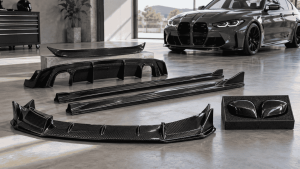
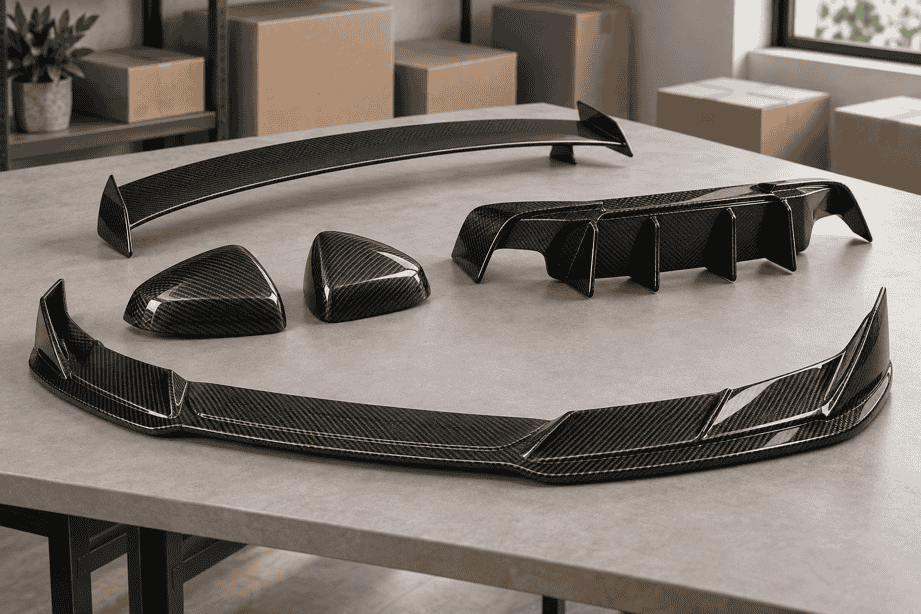
MOQ means minimum order quantity, but a quantity is useful only when it identifies the offered sales unit. A mirror-cap product may be sold as a left/right pair. A front lip may be a complete multi-piece set. Confirm what is included rather than interpreting “one piece” as permission to buy any individual section of a kit.
Specify quantity and unit on every line. If you need a replacement side, mounting kit or individual section, ask whether it is available separately. Availability of a complete assembly does not establish separate supply of every component.
Also separate the catalog item from customization. A standard part with a new label or branded carton can create additional artwork, setup or packaging requirements. Include those requests when asking for the quotation.
2. Choose a first order that answers a purchasing question
For a tuning shop, a useful first purchase may relate to a booked customer job or a vehicle available for evaluation. Record the actual configuration so your installer can assess the intended application.
For a distributor, choose a focused shortlist based on customer inquiries or sales history. Track results by exact reference. Interest in one chassis or part category does not establish demand for every product in the catalog.
For an aftermarket brand, distinguish a catalog sample from a custom prototype. A sample of an existing component can help review appearance and construction, but it does not complete a new-design development or private-label approval process. Use the OEM/ODM project page for that discussion.
3. Confirm sample charges and evaluation scope
Request the sample price, packing and freight, the proposed product version and the dispatch estimate. Ask whether the part is ready or requires production. If a sample credit is important to your buying decision, obtain the applicable arrangement in writing instead of assuming a later reimbursement.
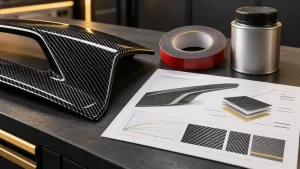
Tell CCF what you need to evaluate: visible finish, backing construction, mounting interfaces, included hardware or fitment on an identified vehicle. Ask which information is available before shipment and which checks will be performed after receipt.
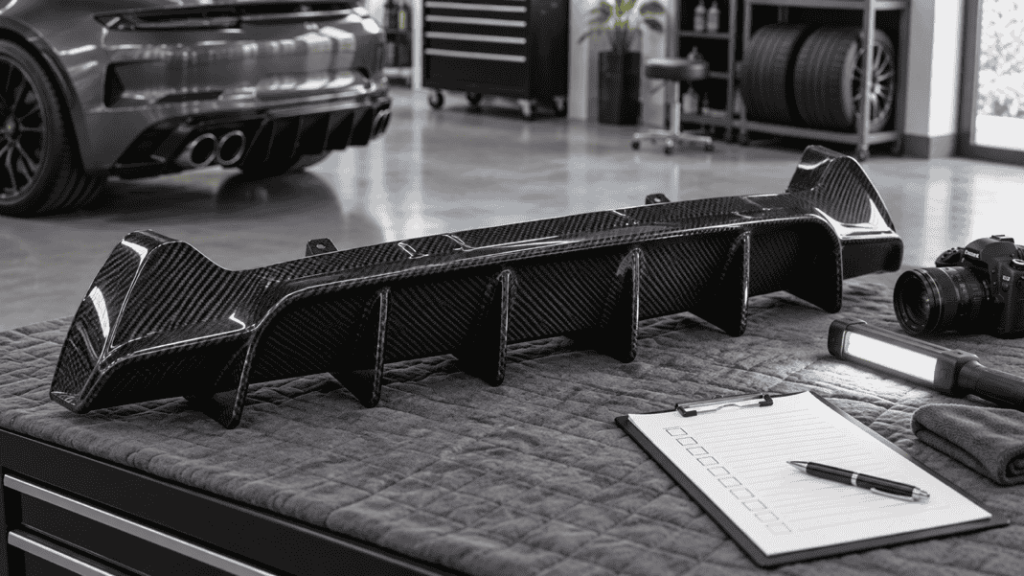
On arrival, record the packaging and product identity before modifying the part. Compare supplied components with the accepted order. Where appropriate, arrange a non-destructive trial fit using the relevant installation information. Keep unanswered questions visible before approving drilling, bonding or other permanent work.
The sample inspection guide provides a more detailed record. If you cannot inspect in person, use the remote sample review guide to define the evidence and the limits of a photo-based assessment.
4. Keep purchasing and shipping decisions separate in a mixed order
A mixed-model inquiry is a list of individual offers plus an order-level shipping review. Ask whether the selected references can be purchased together, then check whether they can be dispatched together on an acceptable schedule.
| Point to confirm | Why it matters |
|---|---|
| Product readiness for each line | One made-to-order reference may affect the timing of a consolidated shipment. |
| Pricing by SKU and quantity | Mixed products do not automatically share one volume discount. |
| Carton count, dimensions and gross weights | Combining items does not guarantee one carton or a lower freight charge. |
| Consolidated or split dispatch | A time-sensitive customer job may need a separate shipment and additional cost. |
| Alternative products or finish changes | A substitute requires approval; it should not be inferred from a general mixed-order request. |
Mark urgent lines before accepting the quotation. If one part must arrive before a workshop appointment, ask for the relevant readiness and shipping options rather than converting a general production estimate into a promised customer delivery date.
5. Send an itemized trial-order list
Use actual product links or marked catalog references. The following table is a purchasing template, not a CCF product offer. Replace each example with the product your business needs.
| Reference | Application and version | Quantity / sales unit | Evaluation purpose |
|---|---|---|---|
| Insert selected front-lip link | Actual chassis, year and bumper; identify material and finish | State number of complete sets | Trial fit for a named workshop job |
| Insert selected mirror-cap link | Actual housing; overlay or replacement version | State number of left/right pairs | Evaluate appearance and attachment |
| Insert selected diffuser link | Actual bumper and exhaust configuration | State number of complete sets | Review application and delivered cost |
If the reference is uncertain, send photographs with the intended part clearly marked. State which requirements are essential and whether alternative styles are acceptable. Use our vehicle range to narrow the shortlist before requesting pricing.
6. Compare delivered cost before increasing the order
Record the product subtotal, any packing or customization charge, freight and the delivery basis. Identify destination costs that remain outside the quote. Use confirmed figures from the offered shipment rather than a generic percentage allowance.
Ask for packing information when allocating freight across resale products. Long aero parts and small trim pieces may contribute differently to the shipping calculation. Our landed-cost guide helps organize the comparison; the quotation comparison guide helps normalize different offers.
Before reordering, review whether the trial matched the accepted references, packaging and timing. Retain the approved product identity, finish and supplied contents so the next request can specify the same version. Increasing stock only makes sense when demand and the complete economics justify it.
Buyer questions about MOQ and samples
Does a one-piece order receive wholesale pricing?
CCF prepares product-specific quotations based on the selected products, quantities and commercial requirements. The ability to order one catalog item does not establish one fixed wholesale discount. Send the reference and quantity for pricing.
Are carbon fiber samples free?
Do not assume free products, free freight or credit on a later order. Confirm the sample charges and any separately offered credit conditions before payment.
Can I mix BMW, Mercedes-Benz and other vehicle parts?
Send the selected references in one list so the combination can be reviewed. Eligibility, pricing, readiness and shipping depend on the actual items; there is no blanket promise covering every catalog combination.
Can I add private-label packaging to a small trial?
Include the branding requirement, artwork and quantities in the inquiry. Feasibility, setup costs and packaging minimums need separate confirmation.
How soon can the first order ship?
Ask for the readiness of each selected SKU and the proposed dispatch arrangement. Timing depends on availability, production and shipping scope; there is no single lead time for every catalog purchase.
Copy this sample or mixed-order inquiry
Subject: Catalog sample / mixed-model trial quotation
Company, website and buyer type:
Delivery country, city and postal code:
Product links or marked catalog references:
Vehicle configuration, material and finish by line:
Quantity and sales unit by line:
Purpose: sample evaluation / customer jobs / stock:
Intended sample checks:
Required date and urgent lines, if any:
Consolidated shipment or split options:
Additional branding or packaging requirements:
Please confirm the offered references, applicable quantities, sample terms, itemized prices, availability, packing and freight basis, proposed dispatch timing and payment terms.
For a broader range-planning decision, read our wholesale sourcing guide. This page focuses on getting the first sample or mixed-product request ready for a useful quotation.
Request Sample or Mixed-Order Pricing
Send your business details, selected products and destination. CCF can review the references and provide a product-specific response for the proposed order.
Send Your Parts List
Include your company, product references, vehicle details, quantities and destination. Mention any documents or unresolved questions you need answered.