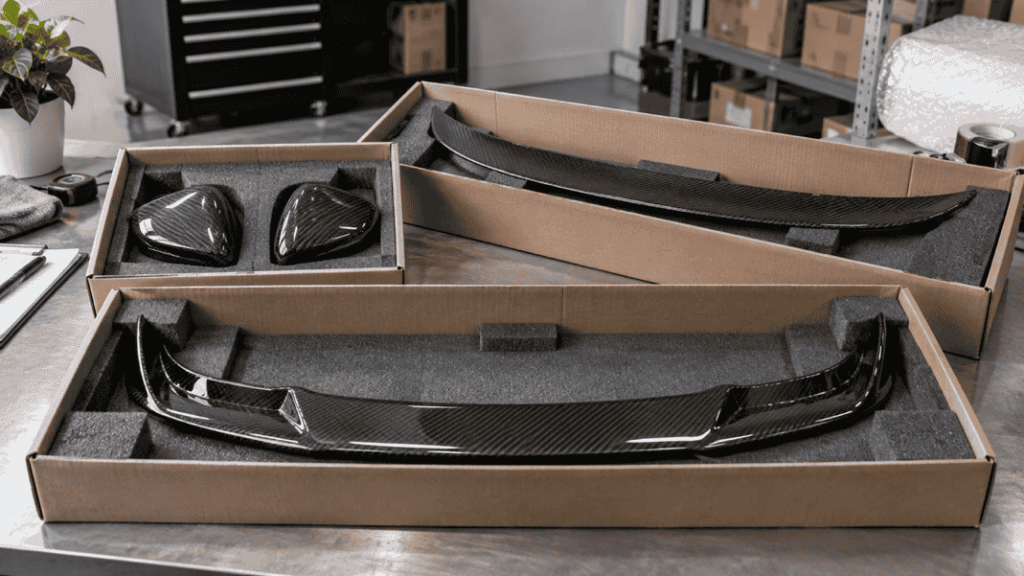
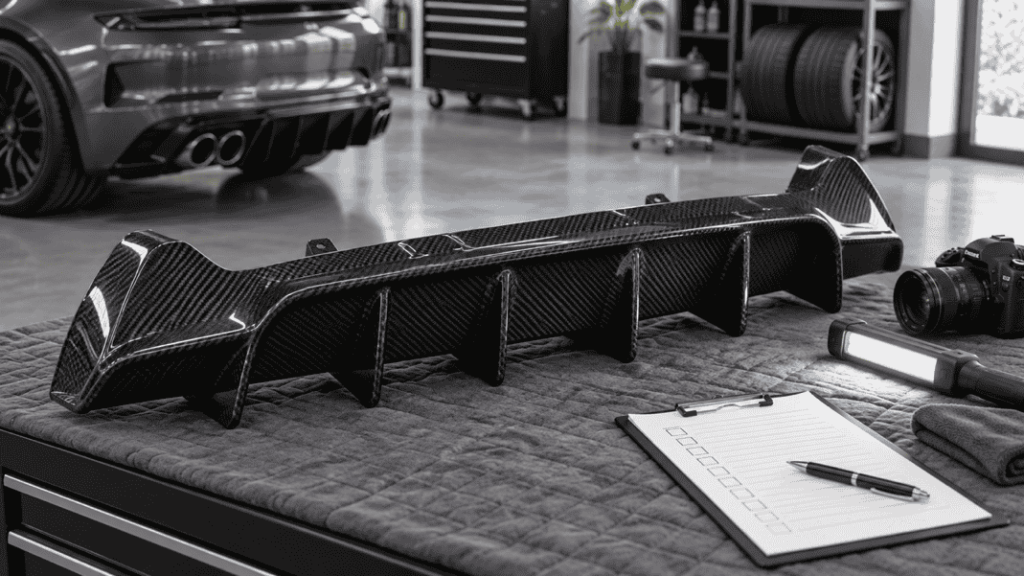
Your order contains mirror caps ready for dispatch and a front lip still awaiting completion. Shipping everything together sounds simpler, but one customer's car is booked sooner than the others. The decision is no longer just about freight price.
Compare split shipping against holding the order using confirmed product readiness, complete customer-job requirements, total shipping scope and the cost of delay to your business. Do not split a set in a way that delivers parts your installer cannot use.

Concept illustration.
Start with a line-by-line readiness record
Separate each SKU and quantity. Mark whether the item is available, awaiting an agreed check, in production or not yet confirmed. A product sitting on a shelf may still require packing or another agreed step before dispatch.
The dealer lead-time guide explains why readiness, dispatch and arrival are separate milestones. Use those distinctions when deciding what “ready now” means for your order.
Group by usable customer job
A front lip without its required joining hardware may not complete the customer's installation. A left side skirt without the right side may create another appointment rather than saving one. Identify the smallest complete shipment that advances an actual job.
| Decision factor | Ship ready items first | Hold for consolidation |
|---|---|---|
| Customer requirement | Useful when a complete urgent job can proceed | Useful when all parts are needed together |
| Packing | Separate protection may be needed | Combined packing still needs approval |
| Freight | Request the total for both shipments | Request the complete consolidated scope |
| Handling | More receiving and tracking events | Fewer shipment events, subject to routing |
| Remaining items | Need a separate status and follow-up | Depend on the slowest required line |
Neither option is automatically cheaper. The landed-cost guide can help you compare quotations with the same included and excluded charges.
Ask for two written options
Request the items in each shipment, packing assumptions, dispatch scope and quoted transport charges. Identify any destination or handling costs that remain outside the quote. If one option includes more services, do not compare its total with an incomplete alternative.
Also ask whether the remaining products can be held safely and whether storage, repacking or later shipping charges apply. Do not presume a supplier will hold goods indefinitely without an agreed arrangement.
Use a decision note instead of a hurried message
An approval should say which order lines move, which stay, the destination and the agreed cost scope. Request confirmation that the original order balance remains visible and that each shipment's packing list will distinguish partial fulfillment.
For example: “Release the confirmed mirror-cap pairs for Customer Job A under the revised shipping quotation. Hold the front lip and its hardware together pending completion.” This is an illustrative instruction structure, not an authorization for any actual order.
Protect the customer communication
Explain what the first delivery enables and what remains outstanding. Do not describe a partial shipment as the complete kit. Keep installation bookings tied to confirmed usable components and realistic delivery information.
If the delay creates a request for another design, treat that as a separate product approval. A substitute part needs its own configuration and commercial review; it is not simply another shipping option.
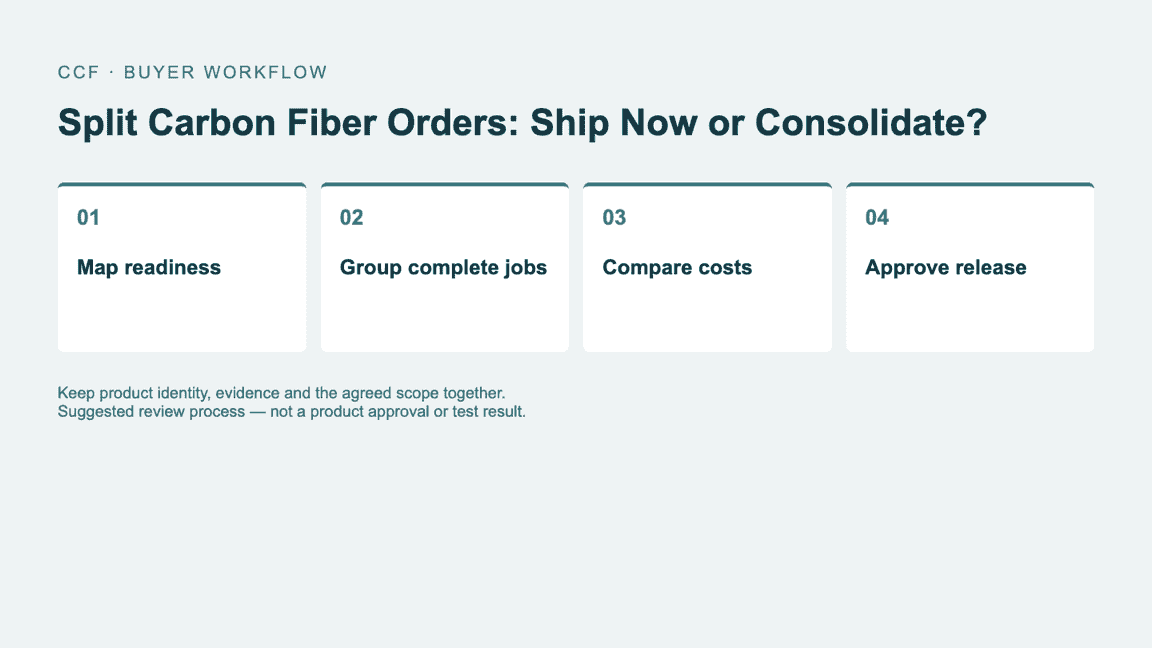
Suggested buyer workflow. Follow the product-specific specification and agreed order terms where applicable.
Compare usable arrivals rather than carton counts
Use this record as a buyer working tool. Examples and sample labels below are illustrative, not CCF inspection, order or test records.
| Record | Example or required entry |
|---|---|
| Option A: wait | All lines travel together; record when each complete customer job could start. |
| Option B: split | Send the ready complete job; identify extra freight and remaining-order handling. |
| Decision rule | Choose against the customer deadline and incremental cost, not merely the number of parts ready. |
Illustrative case: mirror caps for Job A are ready, while all three lip sections for Job B must stay together. Sending only one Job B section creates activity without a usable installation. Ask for written costs before deciding.
Questions buyers ask
Should inexpensive small parts always ship first? Only if doing so serves a real need and the added fulfillment cost makes sense. Product price alone does not decide it.
Does consolidation guarantee safer shipping? No. Packing needs to protect the selected products and their vulnerable features; combining parts without a suitable plan can create problems.
For the related buying decisions, see Carbon Fiber Packing Lists: How Dealers Match Cartons to Customer Jobs and Approving Carbon Fiber Order Changes Before Production or Dispatch.
Request both options before deciding
Send CCF the order references, urgent customer jobs and destination. Ask for a complete split-versus-hold comparison. Make the decision while alternatives are still being discussed, before a carton is dispatched under an assumption.
Send an Inquiry
Include the article title, selected parts, quantity and delivery country.