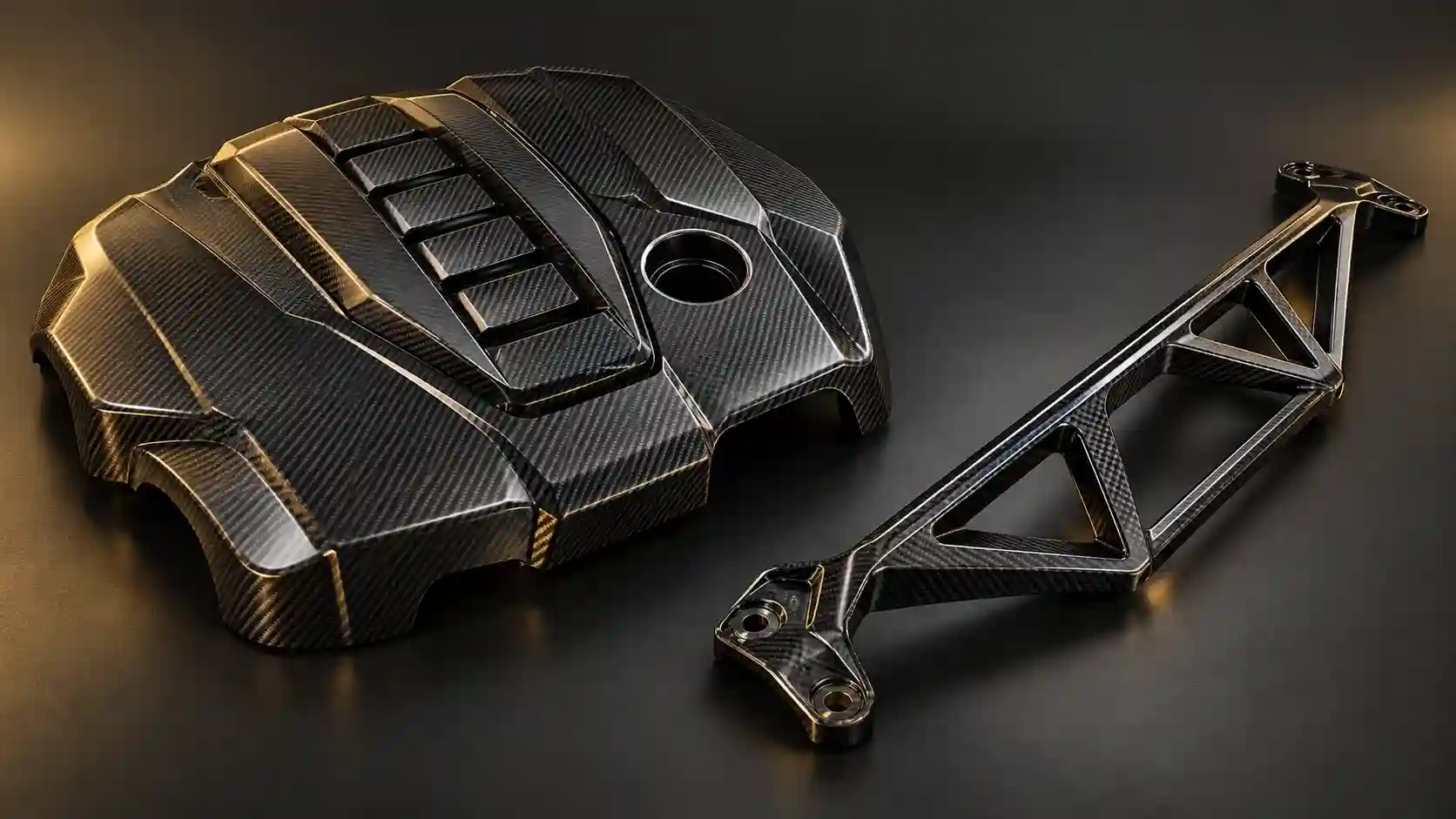
A decorative carbon engine cover changes presentation; a structural brace is intended to carry loads through defined mounting points. Carbon appearance does not tell you which role a part performs. Before quoting a customer build, establish the component’s intended function, attachment system and supporting evidence.
This distinction protects tuning shops from selling an appearance upgrade as a chassis improvement. It also helps distributors avoid grouping unrelated engine-bay products under a vague “performance carbon” label.
Start with the function, not the photograph
Ask what the component is designed to do and which original part, if any, it replaces. An engine cover may be a decorative overlay or a replacement cover with vehicle-specific interfaces. A brace may connect defined structural mounting points. Neither description should be inferred solely from its shape.
A polished finish, thick-looking section or expensive manufacturing process is not proof of a stiffness improvement. Likewise, a decorative cover can be well made and useful without a structural claim. Sell the benefit the evidence actually supports.
Compare the purchasing requirements
| Question | Decorative cover | Structural brace |
|---|---|---|
| Primary buying goal | Engine-bay appearance and finish | Specified structural function |
| Key interface | Cover mounts, clips, clearances or overlay surfaces | Defined load-bearing mounting points and hardware |
| Required description | Overlay or replacement; supplied contents | Intended application, assembly and engineering scope |
| Claim evidence | Appearance and fit records | Relevant design or test evidence for performance claims |
| Installation planning | Access, clearance and applicable product instructions | Vehicle-specific procedure and specified fasteners |
Check the complete engine-bay configuration
Record the vehicle, engine configuration and existing modifications before recommending a part. Intake systems, reservoirs, service access and adjacent components can affect the available space. Do not assume that a shared platform name makes every engine bay identical.
For a cover, request upper and lower views, the attachment details and information about any original insulation or other components that must remain or transfer. For a brace, request mounting-point views, supplied hardware and the applicable installation documentation. Do not invent torque values or substitute a generic tightening guide.
If the customer expects a measurable improvement, write down the improvement they mean. “Better handling” is too broad to evaluate. A claim about stiffness needs an appropriate measurement and defined configuration; a photograph of a brace installed on a car does not provide that measurement.
Use an evidence ladder for sales claims
- Confirmed identity: you know the part reference and intended application.
- Documented interface: the mounting and supplied contents are described.
- Recorded installation: a particular configuration has been checked.
- Supported performance statement: relevant engineering or test information supports a specific claim.
These are different levels. Reaching the third does not automatically reach the fourth. Your website can present clear product information while omitting a performance promise that has not been substantiated.
Separate the products in your range
Use distinct product names and filters for engine covers and braces. A cover listing should state its appearance purpose and assembly type. A brace listing should state its intended role, mounting application and available documentation. Keep installation time, included hardware and additional requirements in the quotation rather than hiding them in a generic disclaimer.
For a mixed order, use separate line items. This makes it easier to confirm whether a customer wants both components and whether they can be installed together. Do not imply compatibility between two products just because both appear in the same catalog.
Before publishing, have someone unfamiliar with the purchase read the listing. Ask them what improvement they believe is promised and which parts they think are included. If their answer exceeds your evidence, revise the wording before taking deposits.
Two separate product records
Use this record as a buyer working tool. Examples and sample labels below are illustrative, not CCF inspection, order or test records.
| Record | Example or required entry |
|---|---|
| Engine-bay cover | Record appearance purpose, supplied construction and the actual attachment interface. |
| Engine-bay brace | Record intended role, mounting application and available engineering evidence. |
| Combined build | Review mutual clearance independently; two catalog entries do not establish joint compatibility. |
Use the CCF cover and brace product references as separate inquiry lines. Do not turn the word “brace” into a quantified stiffness claim without relevant evidence.
For the connected decisions, use How to Verify Carbon Fiber Weight-Saving Claims Before Advertising Them and How to Compare Full-Carbon and Fiberglass-Backed Automotive Parts.
Buyer FAQ
Does dry carbon automatically mean structural?
No. A manufacturing label does not establish the intended load path, mounting design or validated performance of the finished component.
Can a cover and brace be ordered together?
They can be discussed together, but confirm their individual applications and mutual clearance before promising a combined installation.
What should I request from CCF?
Send the product references, vehicle and engine-bay photographs. Ask which items are covers or braces, what each includes and which installation or performance documents are available.
Identify the Right Engine-Bay Component
Send your engine-bay photos and product references. Explain whether the customer wants an appearance upgrade or a documented structural function.
Send an Inquiry
Include this article title, your product reference, vehicle details and the question you need resolved.